
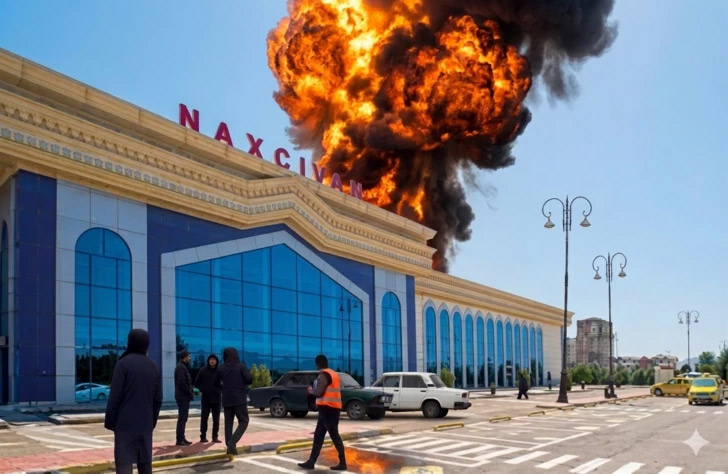
In recent days, a statement circulated by Azerbaijan has caused significant resonance in the information space. According to the report, drone strikes were carried out in the direction of Nakhchivan, damaging the terminals of the city’s airport and nearby infrastructure. Following this, the Iranian ambassador was summoned to the Ministry of Foreign Affairs of Azerbaijan to provide explanations.
Reports of strikes in the direction of Nakhchivan
According to Gohar Iskandaryan, Director of the Institute of Oriental Studies at the National Academy of Sciences, Tehran has neither confirmed nor denied carrying out these strikes.
“At this moment we do not have Iran’s official position. The only information we have is that the ambassador was summoned to the Azerbaijani Foreign Ministry. After these discussions it will become clearer what actually happened and what objectives may have been pursued,” Iskandaryan noted.
The Iran expert does not rule out that the incident may have been a response by Iran to certain actions by Baku that have not yet been publicly disclosed. According to her, Tehran is also seriously concerned by reports that Azerbaijan supplies Israel with the oil resources it needs.
Unconfirmed information suggesting that the Iranian side attempted to strike the Baku–Tbilisi–Ceyhan oil pipeline on Turkish territory also supports this hypothesis. However, according to again unverified reports, the Turkish side managed to intercept those missiles.
Iskandaryan recalls that this pipeline plays an important role in the regional energy system and provides around 30% of Israel’s needs.
“The very fact that there was an attempt to damage this pipeline, which supplies part of Israel’s needs, already indicates how significant this infrastructure is in the context of the current war,” she noted.
Risks of destabilization in the South Caucasus
According to the expert, if such developments continue, the regional security system may be seriously undermined.
“If such steps continue, naturally the Caucasus may also become involved in these processes,” Iskandaryan said.
At the same time, she expressed hope that Iran will try to avoid a large-scale escalation in the region.
According to her, Iran’s resources are limited, and the country cannot simultaneously be involved in several large-scale conflicts in different directions.
“Ultimately, Iran’s resources are not unlimited. It cannot be simultaneously in confrontation with the countries of the Persian Gulf, the world’s most powerful state — the United States, Israel, and now also Azerbaijan in the Caucasus,” she emphasized.
According to Iskandaryan, such a scenario could lead to much more serious consequences for Iran.
“It is obvious that in such a situation its resources could quickly be exhausted, which would lead to even more complicated developments for the Islamic Republic of Iran,” the Iran expert noted.
At the same time, she expressed hope that Tehran will be able to find the right political and strategic solutions to overcome the current situation with the least possible losses.