
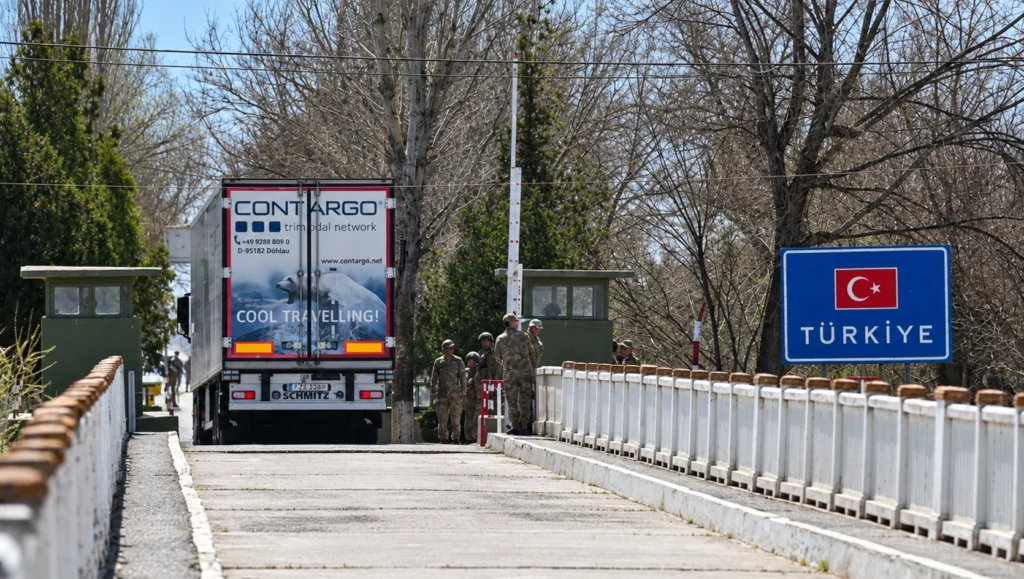
For Russia, the issue of regional communications and the railway is no less important, and perhaps even more important, than the military base. Political scientist Stepan Danielyan made this point while commenting on Russian President Vladimir Putin’s statement that Russia is ready to withdraw the military base.
The Railway Is the Key Issue for Russia
According to Danielyan, the South Caucasus is viewed as an important transit route toward Central Asia, while Armenia and Azerbaijan are also important to Russia in terms of communications toward Iran and, eventually, the Indian Ocean.
“I believe that first and foremost, this is about the railway,” the political scientist stressed.
According to Danielyan, if railway connections through Armenian territory are restored and put into operation, Russia could gain new opportunities through Armenia and Nakhichevan toward Turkey and Iran.
At the same time, according to the political scientist, the railway project being built between Azerbaijan and Iran continues to face difficulties, while Turkey plans to establish a railway connection through Nakhichevan toward Kars.
Danielyan considers it especially important to determine who will control the approximately 40-kilometer section planned or discussed in southern Armenia.
“The whole issue is the railway. First and foremost, the railway is important, and I believe the current discussion is about that, about communications,” he said.
From Artsakh to Regional Communications
Danielyan also links the issue of regional communications to the Artsakh process and the developments that followed the 2020 war.
He believes the issue of the Russian presence in Artsakh was also connected to broader geopolitical and communications projects.
The political scientist argues that the West and Turkey have their own communications projects in the region and that eliminating the Russian presence is important for implementing those projects.
“Essentially, Putin said: do not blackmail us with this military base; if you want, we will withdraw it. In other words, it cannot be used as a bargaining chip over the railway. As for the railway, the Russians say they are ready to discuss any issue, that any investments can be made and, if necessary, separate sections can be built. But the railway is the most important issue because it is a geopolitical matter. In other words, Russia showed that the military base is needed first and foremost by the Republic of Armenia itself,” he said.
Lavrov’s Statement and the Issue of the Border With Turkey
In this context, Danielyan also attaches importance to Russian Foreign Minister Sergey Lavrov’s statement that there are unresolved issues between Armenia and Turkey.
The political scientist suggests that this may refer not only to current political relations but also to the historical and legal documents on the basis of which the region’s borders were formed, particularly the Treaty of Kars.
According to him, negotiations around the treaty were long and extremely difficult, involving questions concerning Armenia’s territory, the border with Turkey, Adjara and a number of other territories.
He recalled that before the Treaty of Kars, Armenia’s territory amounted to about 12,000 square kilometers.
“Before that, under the Treaty of Alexandropol, Armenia had around 12,000 square kilometers, part of which was also a neutral zone. In other words, it did not even have the full 12,000 square kilometers. After difficult and lengthy negotiations, under the Treaty of Kars Armenia became approximately 30,000 square kilometers.”
The Military Base Is a “Matter of the Flag and Treaties”
Danielyan believes this is where the real significance of the Russian military base in Gyumri also emerges.
By his reasoning, Russia’s presence in the region is also connected to maintaining the treaty system within which Armenia’s current borders were formed.
Therefore, in his view, if Russia leaves the region and the Russian military base is withdrawn from Armenia, questions could also arise concerning the borders and their legal foundations.
He specifically refers to the Amasia direction and historical and legal issues related to that section, emphasizing that Russia’s presence as the legal successor of Soviet Russia has, in his view, not only military but also political and legal significance within this entire system.
“If Russia leaves, what remains is the Treaty of Alexandropol concluded between Armenia and Turkey. This may seem unbelievable to many people, but the reality is that these issues exist,” he said, adding that this is the perspective from which he interprets Lavrov’s statement.
“In other words, the issue of the base is an issue of treaties, an issue of borders and an issue of border troops,” Danielyan stressed.