
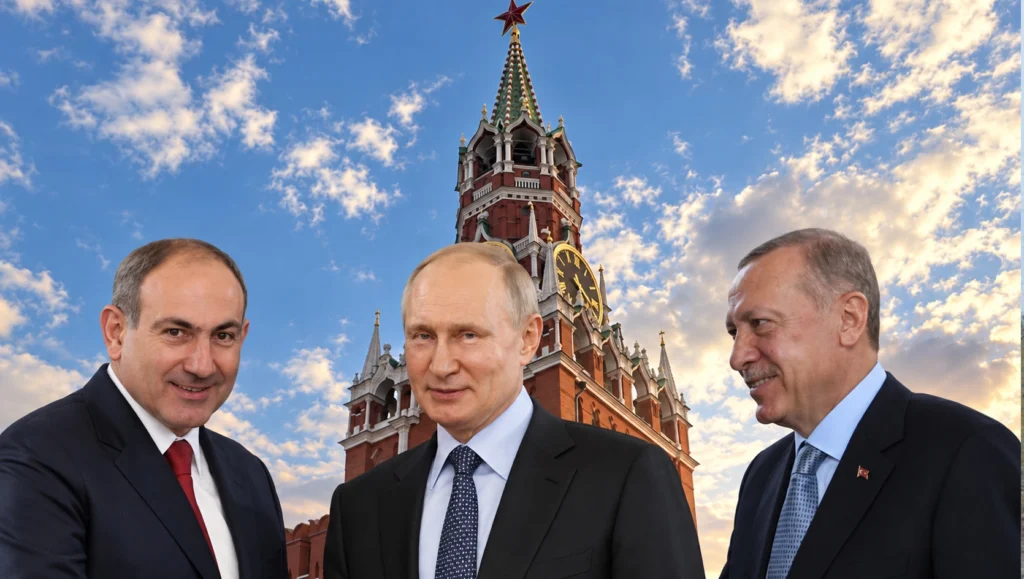
Armenian-Russian relations are currently in an extremely tense phase, and Armenia is on the verge of changing its foreign policy direction. Political scientist Yervand Bozoyan has made this assessment.
In his view, if Armenian-Russian relations completely collapse, the geopolitical vacuum created in the region will not remain for long.
“There is no such thing as a geopolitical void. Turkey will come in and take Russia’s place here,” Bozoyan said.
According to the political scientist, Armenia’s authorities are trying to carry out this process gradually in order to make it as painless as possible for society.
Russia, meanwhile, opposes such an approach, in his view, and wants a clearer understanding of Armenia’s choice.
Bozoyan believes that the recent arrests could also be used as a political “bargaining chip” by Nikol Pashinyan in negotiations with Vladimir Putin.
In his assessment, Armenia has limited leverage in its relations with Russia, while Russia’s economic and political influence over Armenia is significantly greater.
“For Pashinyan to be able to bargain with Putin, he appears to be trying to turn these arrests, so to speak, into a bargaining chip in negotiations with Putin. However, I believe the Russian side will not enter into that kind of game,” he said.
According to Bozoyan, this is where the Armenian authorities’ main problem may emerge, because Moscow, in his assessment, will be guided not by such political signals but by economic and geopolitical interests that are more important to it.
“If You Are Moving Toward the EU, Then Not at Our Expense”
Addressing the view that Armenia is being forced to change its foreign policy direction because Russia failed to fulfill its allied obligations, Bozoyan argues that this widely held assessment in Armenia does not correspond to reality.
According to him, the current policy of the Armenian authorities should also be viewed in the context of the government’s 2026–2031 program, which, in his assessment, differs substantially from the 2021 program and indicates a gradual reassessment of Armenian-Russian relations.
According to Bozoyan, Russia does not want Armenia’s possible movement toward the European Union to take place at the expense of Russian resources and existing preferences.
“If you want to move toward the EU, then you should not do so at our expense. You will have to decide. If you are moving toward the EU, then you will no longer have the preferences you currently enjoy — from gas to nuclear energy,” the political scientist said.
At the same time, Bozoyan acknowledges that Russia has also made mistakes in its policy toward Armenia and the region.
However, in his view, one of the reasons for those mistakes is the nature of the competition between Russia and the West.
He notes that the West has used “soft power” tools more effectively in the post-Soviet space, citing Ukraine, Moldova, Georgia and Armenia as examples.
According to him, Russia’s limited use of such instruments has led to the weakening of Moscow’s position in a number of countries.
However, Bozoyan believes that the expansion of Western influence does not necessarily mean those countries have succeeded.
Armenia’s Prospects for EU Membership Are an “Adventure”
The political scientist particularly questions Armenia’s prospects for integration into the European Union, comparing them with Ukraine’s situation.
According to him, in Ukraine’s case, the geographical and political prerequisites for European integration were incomparably more evident.
Ukraine directly borders EU member states Poland, Hungary and Romania.
In Armenia’s case, he argues, the situation is fundamentally different.
“Armenia’s neighboring countries are Georgia, Turkey, Azerbaijan and Iran. Georgia has frozen its accession to the European Union, Turkey has been unable to become an EU member for 60 years, Azerbaijan has no such objective in its plans, and Iran is very far from the EU in cultural and civilizational terms,” Bozoyan said.
Under these circumstances, he describes Armenia’s movement toward EU membership as a “pure adventure,” arguing that the real reasons behind the authorities’ chosen direction require a separate discussion.
At the same time, Bozoyan believes the further development of processes surrounding Armenian-Russian relations will depend largely on negotiations between the leaders of Armenia and Russia.
According to him, if negotiations between Nikol Pashinyan and Vladimir Putin end without an agreement, it cannot be ruled out that the processes already underway in Armenia will continue.