
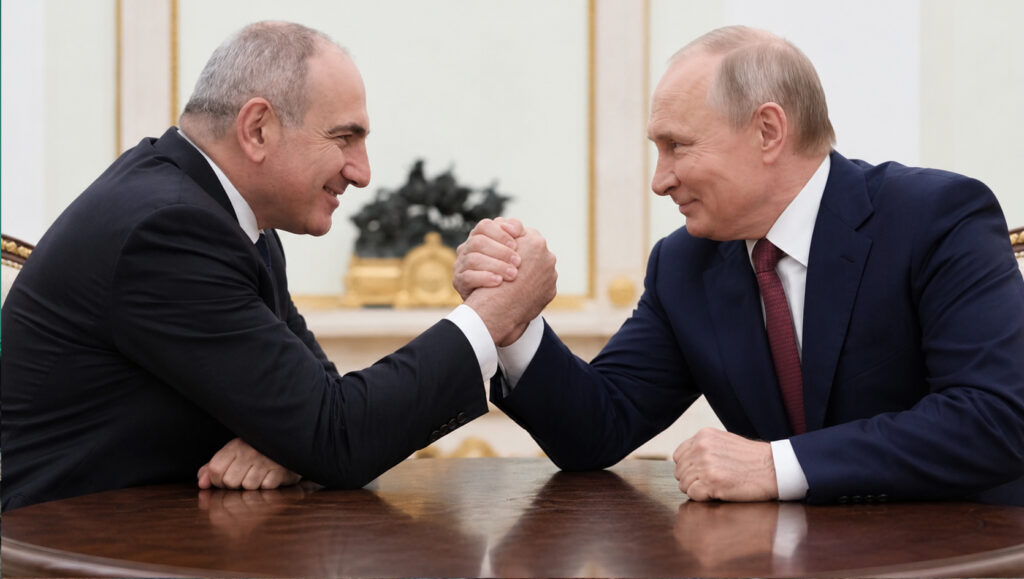
The disagreements between the Armenian and Russian leaderships are approaching a decisive stage, with November 30 emerging as the key deadline in the process. This is the view of political strategist Armen Badalyan.
Badalyan notes that under a decision adopted within the Eurasian Economic Union on May 30, Armenia was given a six-month period, until November 30, to make a choice and clarify its position.
According to him, the planned meeting in Moscow is also important in this context. He believes the meeting will bring the conflict between the two leaders to a conclusion, with Moscow demanding the Armenian side’s “capitulation.”
The Gyumri Military Base as a Signal to Yerevan
Badalyan believes that Russian President Vladimir Putin’s decision to publicly raise the issue of the 102nd military base in Gyumri was not accidental.
He notes that Russia’s economic assets in Armenia, including Gazprom Armenia, the railway concession and assets in the banking sector, are important to Moscow.
However, none of them has the same significance for Moscow as the Gyumri military base because it demonstrates that Russia maintains its influence in the South Caucasus, including Armenia.
At the same time, he stresses that the military significance of the base should not be overestimated.
In his assessment, it has greater symbolic and political significance because it has no direct land connection with Russian territory and could find itself in a difficult position if regional communications are restricted.
According to Badalyan’s interpretation, Putin’s decision to raise the military base issue was also a warning to the Armenian authorities not to use it as an instrument of pressure or blackmail in negotiations with Moscow.
What Could Be Presented to Pashinyan in Moscow?
Badalyan assumes that during the closed part of the Moscow meeting, the Armenian side could be presented with conditions that he describes as “terms of capitulation.”
Among them, he mentions repealing Armenia’s law on the EU accession process, ending the activities of the European monitoring mission and the mission countering hybrid threats in Armenia, and restoring Armenia’s full participation in the CSTO.
According to his account, the package of demands could also include restructuring Armenia’s security system by establishing closer military-political ties with the relevant Russian structures.
Badalyan argues that this is not simply about one law or a separate decision related to the EAEU.
In his view, the disagreement between Russia and Armenia is broader and systemic, involving Armenia’s foreign policy orientation, its security system, Western presence in state institutions and certain mechanisms within the financial system.
If Pashinyan Agrees
Badalyan considers two main scenarios.
Under the first, Nikol Pashinyan could accept the proposed conditions and begin implementing them.
According to the political scientist, in such a situation the prime minister’s political influence would decline sharply, as a significant part of Armenia’s security and law enforcement structures would effectively come under Russian military-political influence.
At the same time, according to Badalyan, Armenia could face a harsh Western response in the form of political and economic pressure.
He does not rule out the possibility that the European Union could demand the return of funds provided to Armenia and begin a stricter assessment of developments in Armenia over recent years, including issues related to human rights, elections and political persecution.
Badalyan also notes that Armenia’s ratification of the Rome Statute could become an additional instrument in the hands of the West if relations with Armenia deteriorate.
If Armenia Rejects Russia’s Demands
Under the second scenario, according to Badalyan, Armenia could refuse to accept the proposed conditions.
In that case, he predicts increased economic and political pressure from Russia.
According to him, restrictions imposed on Armenia could be tightened, including those involving the import and export of certain goods and financial transfers.
Badalyan particularly highlights the risk of possible restrictions on money transfers from Russia to Armenia.
In his assessment, money sent to Armenia by hundreds of thousands of Armenians working and living in Russia plays an important role in the incomes of many families.
If these financial flows are sharply restricted, he believes the impact could be felt not only by recipient families but also by Armenia’s retail sector, banking system and overall economic activity.
Badalyan considers administrative measures against Armenians living in Russia who do not hold Russian citizenship another possible instrument.
In his assessment, under an extreme scenario, hundreds of thousands of people could return from Russia to Armenia, creating an additional burden on Armenia’s social system.
He also does not rule out a scenario in which economic and social tensions could develop into domestic political processes and demands for a change of government.
Possible Expulsion From the EAEU
Badalyan also considers it possible that the issue of terminating Armenia’s EAEU membership could be raised.
According to him, even if EAEU legal documents do not provide a clear mechanism for “freezing” Armenia’s membership, a political decision could lead to a different approach, including restrictions on Armenia or the de facto suspension of its membership.
In his assessment, Russia’s reasoning in such a case could be based on a loss of confidence in Armenia as a partner.
Badalyan cites the risks to Russian investments as an example.
If a Russian company makes a major investment in Armenia and several years later Armenia seeks to join the European Union and, as part of that process, is forced to restrict the presence of Russian capital, serious issues arise regarding the recovery of investments and the status of ownership.
The Risk of Higher Gas Prices and Social Pressure
According to the political strategist, another potential instrument of Russian pressure could be an increase in gas prices.
He argues that if Armenia moves away from the Russian direction, gas prices could rise substantially, affecting not only utility bills but also the production costs of bread and other goods.
Badalyan also questions claims that opening the European Union market would automatically ensure a major increase in Armenian exports.
According to him, even if customs restrictions are reduced, Armenian producers would still have to address logistics, competitiveness, quality, quotas and access to individual EU national markets.
“The Prime Minister Needs at Least One Billion Dollars”
According to Badalyan, if Pashinyan refuses to accept Russia’s conditions, the Armenian authorities will need to quickly secure at least $1 billion in financial resources to mitigate possible economic and social shocks.
He says these funds could be particularly necessary for credit obligations in the agricultural sector, addressing social problems and maintaining the stability of the financial system.
If a large number of citizens or workers simultaneously return to Armenia from Russia, the required financial resources could reach $2 billion, according to his assessment.