
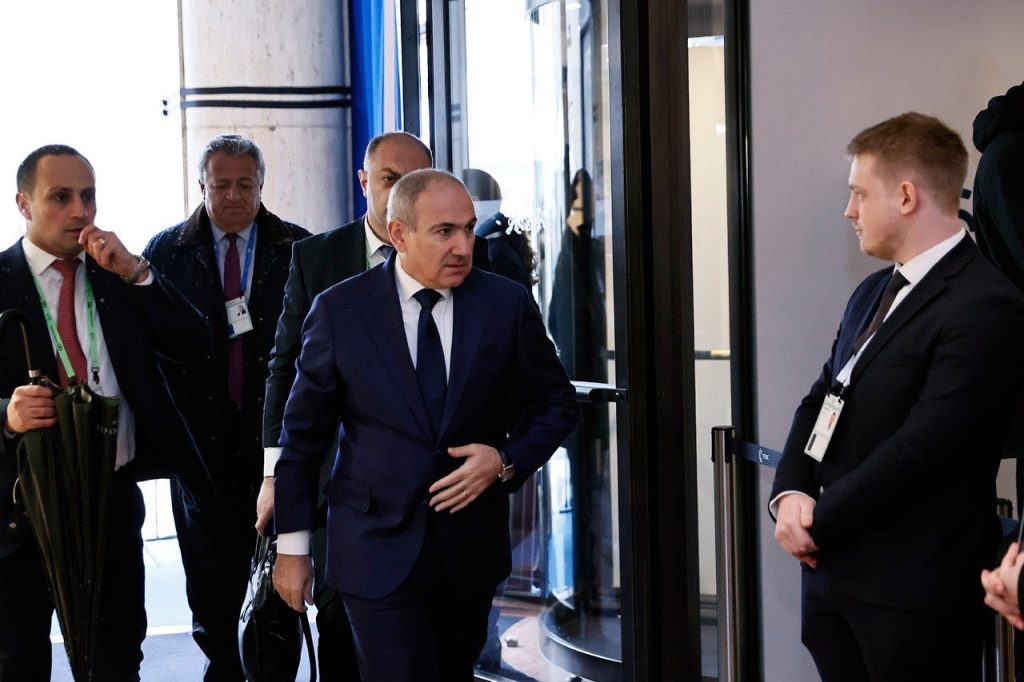
The meeting between Armenian Prime Minister Nikol Pashinyan and Azerbaijani President Ilham Aliyev on July 10 in Abu Dhabi concluded without any concrete results. This is primarily evidenced by the extremely restrained and essentially uninformative statement from Armenia’s Ministry of Foreign Affairs.
The statement lacks any mention of agreements, compromises, or progress on contentious issues. Instead, it contains standard phrases about “reaffirming commitment to bilateral dialogue,” “instructing to continue work on delimitation,” and “measures to build confidence.” Such an outcome sharply contrasts with the expectations formed prior to the meeting.
Bilateral Facade and Multilateral Orchestration
To understand the political context of the Abu Dhabi meeting, one should not overlook the visits of the leaders of Armenia and Azerbaijan to Turkey late last month: first, Ilham Aliyev visited Turkey, followed a day later by Nikol Pashinyan.
In the corridors and the press, there was active discussion of a possible trilateral meeting between Pashinyan, Aliyev, and Erdoğan, but it did not take place. A representative of the ruling party, Arman Yeghoyan, stated at the time that such a meeting was “not planned” but “not ruled out, as such decisions are often made on the spot.”
This comment indirectly acknowledged that the Armenian side expected Turkey to influence Baku and encourage it to engage in dialogue in an expanded format. However, this did not materialize, and after Pashinyan’s return to Yerevan, talks emerged about a new bilateral meeting—this time in Abu Dhabi.
This suggests that Turkey played the role of an organizer or a facilitator, enabling a transition from a failed trilateral attempt to a “productive” bilateral meeting.
The American Factor: Proposals and Expectations
Alongside Turkey’s diplomatic activity, there was a growing informational buzz from the United States. The Carnegie Center published an article discussing a U.S. proposal to unblock communications between Armenia and Azerbaijan, which would involve delegating control to an American company. U.S. Secretary of State Marco Rubio expressed hope that a peace agreement would soon be signed between Armenia and Azerbaijan. Meanwhile, U.S. State Department spokesperson Temi Bruce added, “The Secretary had grounds for that statement, and as soon as we have additional details, I will provide them to you.”
Against this backdrop, in an interview with Azatutyun Radio, Armenia’s Deputy Foreign Minister Mnatsakan Safaryan effectively confirmed that such proposals were indeed under discussion: “Various proposals have been presented. We have already made statements on this matter. If they align with Armenia’s interests, they may be considered. Or they may not be.”
In the same conversation, Safaryan noted that Armenia is not fundamentally opposed to the participation of international parties in implementing transport solutions: “This process must be carried out within the framework of Armenia’s sovereignty, jurisdiction, and territorial integrity. If the proposals align with these principles—yes, it’s possible. It’s a matter of discussion. It’s important to ensure the principle of reciprocity.”
Thus, by the time of the meeting, Yerevan had not only proposals but also hopes for their political realization, believing that Turkey’s mediation and U.S. diplomatic activity would persuade Baku to take the next step.
Disappointment After the Meeting: Diplomatic Silence
However, reality proved different. Immediately after the meeting, footage of Pashinyan showed visible tension, and the Armenian Foreign Ministry’s statement on the talks’ outcome was as vague as possible. It contained no specific results: “The leaders instructed to continue work on delimitation”; “The parties agreed to continue bilateral negotiations and confidence-building measures”; “Gratitude was expressed to the UAE President for organizing the meeting.”
Such formulations indicate one thing: no breakthrough, no agreements, no change in positions. There is also no mention of a peace treaty, despite Safaryan’s direct statement in the same interview: “Armenia has demonstrated political will to sign an agreement. The document has been agreed upon, and the continuation of negotiations is aimed at signing.”
This contrast between expectations and outcomes speaks to diplomatic disappointment. It’s possible that the mediators were unable or unwilling to exert the influence on Baku that Yerevan expected, or they did so insufficiently firmly.
Of course, one should not entirely rule out the possibility that the parties reached some agreements that have not yet been disclosed. The coming period will show how significant the influence of Ankara and Washington was—and whether the Abu Dhabi talks were indeed another step toward peace or merely a tactical pause in a prolonged geopolitical game.