
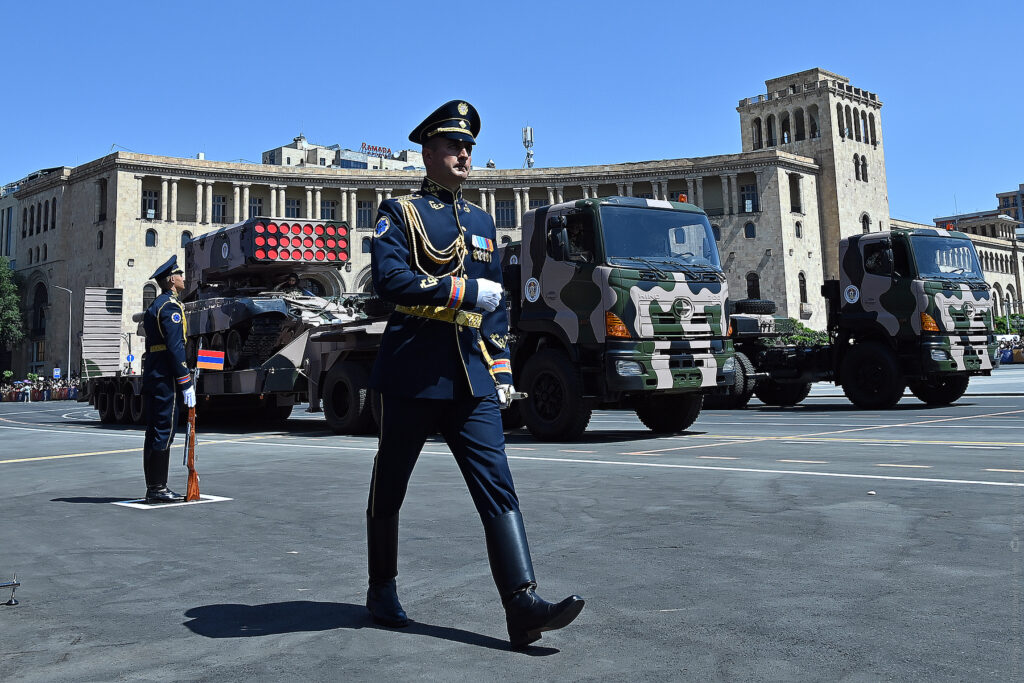
Armenia’s large-scale military modernization and weapons purchases from multiple international partners create new opportunities to strengthen the country’s defense capabilities. At the same time, they present serious challenges related to integrating diverse military systems. This was stated by military expert Leonid Nersisyan.
According to him, diversification of arms suppliers is a positive development because it reduces dependence on a single country. If cooperation with one or several suppliers becomes difficult, Armenia will still retain alternative sources for acquiring and maintaining military equipment.
“When the market is open, it becomes possible to select optimal weapons systems from dozens of manufacturers. However, such flexibility requires capabilities that did not previously exist, because for many years the army relied primarily on a single military standard,” Nersisyan noted.
Integration Is the Key Challenge
In Nersisyan’s view, the main issue is not purchasing military equipment from different countries but integrating all those systems into a unified command-and-control framework.
The expert believes the only effective solution is the creation of a national digital management system capable of allowing different weapons platforms to exchange information regardless of their origin.
To achieve this, Armenia must negotiate software compatibility and integration requirements with manufacturers in advance.
“If this work is done properly, the problem of differing standards will almost disappear. If not, the potential of new weapons may be utilized at only 20 percent of their capabilities,” he stressed.
Transformation of Military Command Structures
Nersisyan noted that modern weapons systems require fundamentally different approaches to military organization.
This involves not only technical modernization but also a deep transformation of command structures and operational principles.
According to him, modern digital command systems are incompatible with many approaches inherited from the Soviet military school.
Such reforms require significant changes in military thinking, greater mobility for units, and broader decision-making authority at lower command levels.
“This is no longer just about purchasing equipment. It is a comprehensive reform that changes the organizational culture of the armed forces,” he said.
The expert added that the success of these reforms depends not only on the military leadership but also on the state’s willingness to support transformation and cooperate closely with the private technology sector.
Higher Demands on Intelligence and Coordination
Nersisyan also emphasized that modern weapons place much greater demands on intelligence gathering and battlefield management.
He cited next-generation artillery systems as an example. While older systems could effectively engage targets at around 20 kilometers, modern platforms are capable of operating at distances of 45 kilometers or more.
To fully utilize such capabilities, armed forces require significantly improved intelligence, data transmission, and rapid decision-making systems.
“The greater the range of a weapon, the more complex its employment becomes. Information must be collected faster, transmitted faster, and acted upon faster. Without this, the effectiveness of expensive weapons purchases will be significantly reduced,” he explained.
Military Exercises Remain Essential
Discussing the role of military exercises, Nersisyan stressed that no reform can be properly evaluated without continuous practical testing.
According to him, every doctrine and every new concept must be verified through real-world exercises.
Only training operations can demonstrate whether new approaches are effective or require further adjustment.
He noted that in recent years Armenia’s armed forces have increased the number of exercises involving actual weapons systems, contributing to improved combat readiness.
“Without exercises, there is no army. Every new system and every innovation must be continuously tested and verified under realistic conditions,” Nersisyan concluded.
In his view, acquiring modern weapons is only the first stage of military modernization. The decisive question is whether the armed forces can implement the organizational and technological reforms necessary to fully unlock the potential of their new capabilities.