
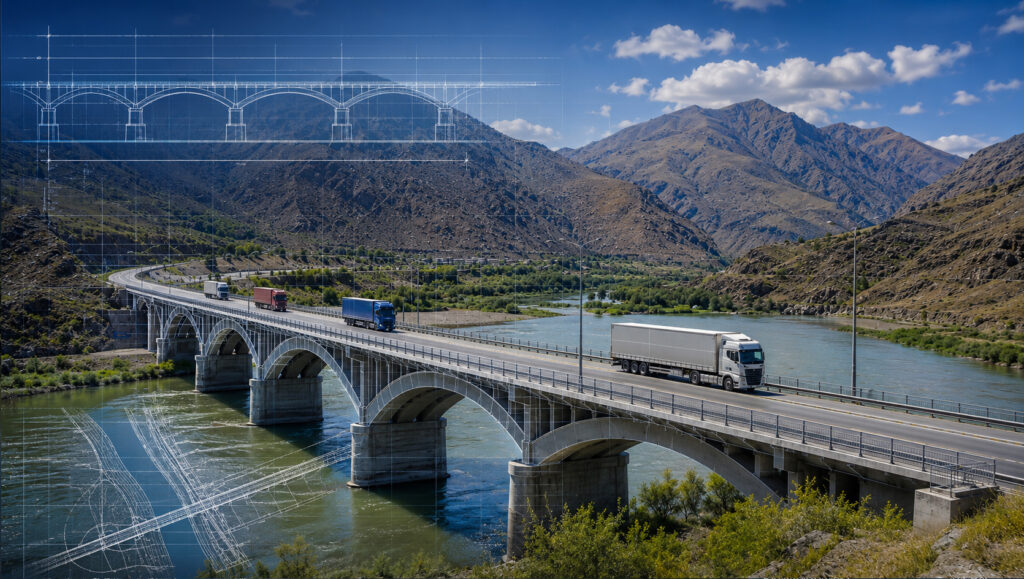
The Armenian Minister of Territorial Administration and Infrastructure visited Iran as the two countries discussed several strategic initiatives on their bilateral agenda. Talks in Tehran covered a number of infrastructure and energy projects, including the construction of a second bridge over the Aras River and a new model of gas cooperation. What new opportunities could these initiatives create for Armenia?
A Second Meghri Bridge Could Reshape Regional Connectivity
According to Iranian-Armenian expert Movses Keshishyan, the proposed construction of a second bridge over the Aras River addresses a long-standing problem whose solution is already overdue. Traffic congestion at the Meghri border checkpoint has demonstrated for years that the existing infrastructure is insufficient.
“I do not think I am revealing a secret when I say that we have long lines of vehicles in Meghri every day. This clearly shows that the shortage of roads and bridges has become impossible to ignore,” Keshishyan said.
According to him, the need for a new bridge was already being discussed in Iran 30 years ago.
“Years ago, people in Iran were saying that the existing bridge was too small and did not meet demand, and that a new one had to be built. There was even discussion of the Iranian side fully financing the investment,” the expert noted.
He said that various factors, including external influence, had previously prevented the project from moving forward. Today, however, the situation has changed.
“Armenia now has the political will, and the Iranian side also wants the project. I believe implementing it would be highly beneficial for both countries,” Keshishyan said.
The importance of the second bridge would extend far beyond the Armenian-Iranian border, he added.
“This route would connect Iran with Georgia and potentially with Russia and other countries. It would therefore be highly useful for Iran. Armenia would naturally receive transit and other revenues that could provide new momentum for its economy,” the expert said.
According to Keshishyan, such projects are particularly important at a time when Armenia faces various external economic restrictions and pressures.
“The economic significance is obvious. The project is becoming more concrete. I believe it is overdue, but it is nevertheless a welcome development,” he noted.
A New Cooperation Model Could Turn Armenia Into a Gas Transit Country
Another major topic in the Armenian-Iranian talks was the possible revision of the existing barter-based gas cooperation model. According to Keshishyan, the issue of Iranian gas is not new and has been under discussion for many years.
He recalled that the capacity of the Iran-Armenia gas pipeline was limited during its construction, demonstrating Armenia’s dependence on external actors.
“Iranian gas reached Armenia, but the pipeline’s diameter was reduced from 140 to just over 70. This directly demonstrated Armenia’s dependence on foreign powers,” the expert said.
According to Keshishyan, the situation is now changing.
“As a result of Armenia’s new policy, we are seeing opportunities in this area as well. It is achievable if both sides are willing,” he said.
Such cooperation is important for Iran because of international sanctions and restrictions on energy exports. For Armenia, it could generate revenue both from transport routes and from gas transit.
Keshishyan emphasized that the proposed model is not limited to supplying gas to Armenia.
“Under this new format, the issue is not simply bringing gas to Armenia, but also transporting it through Armenian territory to Georgia and other countries. This could bring major benefits to both Armenia and Iran,” he said.
Russian Influence Does Not Eliminate New Gas Opportunities
Addressing whether the gas cooperation model could be changed despite Russia’s influence in the sector, Keshishyan said the issue should be viewed in a broader context.
“It is clear that Russia’s influence remains significant because the Russian side holds a monopoly in Armenia’s gas sector. However, this does not apply to transit matters,” he said.
According to the expert, Armenia can move forward in directions that serve its own interests.
“What Armenia will do to reduce its dependence on Russia as much as possible is a question for the future. What matters now is the opportunity for gas to reach Armenia and then continue through Armenian territory toward other destinations. Gas exchange or swap arrangements involving the transportation of Russian and Iranian gas could also be considered,” Keshishyan noted.
In his view, Armenia’s future decisions will also depend on Russian policy and the development of bilateral economic relations.
“If this policy continues and one-sided economic approaches toward Armenia remain in place within the Eurasian Economic Union, Armenia may adopt new policies and take new steps based on its own interests rather than those of external actors,” Movses Keshishyan concluded.