
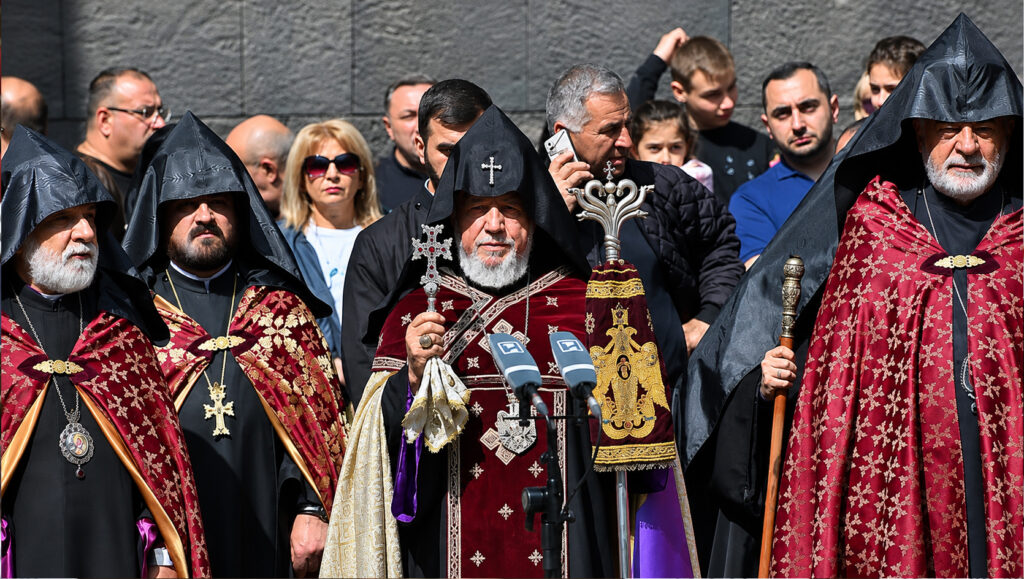
Catholicos of All Armenians Karekin II is due to appear in court today as a defendant. Six other bishops and archbishops have also been charged with obstructing the enforcement of a lawful court decision through abuse of official position.
The case concerns Bishop Gevorg Saroyan, the former head of the Masyatsotn Diocese. The criminal proceedings stem from Saroyan’s lawsuit challenging decisions made by church authorities. A court had previously imposed an interim measure temporarily prohibiting church structures from preventing Saroyan from carrying out his duties.
According to investigators, subsequent decisions by the church leadership obstructed the implementation of that court ruling. The charges were brought under Part 2 of Article 507 of the Criminal Code. A conviction could result in imprisonment for up to two years.
The Process Has Nothing to Do With the Rule of Law
Political analyst Tigran Grigoryan argues that the proceedings have nothing to do with legality and clearly contradict Armenia’s domestic legislation and international obligations.
According to Grigoryan, the Regional Center for Democracy and Security has published several studies over the past year examining the conflict between the government and the church. He said those studies clearly demonstrate that the state has no right to interfere in the church’s internal decisions and procedures.
“The decision of the Catholicos and the Supreme Spiritual Council to remove someone from office is an internal church matter. This creates a very dangerous precedent in which the ruling force can enter areas where it simply has no right to intervene,” he said.
What if This Were Not the Armenian Apostolic Church?
To better understand the nature of the dispute, Grigoryan suggested considering the same situation involving another religious organization.
“When discussing this conflict, I often ask people to imagine that we are not talking about the Armenian Apostolic Church but, for example, a religious organization belonging to a minority community. What kind of reaction would there be if the government attempted this type of interference in that organization’s affairs?” he said.
Grigoryan argued that the process is also problematic from the perspective of Armenia’s international reputation.
According to the analyst, the dispute has already moved beyond Armenia’s domestic political agenda and is attracting international attention. He referred to a recent report by a human rights organization working on religious freedom as well as a Reuters report, noting that both addressed the legal and international dimensions of the confrontation between the government and the church.
The Confrontation Remains on the Government’s Agenda
Grigoryan noted that tensions between the government and the church had somewhat subsided during the election period.
However, he said the ruling force’s attitude toward the church has not changed. He recalled that the governing party even included a provision in its election platform concerning the removal of the Catholicos of All Armenians from office.
“We can see that this process is continuing in the post-election period. Perhaps not with the same intensity or pace as during the previous year, but it remains a focus of the ruling force,” the analyst said.
According to Grigoryan, the situation raises questions not only about religious freedom and state interference in the internal affairs of religious organizations but also about the rule of law and selective justice.
He argued that the case fits a broader pattern in which political opponents of the government face legal consequences for certain actions while representatives of the ruling force who engage in similar conduct do not receive comparable legal treatment from law enforcement agencies or the courts.
“We have numerous cases involving representatives of the ruling force bringing people to various gatherings or engaging in other actions that do not receive the same legal assessment from law enforcement and judicial bodies,” Tigran Grigoryan concluded.