
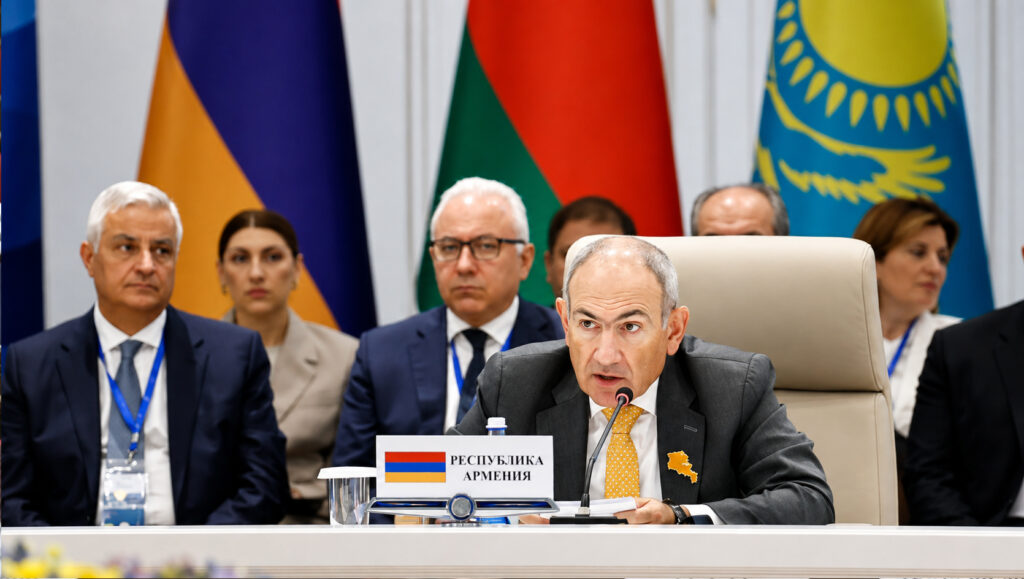
Armenian Prime Minister Nikol Pashinyan’s visit to Kyrgyzstan to attend a meeting of EAEU heads of government raises new questions about Armenian-Russian relations and broader regional developments. According to political commentator Hakob Badalyan, it is particularly noteworthy that Pashinyan traveled to the EAEU meeting after making unprecedentedly harsh statements about the organization.
Badalyan recalled that Pashinyan recently told journalists that the EAEU had effectively disintegrated and was no longer functioning. The prime minister also said that if the problem surrounding Armenian exports to Russia was not resolved, it could mark “the beginning of the end” of the EAEU. At the same time, he stated that Armenia had no plans to leave the union.
According to Badalyan, this contradiction itself raises questions. If failure to resolve the issue of Armenian goods could become the “beginning of the end” of the EAEU, what would that process actually mean if Yerevan has no intention of withdrawing from the organization?
The political commentator believes Pashinyan’s statements may have been intended primarily for a domestic audience, while the issues discussed within the EAEU framework in Kyrgyzstan could have a much broader political and geopolitical context.
Armenian Exports May Be Part of a Larger Process
According to Badalyan, the situation surrounding Armenian exports may not be an isolated economic dispute but rather a consequence of broader geopolitical developments.
He said there is an impression that Armenia’s economy has been placed on the “altar” of these processes. In his view, official Yerevan may subordinate economic considerations to wider political objectives in an effort to preserve its political position and reinforce it through external support.
In this context, Badalyan also referred to a statement by Russian Deputy Prime Minister Alexey Overchuk, who noted before the EAEU heads of government meeting that trade between Armenia and Russia had declined sharply.
In 2024, bilateral trade reached a record level of around $12 billion. According to Overchuk, however, it has now fallen by more than 20%, and the downward trend may continue.
Badalyan believes this could indicate that Moscow is currently unwilling to resolve the problem affecting Armenian goods. In his view, Russia may be linking the issue to Armenia’s foreign policy orientation and, in particular, its deepening relations with the European Union.
He recalled that during a July 27 telephone conversation with Pashinyan, Russian President Vladimir Putin also raised the issue of a possible referendum concerning relations with the European Union. Pashinyan subsequently began using harsher language about the EAEU.
Why Central Asia Matters to Moscow
Badalyan believes the growing economic tensions between Armenia and Russia may have another, broader dimension involving Moscow’s relations with Central Asian countries.
In his assessment, Russia could use the situation surrounding Armenia in its discussions with Central Asian states, particularly as those countries increasingly develop ties with the European Union and the broader West.
Badalyan specifically highlighted Kazakhstan. He argued that if the substantive arrangements being discussed between Kazakhstan and the EU are compared with the current Armenia-EU agenda, the latter may appear considerably more limited.
For this reason, he believes Central Asia is more important to Moscow than the Armenian issue itself. Armenia could therefore become an instrument in Russia’s broader political discussions with those countries.
Kyrgyzstan Meeting Followed a New Central Asian Format
Badalyan also drew attention to the fact that the EAEU heads of government meeting in Kyrgyzstan is taking place only days after a meeting held within the consultative format of Central Asian countries.
The former group of five became a group of six in November 2025 with Azerbaijan’s full participation. The format addresses regional cooperation, transport and logistics links, as well as the development of the Middle Corridor.
Badalyan believes the sequence is not accidental. He considers it particularly noteworthy that after the meeting of the six Central Asian countries, Pashinyan held a telephone conversation with Kazakh President Kassym-Jomart Tokayev on August 4.
The political commentator raises the question of whether Tokayev advised Pashinyan to attend the EAEU meeting and escalate the situation or, on the contrary, to reduce tensions so that Russia would not extend its disagreements with Armenia into relations with Central Asian EAEU members.
According to Badalyan, this sequence is especially significant when viewed alongside other regional developments.
The “Trump Route” and Russia’s Changing Assessment
In this context, Badalyan also points to Nikol Pashinyan’s recent contacts involving U.S. special envoy for peace Keith Kellogg and Steve Witkoff’s upcoming visit to Moscow.
He recalled that similar diplomatic activity around the “Trump Route” had occurred before. The situation has changed, however, because Russia has since adopted a tougher assessment of the project.
According to Badalyan, Overchuk stated in April 2026 that the “Trump Route” could disrupt the regional balance of power and affect the status quo formed within the framework of historical Russian-Persian arrangements.
Badalyan noted that Moscow has made no major new statements about the “Trump Route” since then. In his view, a new phase may now be emerging in which discussions surrounding the project are once again becoming more intensive.
He links these developments to the future of regional transport and logistics projects, including the Middle Corridor and routes expected to cross Armenian territory.
Armenian Goods May Be Only a Bargaining Chip
Badalyan argues that the problems surrounding Armenian exports to Russia may represent only a small part of much larger political processes.
In his assessment, Armenia’s economy could find itself at the center of wider geopolitical agreements and disputes, effectively becoming a bargaining factor.
“The issue of Armenian goods is merely a bargaining chip on the altar of much larger political processes,” Badalyan said in describing the situation.
According to him, the Armenian authorities have not succeeded in developing sufficient political agency and alternative negotiating resources in international affairs. As a result, Armenia’s economy may ultimately be forced to pay the price for these broader geopolitical processes.