
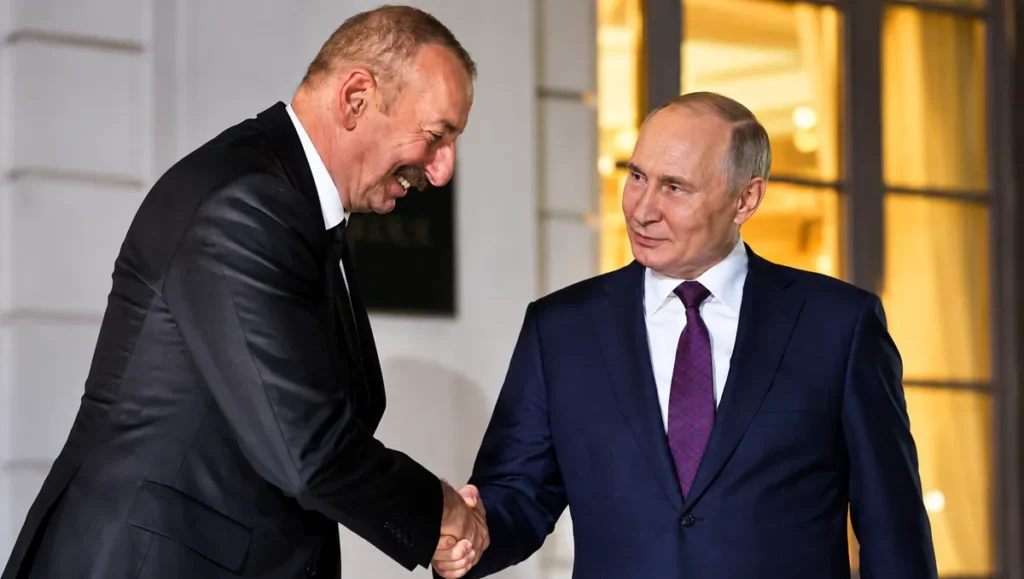
Talk of peace being established between Armenia and Azerbaijan does not reflect reality, as Ilham Aliyev continues to advance claims to Armenian territory. According to Lilit Dalakyan, head of the Mitk analytical centre, Azerbaijan is pursuing two tracks simultaneously. In the West, it seeks to present itself as a supporter of peace and an energy alternative to Russia. On other platforms, it continues to make new demands of Armenia.
Statements about peace are not backed by developments on the ground
Dalakyan said she has repeatedly stressed that peace has not been established between Armenia and Azerbaijan. In her assessment, statements about peace are not backed by developments on the ground.
“Peace is a fiction. There is no document, no delimitation. There are some words and awards,” she said.
According to the expert, Aliyev has never concealed his claims to the territory of the Republic of Armenia. She recalled statements in which the Azerbaijani president forcefully promoted the idea of the so-called “Zangezur corridor”. Dalakyan considers Aliyev’s statements directed at the Armenian authorities, including his latest remarks about Artsakh, to be instruments of pressure.
“Ilham Aliyev is playing two games. One is in the West, to attract European investment in his infrastructure and energy sector, so that Azerbaijan is viewed as an alternative to Russia. On that platform, he talks about peace. On another, he talks about a corridor and makes new demands,” Dalakyan said.
According to her, Azerbaijan has already secured territorial outcomes important to it without making equivalent concessions in return. As the international situation changes, Baku may now attempt to advance its next demands.
Dalakyan believes Azerbaijan’s subsequent steps will depend heavily on international developments.
International instability could affect the South Caucasus
Discussing the global situation, Dalakyan noted rising tensions across regions, from the Middle East to Asia, Africa, Europe and Latin America. According to her, world events have taken a course that makes previously discussed scenarios of a third world war increasingly tangible. The spread of conflicts and the emergence of new military threats could directly affect the South Caucasus.
As an example, she mentioned a statement by the US president suggesting that Iran could strike American cities. According to Dalakyan, US publications have addressed this issue, including reports about Iran and Russia selling modern drones to Cuba. Those reports suggest that such weapons could be used to strike American energy infrastructure in the Caribbean.
The expert drew a parallel with attacks on infrastructure in Ukraine and Iran. She stressed that the use of technology in modern warfare creates new challenges even for major powers.
According to Dalakyan, Venezuela’s example also shows that removing a country’s leader is not enough to resolve its problems. She believes the United States has not adequately prepared for wars involving the latest technologies and has not fully taken Ukraine’s experience into account.
Alongside the continuing war in the Middle East, the expert mentioned discussions about the possible deployment of Turkish and Pakistani troops in Saudi Arabia. According to her, Afghanistan is acquiring weapons from Belarus and India. Clashes along the border with Pakistan continue to keep tensions high.
There are also worrying developments in East Asia. Dalakyan believes South Korea’s leadership is concerned that North Korea could resort to a provocation. At the same time, Seoul does not want to further aggravate relations with Russia, while also worsening its contacts with Ukraine.
The expert also addressed tensions between Serbia and Kosovo, saying recent events have again strained relations. According to her, demonstrations are taking place in Kosovo following the trial of its former leader, Hashim Thaçi.
“We will see growing instability in different parts of the world, and this cannot fail to affect the South Caucasus,” Dalakyan stressed.
Domestic developments in the US could create new opportunities for Azerbaijan
In the expert’s assessment, Aliyev’s next steps will also depend on developments in the United States. If domestic political tensions deepen after the midterm elections, this could change the international balance of power and affect regional processes.
Dalakyan recalled that Donald Trump had warned of possible civil war and instability in the United States if the Republican Party lost the elections. According to her, he described such a situation as serving the interests of Russia and China.
She also suggested that investigations into the activities of Trump’s family could intensify. The expert believes Trump would struggle to accept a possible electoral defeat. Dissatisfaction over military action against Iran and rising energy prices could further complicate his political position.
Against this backdrop, Dalakyan considers the parallel actions of Russia and Azerbaijan significant. In her assessment, the two countries could revive discussions of the regional 3+3 format. They could also demand that Armenia implement agreements on opening transport links as quickly as possible.
“Russia’s leader and Azerbaijan are now becoming more active in parallel. If such a scenario unfolds in the United States, they will again discuss reviving the 3+3 platform and the November 2020 trilateral agreement involving Armenia. They will say: you must open the corridor right now. Remember Aliyev hitting the table: ‘You open it right now,’” Dalakyan said.
In her assessment, this raises the question of where the Trump Route would fit if Azerbaijan attempted to accelerate the implementation of its demands.
Dalakyan recalled that various statements were made after August 8. They concerned Russia’s diminishing regional role, possible changes to Russian involvement in Armenia’s nuclear energy sector, the construction of modular nuclear plants and continued border delimitation.
However, according to her, some of these statements have not translated into actual processes. In particular, continued delimitation remains an issue, including along sections needed for the Trump Route.
The expert also recalled Nikol Pashinyan’s statement that the Trump Route could connect different parts of Azerbaijan. Dalakyan believes this raises questions about the programme’s actual benefits for Armenia.
“How does building the Trump Route benefit us? Is it only to prevent Azerbaijan from attacking?” she asked.
Russia seeks to counter the Trump Route through Iran
According to Dalakyan, the Trump Route must also be considered in the context of Iran’s position and Russian-Iranian relations. In her assessment, Russia is trying to stir up Iranian concerns and foster distrust of the project.
The expert referred to a statement made several days earlier by Shevtsov, deputy secretary of Russia’s Security Council. According to that statement, Iran is aware that US intelligence forces could be stationed in the region if the Trump Route is built.
Dalakyan considers this claim unfounded and described it as a fairy tale. At the same time, she stressed that Russia is currently arming Iran with modern technologies, further complicating the situation.
In this context, the expert asked whether Iran would be willing to support Armenia’s policy of building the Trump Route. Alternatively, would it favour its ally Russia, which, in her assessment, would do everything possible to prevent the project from being implemented in the region?
👉 Region