
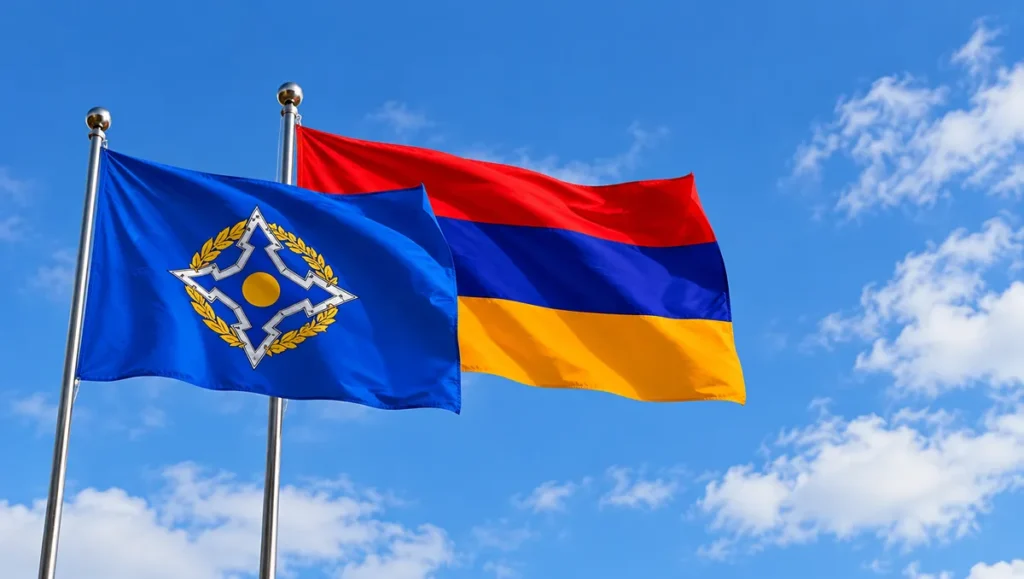
The summit of CSTO heads of state in Moscow on November 11 could discuss measures against Armenia provided for in the organization’s charter. However, raising the question of Armenia’s expulsion is unlikely, political commentator Artyom Yerkanyan says.
According to him, even if such a decision were taken, it would only mark the beginning of the process, since the organization’s charter requires the expulsion procedure to last at least six months.
Russian Foreign Minister Sergey Lavrov stated two months ago that the summit’s agenda would include applying the relevant article of the CSTO charter to Armenia. Yerkanyan believes this most likely concerns the possibility of imposing certain restrictions.
CSTO Secretary General Taalatbek Masadykov also confirmed that the issue was under consideration. At the same time, he expressed hope that Armenia’s political leadership would reconsider its attitude toward the organization before November 11, taking geopolitical developments and the international situation into account.
Yerkanyan recalled that Armenia’s foreign minister responded by saying there were no grounds for Yerevan to reconsider its position. Prime Minister Nikol Pashinyan had also said he would welcome a CSTO decision to expel Armenia. In that case, Pashinyan said, Armenia’s leadership would not have to make that difficult decision itself. The prime minister also stated that it was the CSTO leaving Armenia, rather than Armenia leaving the CSTO.
Unpaid membership contributions as grounds for restrictions
Yerkanyan notes that Armenia has not paid its CSTO membership contributions for almost three years. Those contributions account for around 10% of the organization’s total budget. The exact amount involved is unknown. In the commentator’s assessment, however, the central issue is Armenia’s decision in principle not to pay, rather than the amount owed.
According to Yerkanyan, non-payment violates the CSTO charter. Article 25 allows measures against a member state that fails to meet its financial obligations for two years. Specifically, the organization can deprive a state of voting rights in its bodies and the right to nominate its citizens for positions allocated under national quotas.
However, Yerkanyan emphasizes that both restrictions effectively already exist as a result of Armenia’s own actions, rather than a CSTO decision. Armenia has recalled its representative from the CSTO Joint Staff and has long stopped nominating candidates for quota-based positions in the organization.
Consequently, the commentator believes that applying Article 25 could, at most, formalize the existing situation. It might introduce no new restrictions, and the November 11 summit could leave the matter there. Nevertheless, Yerkanyan does not rule out discussion of Armenia’s expulsion as well.
Armenia’s expulsion is unlikely
According to Yerkanyan, Armenia’s expulsion could theoretically also be considered under Article 20 of the CSTO charter. That article provides for a state that systematically violates the charter to be deprived of voting rights and expelled from the organization.
In the commentator’s assessment, Armenia’s position and actions could, if desired, be interpreted as systematic violations. If expulsion were discussed, Yerevan would be unable to influence the decision, since such matters are considered without the participation of the state whose expulsion is proposed.
Yerkanyan says two political questions are crucial here. First, would Russia benefit from definitively severing relations with Armenia, or would Moscow prefer to preserve the current uncertainty until the relationship’s future becomes clearer? Second, would the other CSTO member states support a possible Russian initiative?
Yerkanyan believes support from the other members is far from guaranteed. He cites an example from the Eurasian Economic Union, where Belarus, Kazakhstan and Kyrgyzstan voted for a proposal to recognize Russian restrictions on Armenian goods as artificial economic barriers. Russia had to exercise its veto to prevent the decision from being adopted.
In the commentator’s assessment, this demonstrates that Russia’s position does not always receive unconditional support, even from its allies. Other CSTO members might therefore decline to support an initiative to expel Armenia or oppose it outright.