
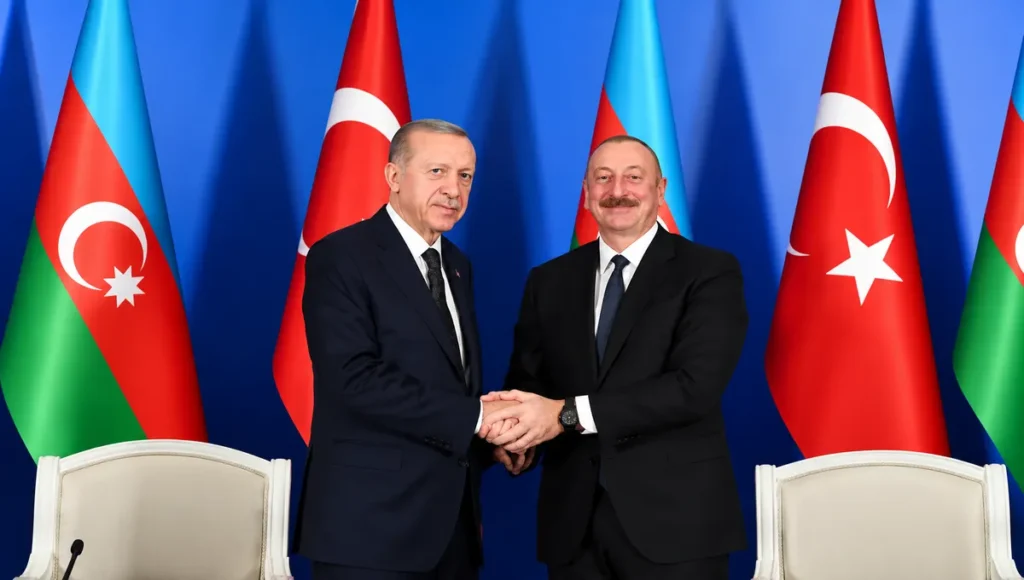
Turkish authorities say all preparations needed to open the Armenian–Turkish border are complete. Does that mean the border will open soon, or is Ankara’s statement simply a diplomatic signal? And how much influence can Baku exert over Türkiye’s decisions?
Political analyst Hrant Mikayelyan argues that the main obstacles to opening the border between Armenia and Türkiye are political. In his view, it is up to Ankara to resolve them.
Ankara made the decision to close the Armenian–Turkish border
Mikayelyan said there were no serious technical obstacles to opening the border in the past either. In his view, Türkiye’s political position remains the main obstacle. He disputes the idea that Ankara keeps the border closed out of concern over Baku’s reaction. He argues that Türkiye has always steered Azerbaijan’s policy.
“I don’t think Ankara is afraid of Baku and is holding off on a decision for that reason. I think it’s the other way around. Ankara has always called the shots in Baku, since 1991—or, more precisely, since 1992. Baku just bares its teeth from time to time so that Ankara doesn’t forget its interests. But by and large, Ankara has been the one directing the process,” Mikayelyan said.
He also drew attention to the timeline of the border closure. In response to the widely held view that the border closed in 1993, Mikayelyan argued that it had already stopped operating on a regular basis in 1991. He said humanitarian aid, mainly from the United States, crossed into Armenia on isolated occasions, but the border never operated fully. “Türkiye has always kept the border closed to maintain the blockade on Armenia, and that policy hasn’t changed,” he said.
Negotiating in stages gives Türkiye more leverage
Mikayelyan said the current process of normalizing relations between Armenia and Türkiye is proceeding in stages. The parties have already completed some of those stages, but that does not guarantee a successful outcome. He explained that each new stage requires fresh political and technical decisions. In his view, this format favors the stronger party because it can use its negotiating advantage again at every stage.
“The stronger side always tends to prefer a phased approach so it can use its negotiating leverage again at every stage. That multiplies its leverage over the weaker side,” Mikayelyan explained. He believes the party with the weaker negotiating position should seek agreement on all issues at once, as a single package. That would prevent the stronger party from repeatedly using the same leverage at different stages.
According to Mikayelyan, Armenia previously made its preference for this approach clear. The general approach remains the same, he said, but it has yet to produce results. He attributed this to Armenia’s failure to build sufficient negotiating leverage. “I don’t think it’s working because we haven’t built up enough leverage of our own,” he said.
Putting TRIPP into operation is a key demand for Türkiye and Azerbaijan
In Mikayelyan’s assessment, Türkiye has already moved through several stages of normalization with Armenia, but some issues remain unresolved. One is whether further progress will also serve Azerbaijan’s interests. He said that, at this stage, the actual launch of TRIPP—the Trump Route for International Peace and Prosperity—is crucial to both Azerbaijan and Türkiye.
In his view, Ankara and Baku want more than agreements on paper. They want transport links through Armenian territory to be operational.
“The main thing Azerbaijan wants, and Türkiye wants it too, is for TRIPP to open and actually start operating. They need to start using Armenian territory for trade and for other purposes as well. Only then will they consider the issues concerning Armenia resolved at this stage,” Mikayelyan said.