
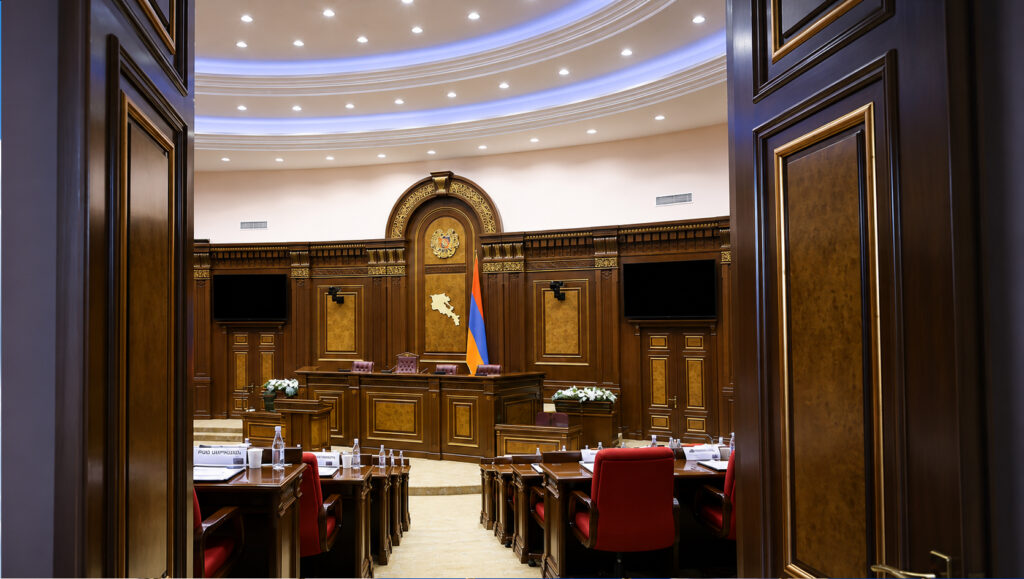
The first sitting of Armenia’s ninth National Assembly demonstrated that the parliamentary opposition has neither reassessed the results of the June 7 elections nor understood the shift in public attitudes. This was stated by political strategist Armen Badalyan, who assessed the start of the new parliament’s work.
“Listening to the opposition’s questions, it became clear that it still has not realized that this is 2026, not 2021, and has not understood why it lost on June 7,” he said.
According to Badalyan, the election results cannot be explained solely by the use of administrative resources. Even if 300,000 votes were hypothetically deducted from the 727,000 votes received by the ruling force as the result of administrative pressure, around 427,000 voters would still remain. That figure is higher than the number of votes received by each opposition force individually.
“This means that a change has occurred in the thinking of at least those 427,000 people. They now view the Artsakh issue, the international recognition of the Armenian Genocide, relations with Russia and the current state–church tensions differently. Even if we accept the harshest estimates regarding administrative resources, that change still remains,” he said.
Anti-Turkish Rhetoric Has Lost Its Former Influence
In Badalyan’s view, the opposition chose a campaign strategy that is no longer politically relevant.
“They tried to show that Ruben Rubinyan studied in Turkey, interacted with Turks and was therefore somehow connected to Turkey. But if someone studied in Turkey, it is natural that he communicated with Turkish people. Such questions had no political substance,” he said.
Badalyan argued that anti-Turkish rhetoric no longer has the influence it once did.
“There was a time when anti-Turkish sentiment was a political trend in Armenia. That is no longer the case. Yes, anti-Turkish groups still exist, but the overwhelming majority of society no longer follows that logic,” he stressed.
The Opposition Should Have Focused on Political Positions
According to Badalyan, parliamentary discussions should have centered on domestic and foreign policy rather than the candidate’s biography.
He said the opposition should have asked Ruben Rubinyan about his positions on Armenia’s possible membership in BRICS, the Shanghai Cooperation Organization and NATO, relations with the European Union, and the country’s economic development strategy.
“If a person is seeking one of the two most important political positions in the country, he should answer questions about his political views, not his student biography,” Badalyan said.
Political Competition Must Be Based on the Existing Reality
Addressing the continuing disputes over the election results, Badalyan said the opposition continues to speak about electoral fraud instead of building its political struggle around the reality that has already taken shape.
“At this point, the fact is that the Civil Contract party has 64 seats and the opposition has 41. Whether someone likes it or not, political competition must be built on that reality rather than endlessly returning to elections that have already concluded,” he said.
According to the political strategist, the opposition should try to demonstrate to society that it is more politically mature than the government instead of repeatedly making the same accusations.
Badalyan did not rule out the possibility that the current ruling force could remain in power for a long period. In parliamentary systems, he noted, governing political forces often remain in office for decades even as prime ministers change.
“For example, in Japan, the same political force can remain in power for decades simply by changing prime ministers. In Armenia, it is also theoretically possible that the prime minister may change after several years while the same political force remains in power,” he said.
Social Problems Do Not Automatically Produce Mass Protests
Speaking about socioeconomic problems and the impact of Russia’s economic restrictions, Badalyan said these measures could worsen living standards but would not automatically develop into mass protest movements.
“People are not trying to fight for a change of government. They are trying to solve their own problem by finding a way around it. If one route is closed, they look for another. If they cannot work in one direction, they try to find an alternative,” he said.
In Badalyan’s assessment, emigration has become the most common form of social struggle among Armenian citizens.
“The Armenian people have not stopped struggling; they are simply struggling in a different way. Emigration has become one of the forms of struggle in our society. If a person sees that he cannot improve his life, he packs his belongings and leaves. This is a very pragmatic approach: people live only once and want to live well,” the political strategist concluded.