
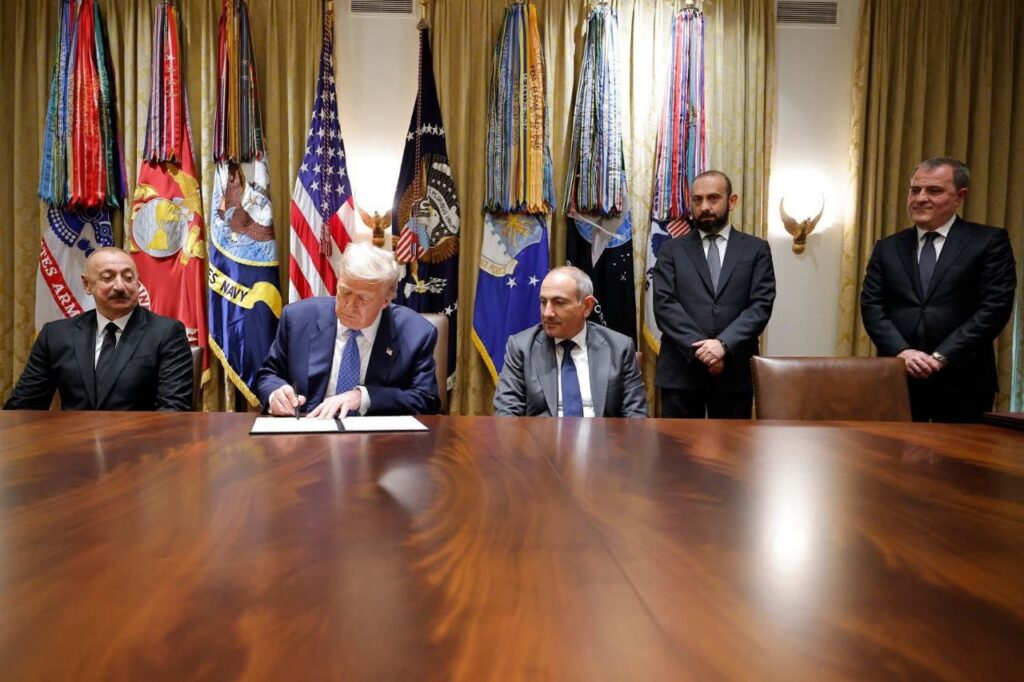
In the context of normalizing relations between Yerevan and Baku, the Washington meeting has elicited mixed assessments, according to political analyst Tigran Grigoryan.
He noted that the initialing of the peace agreement text was perceived by many as significant progress and a diplomatic achievement. However, in reality, the parties were ready for this step even before the U.S. meeting. The issue of initialing was actively discussed in Abu Dhabi, and the process could have taken place there.
The primary significance of the Washington meeting lies in the fact that the document was initialed in the capital of one of the world’s most influential countries and in the presence of the U.S. President. This can be seen as a kind of “light” security guarantee—a high-level international confirmation of agreement on the peace treaty text.
Another key outcome was the signing of a statement on the dissolution of the Minsk Group.
“Armenia had no fundamental objections but insisted that this statement be submitted on the day the peace treaty was signed. However, as we see, Armenia has backed down—the treaty has not been signed and is unlikely to be signed in the near future, yet the statement on the dissolution of the OSCE Minsk Group has been submitted,” the analyst remarked.
Regarding the Trilateral Declaration signed by Pashinyan, Trump, and Aliyev, Grigoryan emphasized that two key points of the document are directly related to the unblocking of communications.
“When comparing the current situation with the November 9 declaration, there is some progress: the principles of territorial integrity and sovereignty have been enshrined. At the same time, the provision on unimpeded movement has been retained. However, in the earlier document, there was a certain symmetry—Artsakh and the Lachin Corridor existed. Now, in the worst-case scenario, this could turn into a unilateral concession, as that symmetry is gone. Moreover, the principle of reciprocity in the current document is formulated quite vaguely—it is not explicitly mentioned, and instead, there is only talk of ‘mutual benefits,’ the meaning of which remains unclear.”