
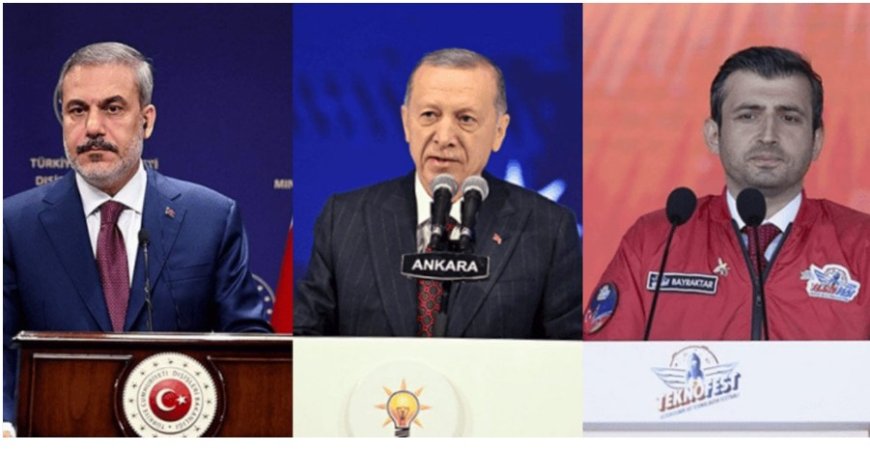
Erdoğan’s “second youth” and the unresolved succession question
According to political analyst Tiran Lokmagyozyan, many observers believed the previous elections could be President Recep Tayyip Erdoğan’s last. These expectations stemmed mainly from his sharply deteriorating health at the time.
However, today Erdoğan appears to be experiencing what the expert calls a “second youth”, suggesting he still has enough political energy to govern. Lokmagyozyan stresses that Erdoğan does not wish to stay in power indefinitely, but the unresolved succession issue keeps him in a state of serious consideration.
Who could succeed Erdoğan? Several names circulate
1. Erdoğan’s son — unlikely due to scandals
One of the frequently mentioned candidates is Erdoğan’s son. His potential candidacy was even compared to the dynastic model of the Aliyev family in Azerbaijan.
However, his involvement in several public scandals seriously damaged expectations. After relocating to Italy — where new issues emerged — he eventually returned to Turkey.
Today he avoids public activity entirely, as any unsuccessful statement could harm Erdoğan’s political standing. Because of this, Lokmagyozyan considers his candidacy unlikely.
2. Erdoğan’s son-in-law Bayraktar — kept “in reserve”?
Another potential successor often mentioned is Erdoğan’s son-in-law, Bayraktar, who previously served as a minister. Yet he has also gradually stepped away from public life and now rarely appears in political contexts.
“There are two important factors,” Lokmagyozyan explains. “Erdoğan may indeed view him as a future successor, but is deliberately keeping him in the shadows to protect him from political conflicts and prevent reputational damage. Turkey’s political field is extremely harsh — any misstep can be destructive. Most likely, Erdoğan wants to keep him ‘in reserve’ until the right moment. This is a very realistic scenario.”
3. Hakan Fidan — the strongest and most serious candidate
Despite other names, Lokmagyozyan believes the real leading candidate is Hakan Fidan, currently Turkey’s foreign minister.
A unique background shaped by intelligence and military roles
“Hakan Fidan’s phenomenon is unique,” the analyst notes.
His entire career has involved classified positions:
- years in the military,
- a long tenure as head of Turkey’s National Intelligence Organization (MIT),
- diplomatic connections, including a wife who worked in the foreign service.
There is very little public information about either of them — their professional and personal files remain largely closed.
Highly qualified, influential — but lacking charisma
Fidan is regarded as one of the most capable and educated officials in Turkey. He:
- is fluent in English,
- has professional experience in the United States,
- has military education,
- participated in multiple international programs.
Under Erdoğan’s protection, Fidan occupied positions that made him one of the most influential figures in the state. In terms of professional expertise, Lokmagyozyan even considers him “stronger than Erdoğan”.
But Fidan has one major weakness: a lack of charisma.
While Erdoğan can speak emotionally for hours without notes, building powerful narratives that move the masses, Fidan communicates briefly and strictly, without rhetorical flair. In Turkey, where public charisma often determines electoral success, this is a serious disadvantage.
Could Erdoğan run again? The analyst says yes
Because the succession issue remains unresolved, Lokmagyozyan believes Erdoğan has not yet made a final decision.
“If he cannot choose a successor, Erdoğan may run again,” the expert says. “This would be an extreme scenario, but not impossible. He knows his political era is limited — yet he remains Turkey’s most influential, charismatic and widely supported leader. All other candidates still need time to grow.”
A phased transition or a surprise successor
Lokmagyozyan also considers another possibility: Erdoğan could win one more term and then gradually elevate one of the three potential successors, strengthening their public visibility and popularity.
“Or he may unexpectedly choose an entirely different person,” he concludes.