
In the Armenian segment of social media — primarily on Facebook — a striking and long-standing asymmetry can be observed in user reactions to criticism directed at various institutions of power. This disproportion becomes particularly visible in the context of upcoming elections, increasing pressure on the church and the opposition, and the absence of any real political counterbalance to the ruling team.
Criticism of Prime Minister Nikol Pashinyan — even when moderate in tone — triggers an aggressive and immediate response. The typical pattern involves a flood of defensive comments from accounts that show no signs of organic, real-life activity: these accounts often lack profile photos, personal posts, or friend networks; their content mainly consists of reposts of pro-government materials, slogans, and memes. While these are not necessarily fake accounts in the technical sense, they function as digital proxies, creating the illusion of mass support and shaping a visual effect of “public consensus.”
Comments under posts or publications criticizing Pashinyan are filled with structurally similar phrases such as “who else, if not him?”, “do you have a better alternative?”, “what about the former ones?”, and profanities that are entirely unrelated to the substance of the original post. A similar — though less intense — pattern is observed with regard to Parliament Speaker Alen Simonyan, whose public persona also appears to benefit from active digital protection.
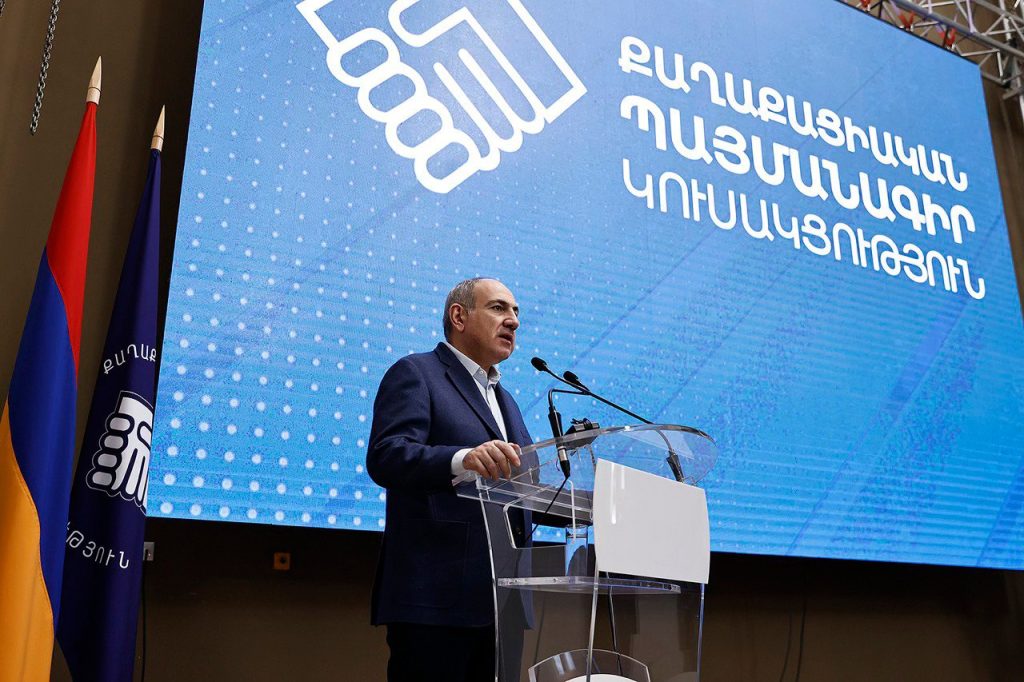
However, the most notable gap appears when it comes to the ruling party itself — Civil Contract. Posts criticizing the party as a structure, as a political brand, or as a decision-making mechanism almost never provoke a comparable digital counterattack. Nor do such publications attract significant organic support from users. This creates the impression that, in the minds of both the public and perhaps the authorities themselves, the party is not seen as an independent political subject. It lacks political authority and electoral weight beyond the shadow of its leader.
This dynamic reflects the underlying structure of Armenian governance — both current and previous: the political vertical is built not around the party as an institution, but around the individual. Accordingly, efforts at information defense are focused on the person, not the structure. That is why the digital protection of the “leader” works rapidly, cohesively, and at scale, while the party remains a secondary, technical shell.
Civil Contract functions more as a tool to retain a parliamentary majority than as a carrier of a political program or value system. Such a structure may ensure manageability, but it does not provide resilience — especially in the face of political shifts, international pressure, or internal party conflict. This is a leader-centric model disguised as institutional democracy. In such a setup, political responsibility becomes blurred because the party is no longer associated with specific decisions. All responsibility — and all legitimacy — is concentrated in one person. But a parliamentary republic, by definition, is not designed to operate on the basis of personalist rule.
In essence and function, Civil Contract resembles a bedbug nymph — a stunted developmental form that has not undergone any real transformation. This is not a phase of maturation, but rather a frozen, degenerated state, one that is only functional to the extent that it is nourished by its environment — in this case, the media and electoral aura surrounding the leader. In a system without strong opposition, genuine party competition, or independent media, such a nymph can survive for a long time. But it will never evolve into a fully-fledged political organism. And therefore — it will not be able to withstand crises, deliver progress, or protect the country.