
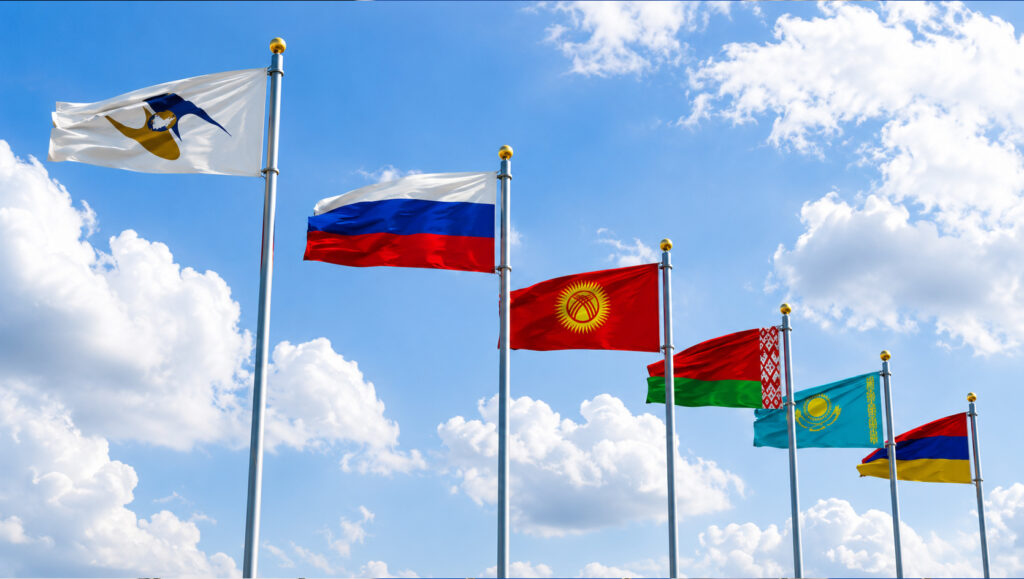
Armenia’s withdrawal from the Eurasian Economic Union could have disastrous consequences for the country’s economy, ranging from higher energy prices to the loss of export markets. This was stated by international affairs expert Armen Manvelyan, who commented on Prime Minister Nikol Pashinyan’s warning that continued Russian restrictions on Armenian products could mark the beginning of the end of the EAEU.
According to Manvelyan, the situation is exactly the opposite: if Armenia leaves the EAEU, it could mark the beginning of the end for the Armenian economy.
He said the ideology behind the creation of the EAEU was based not only on trade but primarily on energy cooperation.
“The idea of the EAEU was for its member states to establish a unified center of energy cooperation. This involved integrating the gas, oil and electricity markets. Many countries had access to relatively inexpensive energy resources, which provided an important advantage for economic development,” he said.
In Manvelyan’s assessment, this is why leaving the EAEU or sharply worsening relations with the organization could deepen Armenia’s economic problems.
“When you leave such a system or take steps against it, the first consequence will be higher prices for energy resources — gas, oil and petroleum products. This could trigger a chain reaction and damage your own economy rather than the EAEU,” he said.
The Importance of the Russian Market for Armenian Products
Manvelyan emphasized that the export market for finished goods is particularly important for Armenia.
“The phrase ‘finished product’ must be emphasized. Mineral raw materials can be exported to China or other countries, but jobs are primarily created by goods manufactured in Armenia and exported in finished form,” the expert said.
According to him, Russia remains the main market for Armenian finished products.
“Most of our finished products go to the EAEU market, with the lion’s share going to Russia. This market should be preserved, developed and used effectively rather than dismissed by claiming, for example, that Armenian products are of poor quality,” Manvelyan said.
Possible Changes to the South Caucasus Railway
Manvelyan also addressed the South Caucasus Railway, noting that while it is strategically important, its economic position is highly complicated.
“The South Caucasus Railway is strategically important for Armenia. However, if we look at the map and assess its economic potential, it becomes clear that it cannot operate effectively without major investment. It is not a profitable system on its own,” he said.
According to the expert, several years ago the railway could have operated more efficiently because the Sotk mine generated a significant share of its freight traffic.
“At that time, approximately one million tons of cargo were transported annually from the mine, providing substantial volumes for the railway,” he said.
Manvelyan noted that the situation has changed in recent years and that the mine’s operational capacity has declined significantly.
“Since the Sotk mine no longer operates at its previous level and is functioning at only around 10–20% of its production capacity, the South Caucasus Railway has effectively become an unprofitable system,” he said.
The expert stressed that the railway’s future operation cannot therefore be viewed solely through the issue of changing its management. Without stable freight volumes and major investments, maintaining the system would be difficult.
The Concession Agreement and Employment
Addressing the possible consequences of the Russian side’s departure, Manvelyan said the terms of the existing concession agreement must also be considered.
“Under the concession agreement, the Russian side was given a social obligation to preserve jobs. Around 3,000 people currently work there. Many specialists believe that, from a technical standpoint, such a large workforce is not actually necessary, but the jobs are maintained because of contractual obligations,” he said.
According to Manvelyan, a new operator may adopt a different approach.
“If someone takes over the system tomorrow, the question is whether they will be prepared not only to manage it but also to make major investments. If their calculations show that the system is not profitable, one of their first steps may be to dismiss a large share of the workforce,” the expert said.
In his assessment, changing the management of the South Caucasus Railway could create more problems for Armenia than benefits.
“Any party can take over the system if it calculates that there is an opportunity for profit. However, I am convinced that if a new operator arrives, one of its first decisions may be to cut 60–70% of the employees because it will not be bound by the existing social obligations,” Armen Manvelyan concluded.