
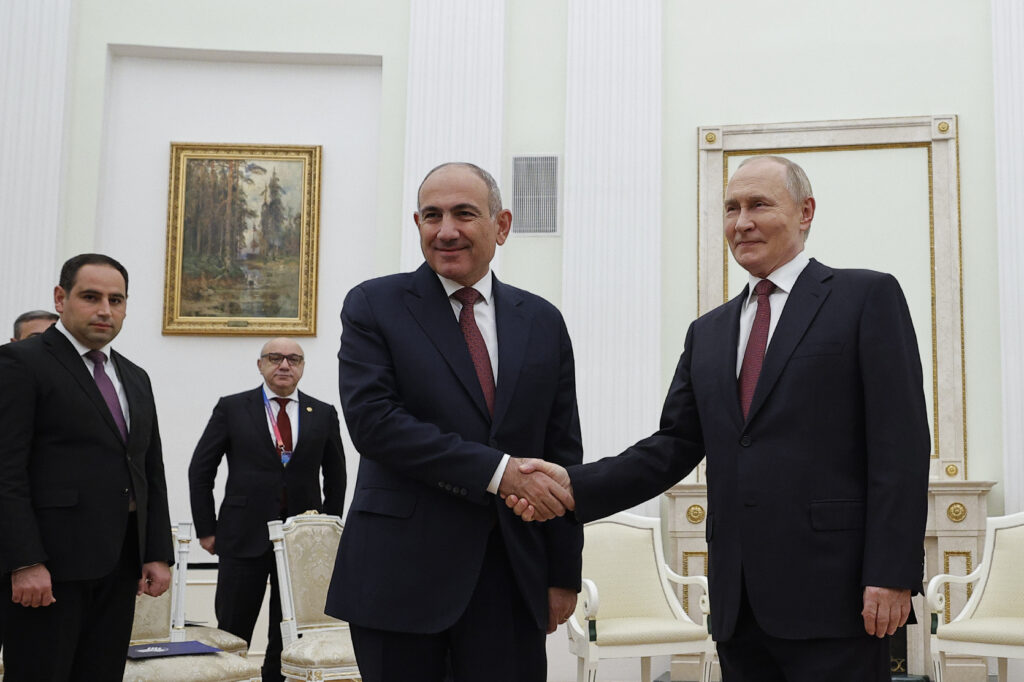
Amid increased U.S. engagement, Yerevan–Moscow relations are returning to more measurable and objective foundations. This view was expressed by expert Armen Petrosyan.
According to him, in the past Armenia–Russia relations were framed as a strategic partnership and an alliance, enshrined in various documents and reinforced by high-level rhetoric. However, Petrosyan continued, the 2020 Artsakh war and the developments that followed — Azerbaijan’s attacks on Armenia’s sovereign territory, the CSTO’s inaction, and events related to Artsakh — demonstrated that these relations do not correspond “on the ground” to the declared formulations.
Limitation of Russia’s Influence
The expert notes that Russia is gradually coming to realize that its capabilities in the South Caucasus — both at the level of individual countries and the region as a whole — are changing in nature. These changes are driven not only by bilateral relations but also by geopolitical competition in the region.
Petrosyan points out that it was precisely as a result of this competition that the United States became a more active, proactive, and consistent player. As a result, U.S. presence began to be viewed as more preferable by both Armenia and Azerbaijan. Evidence of this is the fact that the parties chose to initial peace arrangements in Washington, bypassing Moscow.
Nuclear and Energy Sectors as Strategic Challenges
Referring to the Metsamor Nuclear Power Plant, the expert recalls that it is under the management of Rosatom, and it is therefore natural that cooperation between Armenia and the United States in the field of nuclear energy will be perceived in Russia as a strategic challenge. The same applies to the TRIPP project.
According to Petrosyan, in all areas where Russia previously held a monopolistic position — nuclear energy, gas supply, petroleum products — other players are now gradually emerging. This will inevitably create challenges at the level of Russia’s response, although such responses do not yet imply real influence over the ongoing processes.
What Is the Real Extent of Russia’s Influence?
The expert highlights one key question: to what extent is Russia today truly capable of influencing processes unfolding on the ground. In his view, reactions and statements are one thing, while real capacity to obstruct developments is quite another.
Petrosyan emphasizes that at this stage relations with the United States are extremely important for Russia, especially in the context of possible moderation of the Ukrainian crisis. For this reason, Moscow refrains from taking sharp steps. If an active regional actor were, for example, the European Union, Russia’s response could be much harsher. In the case of the United States, the expert argues, such restraint is understandable and logical.