
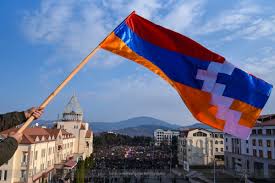
Armenian figure skaters representing Armenia were banned, at Azerbaijan’s demand, from performing a piece titled “Artsakh.” Although at first glance this may appear to be a purely sporting or technical issue, in reality it carries a much deeper political significance. Political scientist Suren Zolyan draws attention to this.
According to him, what happened demonstrates not only the penetration of politics into sport, but also the true meaning of the so-called “peace” that is currently being discussed on international platforms. “When we are told that peace has been established in the region, we must understand what kind of peace this is, if today not only Azerbaijan but also international bodies effectively prohibit even the use of the word ‘Artsakh,’” Zolyan notes.
The Perpetrator of Genocide Presented as a Peace Initiator
In Zolyan’s assessment, the incident is particularly shocking in light of the fact that the forced displacement and the process of ethnic cleansing carried out in Artsakh have not received proper international evaluation. Moreover, today not only have people been expelled from their homeland, but even the mention of the name of that territory is being banned.
“This is the consequence of a situation in which the side that carried out genocide is presented as a peace initiator, while international — quite authoritative and seemingly independent — institutions accept precisely its dictates,” Zolyan emphasizes. In his view, this is an almost unprecedented phenomenon in history.
Legal Violations and the Question of Armenia’s Position
Zolyan also highlights the legal aspect, noting that the piece in question is registered under the title “Artsakh” within the framework of international copyright law. According to him, no body has the right to change the title of a musical work without the author’s consent. “First, the author’s consent should have been obtained, which was not done,” he stresses.
In addition, Zolyan recalls that the same piece had previously been performed on international stages, and at that time Azerbaijan raised no objections. “Back then, there was no peace, yet they saw no problem. Now, under the conditions of so-called peace, the pressure extends even to the level of culture and vocabulary,” he says.
The Ban on the Word “Artsakh” Is Not a Minor Episode but a Symbol of a Major Tragedy
According to Zolyan, the current situation is also a consequence of the position of the Armenian state. He argues that if the state effectively refuses to defend such issues or even aligns itself with the opposing side, then all efforts by individuals, political parties, or civil society organizations are doomed to failure.
“When issues such as the dignified return of the population, the preservation of cultural heritage, or other fundamental matters are raised in international forums, the response will always be the same: your state is against it, because it contradicts the peace agenda,” Zolyan emphasizes.
In his view, the ban on the word “Artsakh” is not a small episode, but a symbol of the entire tragedy. “It shows that peace is being built at the expense of Armenians — at all levels. This is not peace between equals, but a process in which one side dictates its terms while the other is forced to remain silent,” Zolyan concludes.