
Today, there is no opposition force or political figure in Armenia’s political landscape that openly speaks out against the idea of partnership with the United States. This was stated by political technologist Karen Kocharyan.
According to him, even in the event of a change of power, it is difficult to imagine that any political force would attempt to cancel programs being discussed with the United States, including major infrastructure or economic initiatives.
Kocharyan notes that the key question is not whether the United States can be a partner of Armenia, but rather in what capacity. In his view, at this stage the United States is not seeking to become the primary player, but instead sees its role as that of a secondary or complementary partner.
The U.S. Geopolitical Calculation in the Region
The political technologist recalls a well-known statement by Donald Trump, in which he said that he had “entered Vladimir Putin’s zone” and managed to establish peace there in a short period of time.
“In other words, Trump himself emphasizes that this is a zone of Putin’s influence. This observation is important for understanding how Washington envisions its role in the region,” Kocharyan said.
In his assessment, the United States is a highly experienced player in the geopolitical arena and clearly understands that it cannot immediately enter a region where it has previously had little involvement as the number one actor. For this reason, the U.S. is acting gradually, strengthening its presence across various directions.
Political Interests Beneath the Economic Agenda
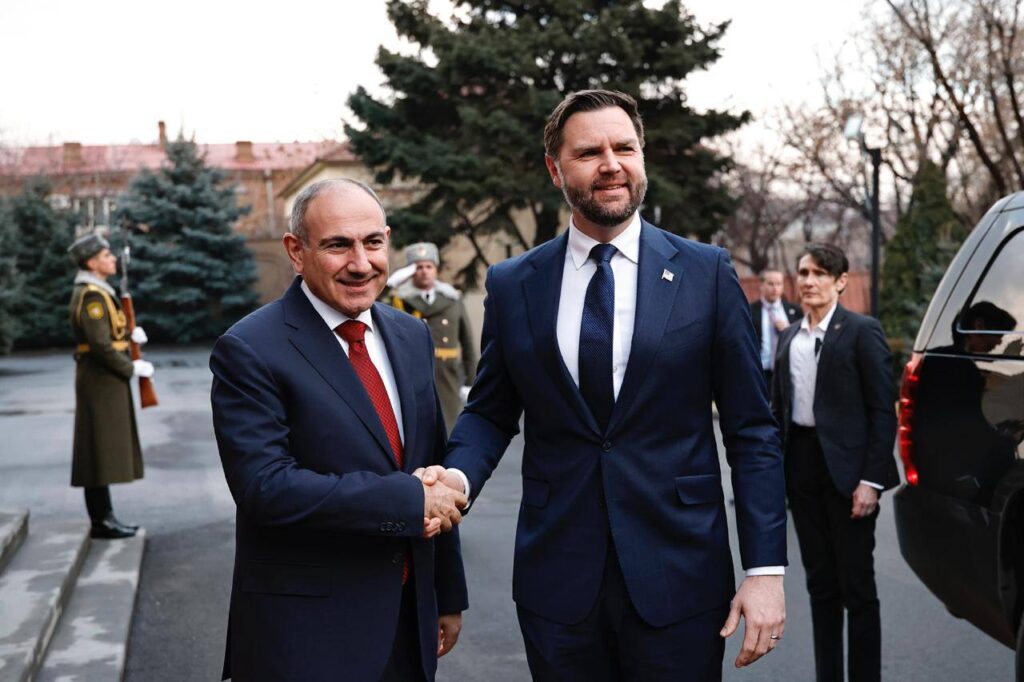
According to Kocharyan, the remarks made during the visit of U.S. Vice President J.D. Vance to Armenia were largely economic in nature, with almost no explicit political statements. In practice, the visit was presented as discussions on agreements or preliminary arrangements on economic cooperation in sectors where Russia is already involved.
However, the political technologist questions the assumption that the United States can expect significant economic benefits from Armenia. In his view, a country with an economy of such scale is unlikely to offer substantial economic profit. Therefore, Kocharyan argues, if Americans are making investments, they are doing so not “for nice eyes,” but on the basis of clear and calculated interests.
Who Pays—and at What Cost—for the U.S. Presence
According to Kocharyan, if the benefit is not economic, then it is political—specifically geopolitical. In his view, the main purpose of Vance’s visit was precisely to strengthen the U.S. geopolitical presence in the region. This, however, raises a key question: what must Armenia pay in return?
The political technologist notes that when a player enters a region where it has not previously been active, this in itself comes at a cost.