
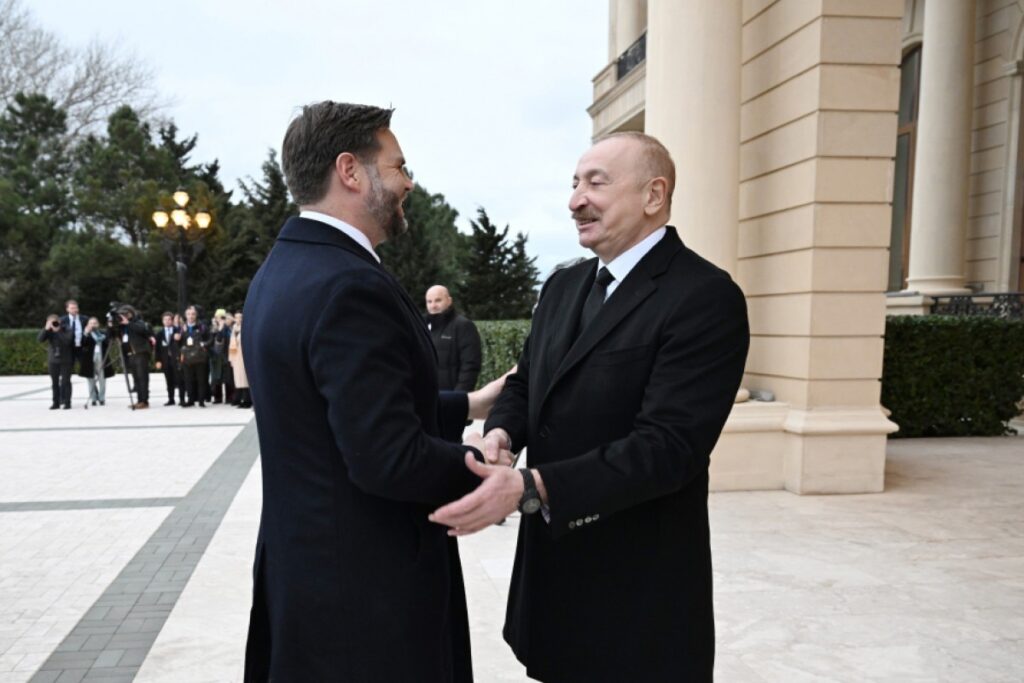
The four-day regional visit of U.S. Vice President J.D. Vance to Armenia and Azerbaijan was received with great fanfare by the Armenian authorities. The ruling circles, led by Nikol Pashinyan, described the trip as “historic,” stressing the beginning of a new phase in Armenian-American relations. However, the same visit was presented very differently in Azerbaijan’s information space.
According to Azerbaijan expert and PhD in history Tatev Hayrapetyan, the visit in Baku was covered in an extremely restrained, almost unnoticed manner. “I did not see the emphasis or the ‘spark’ in the Azerbaijani press that they tried to create in Armenia. On the contrary, it was presented as a routine, mostly protocol visit,” she notes.
Azerbaijan is multi-vector, Armenia is one-sided
Before and during the visit, there was active discussion about whether Vance would raise the issue of releasing Armenian prisoners of war. Hayrapetyan says there were no clear public statements on this matter, making it impossible to determine whether it was discussed behind closed doors.
At the same time, before leaving Yerevan, Vance stated that he would also raise the issue in Baku. According to the expert, an important leverage point for Armenia could be U.S. President Donald Trump’s August 7 statement, in which the American side expressed readiness to assist in resolving the POW issue. “We must regularly return to that statement and remind the American side of its own commitments,” Hayrapetyan emphasizes.
She also notes that ahead of the visit Azerbaijan was actively working in the Chinese direction, once again demonstrating its multi-vector foreign policy. “Unlike Armenia, which clearly identifies the U.S. as its main partner, Azerbaijan avoids dependence on a single center and maneuvers in different directions,” she says.
Overall, apart from jokes directed at Aliyev, Vance’s visit fit within the framework of classic protocol diplomacy.
The TRIPP project — corridor or opportunity
Nikol Pashinyan’s post-visit interview with public television revealed several alarming details. In particular, the prime minister effectively admitted that he reviewed some of the proposed documents only at the final stage. “This shows that we are not dealing with a long-negotiated document, but with a ready-made version placed on the table, requiring a quick ‘yes’ or ‘no,’” the expert stresses.
Special attention has also been drawn to the TRIPP investment program. According to Hayrapetyan, if the project were purely an Armenian-American initiative, the issue of Azerbaijan’s signature would not arise. “If there is no link to Azerbaijan, why is their signature on this document?” she asks.
The expert believes that nothing has been finalized yet: there is a general framework, while the substance is shaped during negotiations. And this is precisely where the quality of the negotiator becomes decisive.
Hayrapetyan underlines that in today’s complex geopolitical environment — with active U.S. involvement, Russia’s wait-and-see stance, and ongoing instability in Iran — it is vital for Armenia who negotiates and how.
“TRIPP can become either a dangerous corridor or a real opportunity for Armenia. Everything depends on whether the negotiator is guided by state interests and long-term thinking,” she concludes.