
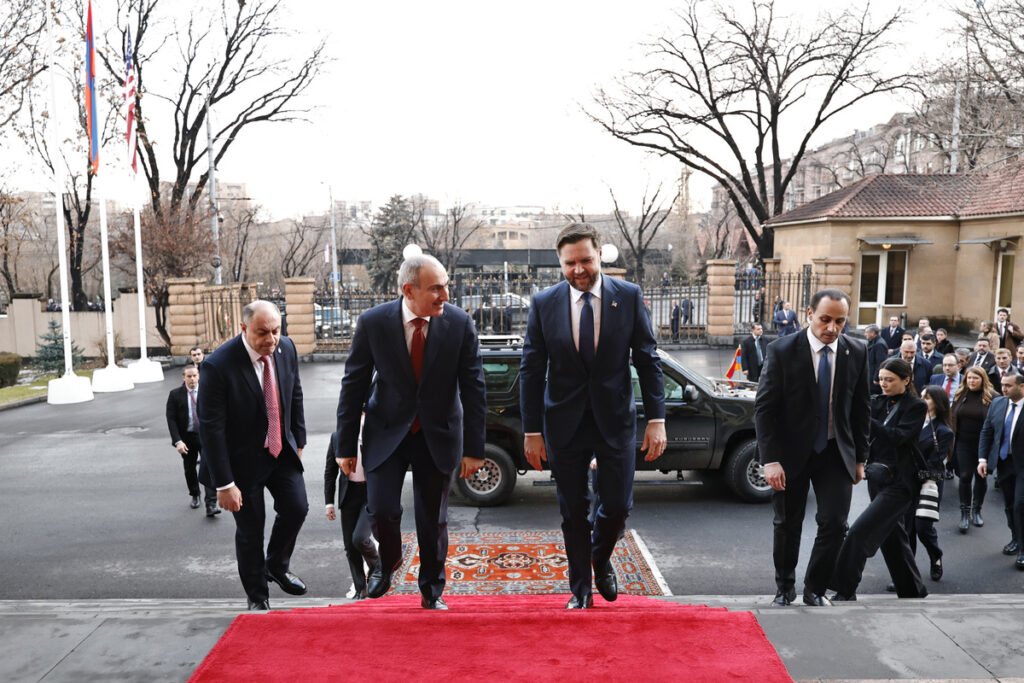
On February 9, 2026, in Yerevan, Armenian Prime Minister Nikol Pashinyan and U.S. Vice President J.D. Vance signed a joint statement announcing the completion of negotiations on a Section 123 agreement concerning cooperation in the peaceful use of nuclear energy. Is this a new chapter in Armenia’s energy sector, or a multi-billion-dollar obligation? Who benefits from the American nuclear agreement?
Misunderstandings Around the “123 Agreement”
According to expert Artur Avetisyan, the “123” agreement does not imply that Armenia is obligated to build an American nuclear power plant, regardless of its type. The document contains neither direct nor indirect commitments of that nature.
Avetisyan explains that the agreement establishes a legal and institutional framework enabling the transfer of information, technologies, and expertise in the field of peaceful nuclear energy. Before such an agreement, these transfers were legally impossible.
At the same time, the process is not limited to international procedures. Armenia must also complete domestic procedures, which may take up to one year. Therefore, the process is not yet fully completed, although the key negotiation stage has effectively been finalized.
International Context
The expert notes that Section 123 agreements are not limited to smaller U.S. partners. Major actors, including Russia and China, have also concluded such agreements. Moreover, Russia remains one of the largest suppliers of nuclear fuel to the United States despite political tensions.
According to Avetisyan, this demonstrates that the “123” agreement is not a document dividing geopolitical camps, but rather a tool for technological and legal cooperation.
For Armenia, the core issue lies elsewhere. The operational lifespan of the Metsamor Nuclear Power Plant is nearing its end, yet there is still no clear decision on which technological solution will replace it.
“We have a nuclear power plant, but we do not have a clear decision about which reactor will replace Metsamor. That is the key issue,” the expert emphasizes.
If Armenia chooses conventional, well-tested nuclear technologies, the design and commissioning process typically takes around ten years. In the case of small modular reactors, the situation is more complicated. These technologies are relatively new in civilian use and lack extensive operational experience.
Avetisyan notes that the American NuScale technology, once considered highly promising, was ultimately discontinued due to excessive costs. New projects in the United States based on Westinghouse technology are currently being initiated, but they are not yet in practical operational stages.
Russia has operated a floating small modular reactor since 2020 with a capacity of 70 megawatts. However, it does not yet have a land-based SMR licensed by the International Atomic Energy Agency. China, by contrast, has operated a small modular reactor since 2023 and plans to commission another 125-megawatt reactor in the first half of 2026, which already holds an IAEA license.
Is the “123 Agreement” Beneficial for Armenia?
According to the expert, joining the agreement is clearly a positive and beneficial step for Armenia. However, it is incorrect to interpret it as an obligation to construct a specific American or modular nuclear power plant.
Avetisyan argues that the “123” agreement is the result of negotiations, not an instrument of coercion. It opens the field for deeper cooperation between Armenia and the United States in peaceful nuclear energy.
He also stresses that peaceful nuclear energy extends beyond electricity generation. It includes medicine, industry, scientific research, and other sectors.
“Who said that joining ‘123’ means only building a power plant? This is about much broader and more strategic cooperation,” he concludes.
👉 Politics
https://vectors.am/en/category/politics/