
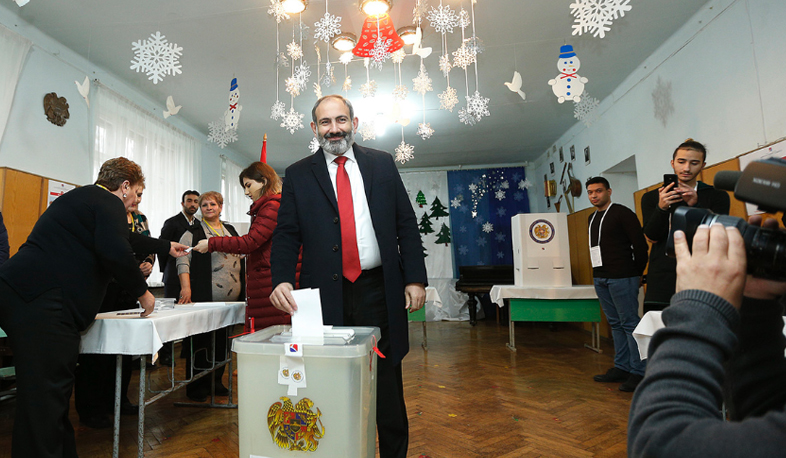
The example of Hungary has shown that high voter turnout can have a decisive impact on the position of the ruling authorities. This view is expressed by political strategist Vigen Hakobyan.
Hungary’s example and the turnout factor
Hakobyan emphasizes that with high turnout, the ruling power is almost guaranteed to lose to the opposition, especially if relevant public sentiments are already present. According to him, current political and psychological trends worldwide indicate that the decisive factor is not external signals but internal decisions.
He notes that it does not fundamentally matter what statements are made by external actors — whether it is the US Vice President, the Turkish Foreign Minister, the President of Azerbaijan, or the President of Russia. In Hakobyan’s view, everything will ultimately be decided internally, by the society itself.
Polling data and expected turnout
The strategist also refers to sociological data, noting that it indicates expectations of high voter participation. According to recent surveys, around 60–61% of citizens say they are likely to take part in the elections.
At the same time, he considers this figure somewhat optimistic and suggests that actual turnout may be closer to 53–55%. However, even this level, in his opinion, is relatively high and could create serious challenges for the ruling authorities.
Limits of administrative resources
Hakobyan explains in detail the structure of the government’s electorate, noting that any власть has an administrative resource, which is usually composed of more organized and disciplined voters. This resource includes those who ensure participation through various mechanisms, often in a coordinated manner.
However, he stresses that this resource is limited and typically составляет around 25–30%. When turnout is low, this percentage carries significant weight in the final outcome, but as turnout increases, its influence decreases considerably.
Hakobyan gives a simple example: if 1 million people participate in the election, then 25% equals 250,000 votes. But if those same 250,000 votes are counted against a total of 1.2 or 1.4 million participants, their relative weight drops significantly, reducing the власть’s ability to reproduce itself through its own base.
Pre-election phase and turnout growth
The strategist notes that there is still time before the elections, and turnout may increase, as the official campaign has not yet started. According to him, although the campaign has effectively begun, not all citizens are yet fully aware of the importance of the vote.
Hakobyan also argues that many do not recognize a simple “arithmetical” fact: not participating in elections effectively supports the reproduction of the current authorities. Lower participation makes it easier for those in power to maintain their positions.
At the same time, according to expert calculations, with turnout around 55%, the chances of the ruling authorities, given their current ratings, remain quite low. In his words, under such a scenario, the prospects for power reproduction become “uncertain,” if not “rather bleak.”