
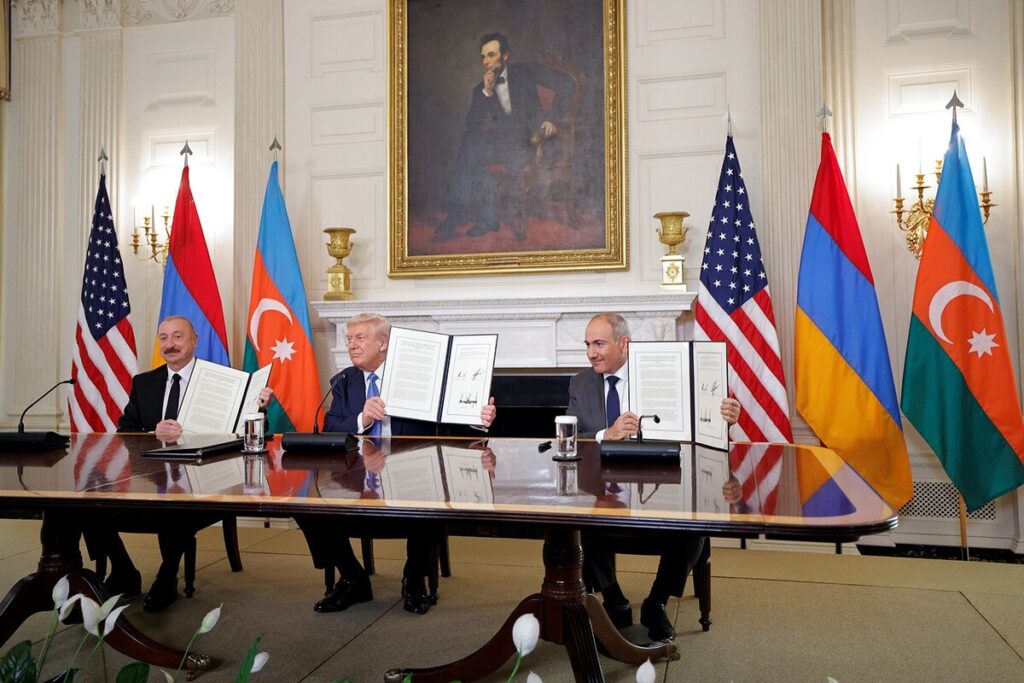
In Washington, Armenian Prime Minister Nikol Pashinyan, Azerbaijani President Ilham Aliyev, and U.S. President Donald Trump signed a Trilateral Declaration. For the authorities in Yerevan, this is “the first step toward establishing a lasting peace.” For the opposition, it represents a threat to national interests. Why did the same text provoke such different reactions, and what really lies behind the wording of the Declaration?
Both the authorities’ assessments and the opposition’s criticisms have their own logic. On one hand, the declaration indeed appears as a signal of transition from conflict to integration into a regional transport and economic system under U.S. mediation. On the other hand, the set of formulations and obligations contains certain risks for Armenia. It is precisely these points that deserve a closer look.
Paragraph 3: The status of a “special transit zone”
One of the most controversial elements of the declaration is the commitment to open communications between Armenia and Azerbaijan, with a separate line emphasizing “unimpeded communication between the main part of the Republic of Azerbaijan and Nakhchivan through the territory of the Republic of Armenia.” This emphasis gives the route special significance, elevating it above other directions.
U.S. President Donald Trump went even further in his speech, calling this route a “special transit zone” within the framework of the “Trump Route for International Peace and Prosperity” (TRIPP) project:
“We resolved a very important issue, this is a special transit zone, a territory that will allow Azerbaijan full access to Nakhchivan while fully respecting Armenia’s territorial integrity.”
According to him, the corridor will be managed for 99 years with the possibility of a 99-year extension, and major American investments will flow into its development.
Thus, the special status of the route is already politically established, even if it is not yet explicitly stated in the declaration. Although the document mentions that Armenia will also receive “mutual benefits” for its transport, neither the text nor public statements have mentioned the creation of a similar “special transit road” through Azerbaijani territory for Yerevan’s needs. This creates an asymmetry: a special regime is guaranteed for one direction, while Armenian access to Azerbaijani territory remains uncertain.
From “unimpeded passage” to claims
The wording on “unimpeded passage” is ambiguous and may later provide grounds for divergent interpretations by the parties. The Armenian Prime Minister assures that it only means that the parties simply commit not to obstruct border crossings.
Undoubtedly, on paper, the issue of unimpeded passage is combined with respect for Armenia’s sovereignty and jurisdiction, but in political practice, such commitments are often interpreted as a reduction or elimination of border and customs controls, as has occurred in other international agreements, for example, within transit corridors in the EU.
If “unimpeded passage” and the status of a “special transit road” become binding international obligations (which the declaration is not!), Baku will be able to interpret any delays, inspections, or changes in transport procedures as violations of the agreement, leading to all the resulting problems—from the actual loss of control over transport infrastructure to increased dependence on the U.S., which will participate in managing this corridor.
Uncertainty about “third parties”
Paragraph 4 of the declaration states: “The Republic of Armenia will work with the United States of America and mutually agreed third parties to develop the framework for the transport connectivity project ‘Trump Route for International Peace and Prosperity’ (TRIPP) on the territory of the Republic of Armenia.“
However, the declaration does not specify who exactly these “third parties” are or how their agreement process will be structured. It is logical to assume that the third parties are companies directly involved in implementing the project, but the vague wording used in the declaration opens broad possibilities for subsequently involving not only companies but also regional states. The U.S., including in consideration of its own geopolitical interests, may at some stage insist on involving regional players in the project.
But it should not be forgotten that the declaration is essentially a preliminary document, on the basis of which a more detailed agreement will later be developed on this issue. Therefore, it is extremely important that Armenia, when preparing the main document, achieves the clearest possible wording regarding the “third parties.”
In the case of a multilateral project, Armenia—with less political and economic weight—may find itself in a situation where its official veto rights are limited by procedural rules or neutralized by mediation mechanisms designed to resolve disputes. In other words, Armenia may be able to block decisions only theoretically, while in practice it will be forced to make constant concessions.
Clarity in wording — a guarantee of success
To prevent such a situation during the preparation of the main agreement, Armenia must strive for maximally transparent, clear, and unambiguous formulations, strict rules for participation, decision-making, and dispute resolution, which will provide it with real control over the project and exclude unilateral expansion of participants or involvement of states rather than businesses without its consent. To minimize risks, the future agreement must also clearly define control mechanisms that exclude ambiguous interpretations and secure Armenia’s right to full customs and border supervision.