
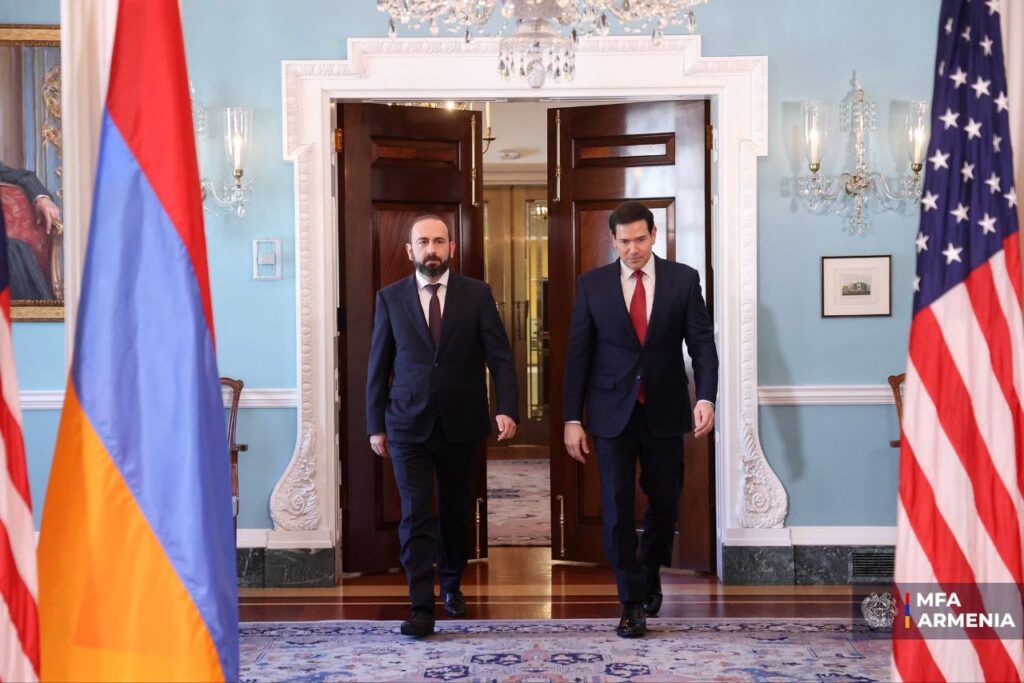
The meeting held in Washington between US Secretary of State Marco Rubio and Armenian Foreign Minister Ararat Mirzoyan was officially presented as negotiations. However, many experts have gained the impression that the Armenian side was simply presented with a pre-drafted document, with the expectation that it would be accepted without a genuine negotiation process.
According to Grigor Muradyan, former Deputy Minister of Justice and Director of the legal consulting firm “Justice Through Law,” the published joint statement contains almost no substantive clarity.
Absence of legal obligations
One of the most problematic aspects of the document, Muradyan argues, is its non-binding legal nature. The text explicitly states that it does not create and is not intended to create any legal obligations or commitments between the Republic of Armenia and the United States. In essence, the document lacks legal force and can only be regarded as a political memorandum.
At the same time, it is presented in the public sphere as a significant achievement, creating the impression that concrete obligations have been undertaken. According to the expert, this constitutes political manipulation.
Additional political pressure on Armenia
Muradyan notes that the document explicitly links its “success” to the institutionalization of a peace agreement between Armenia and Azerbaijan, as well as to progress in the full normalization of relations with Turkey. In practice, this means that additional political pressures are placed on Armenia.
Both Azerbaijan and Turkey, he recalls, have advanced preconditions, including demands for constitutional changes. If such changes are not implemented, the document’s logic implies that it will simply lose its “value.”
In this context, there is no indication of US readiness to exert pressure on Turkey or Azerbaijan in order to protect Armenia’s interests. There is not even a hint of Baku abandoning its demand for constitutional changes.
Referring to a recent statement by Turkish Foreign Minister Hakan Fidan, Muradyan emphasizes that Ankara expects the implementation of the so-called “Zangezur corridor” in a manner preferred by Azerbaijan. Such statements, he argues, clearly demonstrate the lack of genuine willingness among regional actors to make real compromises.
Electoral calculations
Muradyan concludes that at this stage the document primarily serves domestic political purposes. It may be used as a pre-election campaign tool, particularly by the authorities, while Armenia’s real interests are pushed into the background.
“Substantively, this document could have had serious significance if it were not entirely dependent on the prospects of peace with Azerbaijan and Turkey,” the expert stresses. However, this interdependence, in his assessment, effectively strips the document of meaning, turning it into a political declaration without real instruments.