
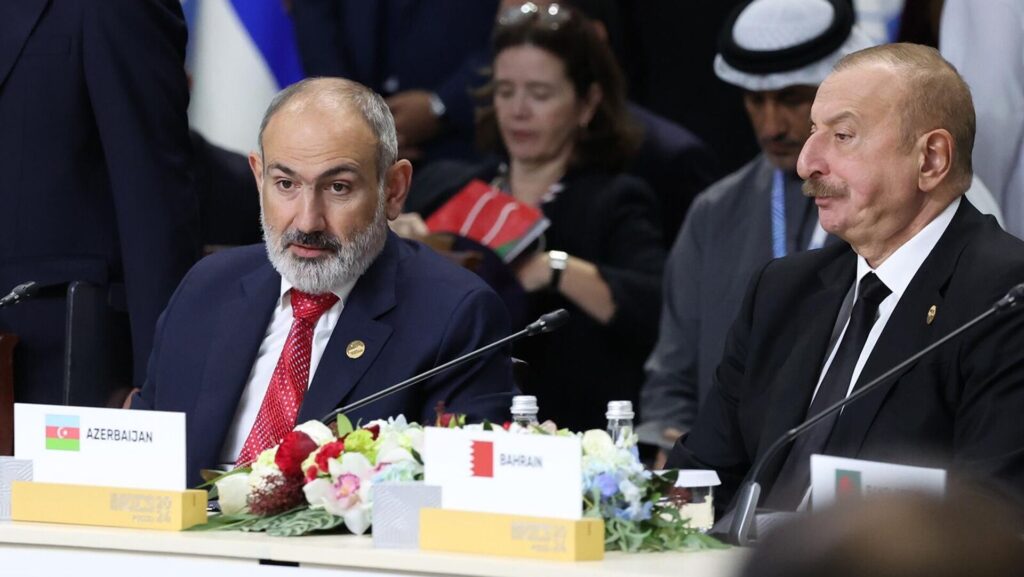
Recent statements from Baku and Yerevan are not a random coincidence but part of a clearly synchronized process. This opinion was expressed by political scientist Allen Gevondyan.
According to the expert, the rhetoric of both Pashinyan and Aliyev features mutually complementary messages that could become a key tool in the pre-election tactics for Armenia’s current authorities.
“Some changes in Aliyev’s lexicon were related to the topic of unblocking communications. He spoke about transit routes, but not about the trucks that should pass through Azerbaijani territory toward Armenia. This was undoubtedly a fairly positive signal—from the perspective of public support for the current prime minister’s policy,” Gevondyan noted.
In his view, Pashinyan will be able to “sell” this message at a very high price in the pre-election phase: “He excels at this sales element. In reality, all of this will serve domestic political interests, presented as an example of ‘peace’ and mutual agreements.”
Commenting on Pashinyan’s statement about the Margara–Yeghgnadzor–Sisian–Goris route, Gevondyan emphasized that it refers to a road project passing through Nagorno-Karabakh.
“He makes a counter-statement, but it’s important to understand that everything is synchronized—the content of the statements, their wording, and their chronology. This is a coordinated process,” the political scientist said.
Gevondyan also drew attention to other emphases in Aliyev’s press conference.
“He talks about grain, then about the Zangezur corridor. And it’s very symbolic that this all sounds precisely during the days of elections in Armenia. When Aliyev states that something is expected on the 28th, it’s a message that the power in Armenia should not change to preserve the so-called ‘peace.’ However, this peace is formal and fictitious,” he stressed.
According to the political scientist, the “peace” theme is often used for manipulation to accuse the opposition of seeking war:
“In reality, there are different forms of annexation in the world—military, economic, ethno-demographic, or those carried out through soft instruments. Today, Armenia is directly under the influence of several of them.”
Gevondyan believes Aliyev understands that a military attack on Armenia is not currently on the agenda.
“He knows there’s no need for it right now. He will step by step legitimize his actions across all platforms. And when it comes to the Zangezur corridor thesis—that is, the actual establishment of Azerbaijani sovereignty over Armenian territory—the current prime minister will show that he has no tools to resist, because the international community will perceive it as a fait accompli. The same happened with Artsakh,” he noted.
In Gevondyan’s assessment, the processes unfolding today indicate that the “peace” theme is turning into the main tool for regional political manipulation, while Armenian authorities, within this context, seek to retain their power—with international support.