
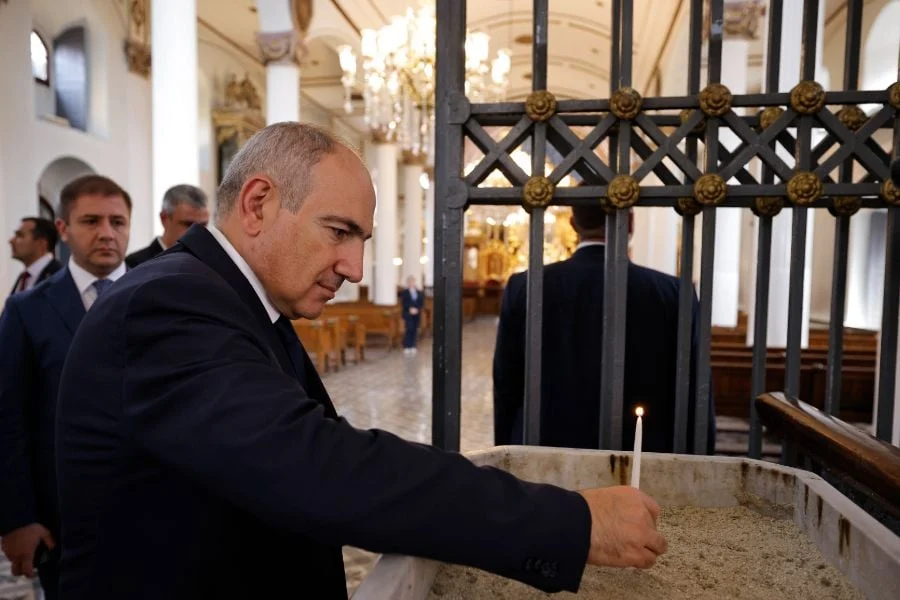
Prime Minister Nikol Pashinyan’s recently presented “roadmap for renewing the Apostolic Church of Armenia” does not simply propose reforms. It effectively changes the model of how the Armenian Apostolic Church (AAC) exists within the state. Renewal may be necessary with time, but when carried out through state mechanisms, it risks turning modernization into subordination. Most importantly, the attempt to implement these changes clearly violates the Constitution.
The Constitution: Church Self-Governance and Limits on State Interference
The Constitution of Armenia establishes two key principles.
First, the AAC is recognized as the national church and plays a special role in spiritual life, national identity, and cultural heritage.
Second, the Church is separate from the state. It operates freely, and its internal affairs cannot be regulated by the government.
This means the Constitution acknowledges the special status of the AAC but does not give the state the right to intervene in its governance, canons, leadership elections, property matters, or doctrinal issues. This balance forms the foundation of the state–church model in Armenia.
The Law on Freedom of Conscience and Religious Organizations also states that internal structures, statutes, and administration of religious communities must be defined by the communities themselves. The state has no authority to initiate or impose rules related to church hierarchy, leadership elections, or canonical law.
In the proposed roadmap, two points directly contradict these constitutional principles.
The most obvious one is the adoption of a new Canonical Book.
Drafting a new statute is an internal spiritual and administrative matter. If the initiative comes from the head of government rather than from within the Church, it represents an overreach of state authority. Pashinyan even notes that the government is ready to “assist” in its development.
Another contradiction is the proposal to organize the election of the Catholicos under new rules. Any reform of the mechanism for electing the Church’s leader — even under the label of “renewal” — strikes at the core of the AAC’s autonomy. When a new system appears as a political initiative, it raises a fundamental question: is the Church being transformed into an institution managed by the state?
Finances and Social Guarantees: Modernization or Dependence?
The proposal for tax reporting and tax refunds may appear as an attempt to make the Church’s finances more transparent.
However, the model where “the Church pays taxes and the state returns them” creates financial dependence on the government. This becomes a lever of influence over a spiritual institution.
Social guarantees for clergy — pensions, healthcare, benefits — look positive, but only as long as they do not become a tool of administrative control over the Church through the dependence of its clergy.
Politicization Under the Banner of Depoliticization
The paradox is that a program declaring the “depoliticization of the Church” is itself a political initiative.
Given the current tension between the government and the AAC, such a document cannot be perceived as neutral.
If the government “helps” draft the Canonical Book, takes part in forming temporary leadership, and influences the election of the Catholicos, the Church stops being an institution above politics. It becomes a component of political power.
Where the Church becomes dependent, it loses the ability to criticize the state.
Where the Church is not autonomous, believers lose the guarantee of spiritual freedom.
The result of such interference will be the weakening of the AAC’s institutional independence and the transformation of the Church into a structure partially managed by the government. Moreover, there will inevitably be those within the Church who reject externally imposed rules, deepening internal division — a division that is already visible today.
Lilit Avetisyan