
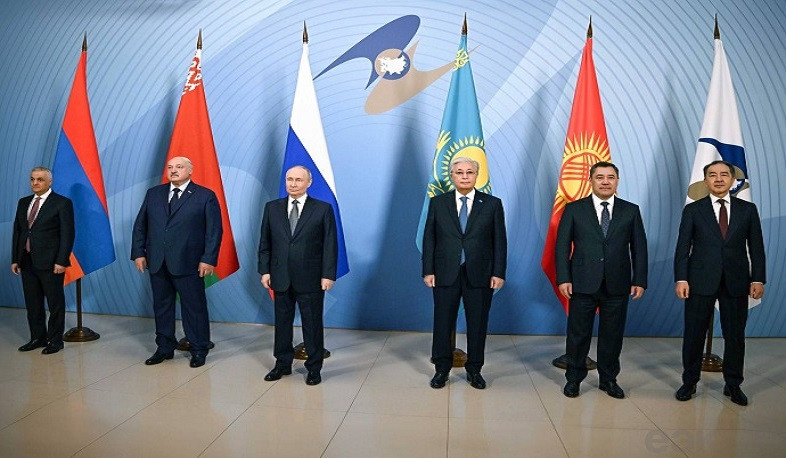
Statements made during the Eurasian Economic Union summit in Astana, including references to a possible referendum, should be viewed as political signals containing elements of pressure, according to Modus Vivendi Center director Ara Papyan.
Kazakhstan’s Position Draws Attention
Papyan notes that one of the most interesting aspects of the discussion is Kazakhstan’s participation in the message directed at Armenia.
According to him, Kazakhstan’s trade structure is significantly more diversified than Armenia’s.
China is Kazakhstan’s largest trading partner, the European Union ranks second, and Russia comes only third.
By contrast, around 41 percent of Armenia’s foreign trade is linked to Russia.
Moscow Remains the Main Actor
The analyst believes that Russia is the principal force behind the political message delivered in Astana.
He compares the situation to the Soviet-era practice of collective statements, where responsibility was intentionally shared among multiple participants.
In his view, Moscow wanted the signal to come from the entire union rather than from Russia alone.
Expulsion Is the Least Likely Scenario
Papyan recalls that the next EAEU summit is scheduled for December, when Armenia’s future status may receive greater attention.
Nevertheless, he considers Armenia’s removal from the union unlikely.
According to him, expulsion would represent Moscow’s most extreme option and would leave few additional instruments of pressure available afterward.
Economic Restrictions Are More Likely
The political analyst believes a gradual expansion of economic restrictions is a more realistic scenario.
He points to existing difficulties affecting Armenian exports such as flowers, fish, and agricultural products.
Additional measures, he argues, could be introduced under technical justifications related to quality standards or sanitary requirements rather than explicit political motives.
Papyan also does not rule out continued pressure through energy pricing mechanisms.
New Markets Are Essential
According to the analyst, Armenia should focus on developing new economic partnerships rather than concentrating solely on domestic political disputes.
He identifies the European Union and Gulf countries, including Saudi Arabia and the United Arab Emirates, as promising alternative markets for Armenian exports.
Food Security Remains Strategic
Papyan emphasizes that agriculture remains strategically important for Armenia.
As a small country facing logistical constraints, Armenia must pay particular attention to food security and market access for local producers.
In his view, government policy should prioritize protecting farmers from losing export opportunities and facing serious social difficulties.