
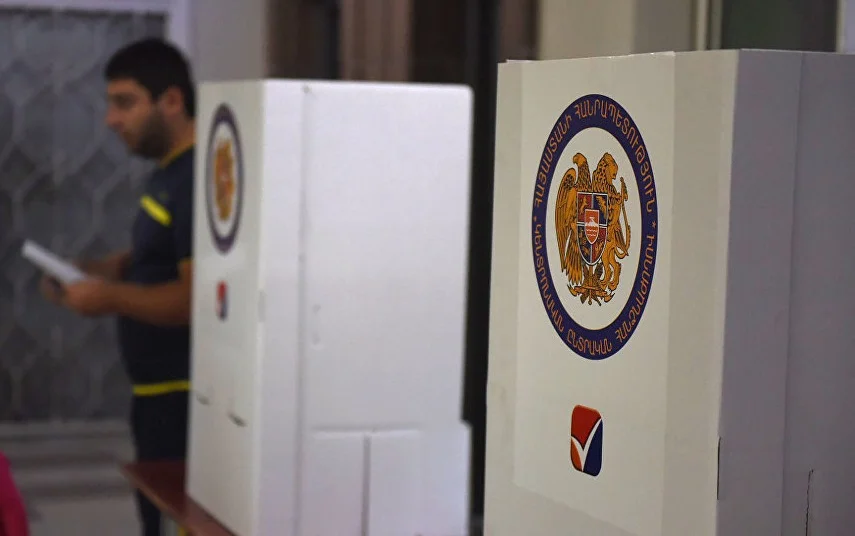
Armenia’s Central Electoral Commission has invalidated the voting results at three polling stations and announced that no repeat vote will be held.
According to a statement issued by CEC Chairman Vahagn Hovakimyan, invalidating voting results at a polling station does not automatically require the Commission to schedule a repeat vote. He argued that voters who participated in the main election cast their ballots at a time when the overall results were still unknown. They did not know which political force was leading, what the vote gap was, which parties would pass the electoral threshold, or how their vote would affect the final outcome.
“Participants in a repeat vote, however, would be voting under entirely different circumstances. The overall picture may already be known to them. In such conditions, voter behavior may be shaped not by their original political preferences and free choice, but by an intention to modify an already known result. This risk is commonly referred to as tactical voting,” he stated.
Political strategist Karen Kocharyan believes that nearly every election held in Armenia, with the exception of the 1991 presidential election and the 1990 Supreme Council election, has been accompanied by various irregularities, while only the methods of electoral manipulation have changed over time.
“In the 1990s it was ballot box theft, violence, and intimidation. Later, it became a matter of simply drawing the numbers. Then came the well-known era of vote-buying — more civilized in appearance, but no less problematic in terms of electoral fraud,” he said.
According to Kocharyan, it appears that the current authorities have carefully studied the manipulation techniques used by previous governments and decided to apply all of them at once.
Meanwhile, Daniyel Ioannisyan, Program Coordinator of the Union of Informed Citizens NGO, argues that repeat voting at individual polling stations is explicitly prescribed by Armenia’s Electoral Code and cannot simply be erased by a decision of the CEC.
He described Hovakimyan’s reasoning as manipulative, noting that under the Electoral Code, repeat voting at individual polling stations is always held two weeks after election day, when the overall results are already known to the public. Therefore, the possibility of tactical voting is an inherent feature of every such procedure.
“Moreover, repeat voting is specifically scheduled when the results of those polling stations are significant for the overall election outcome. In other words, under the Electoral Code, repeat voting at individual polling stations will always involve elements of tactical voting. If we follow the logic presented by the CEC, then repeat voting should never be conducted at all. The argument used by the Commission in this case applies equally to any hypothetical situation and directly contradicts the provisions of the Electoral Code,” Ioannisyan stated.