
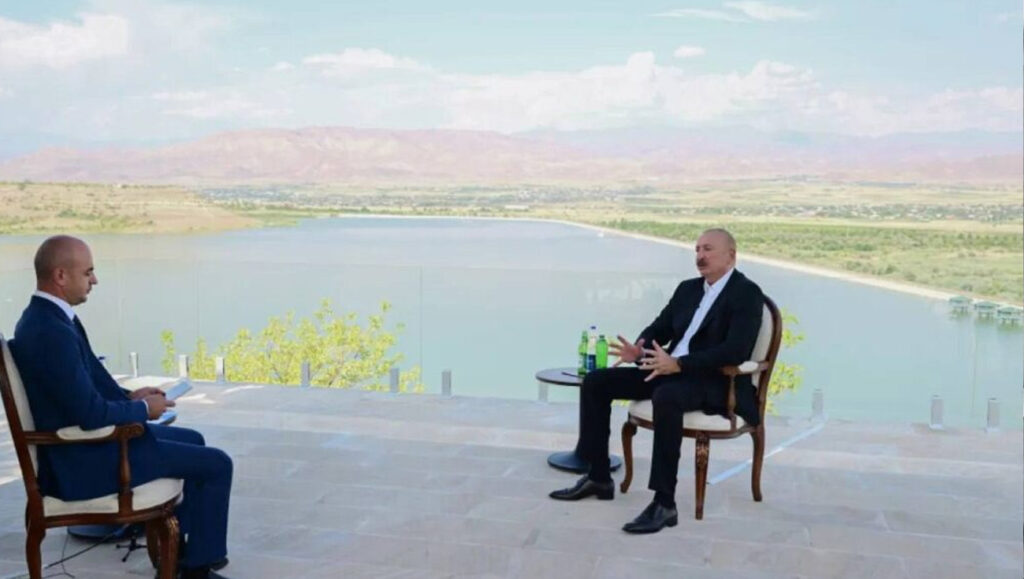
Azerbaijan is trying to convince Armenia that the proposed electricity corridor through Syunik primarily serves Armenia’s own interests, according to political commentator Artyom Yerkanian. In his assessment, the recent proposal made by Azerbaijani President Ilham Aliyev conceals an effort to weaken Armenia’s energy self-sufficiency and turn the country into an electricity importer.
Azerbaijan’s Electricity Proposal and Armenia’s Energy Security
“Azerbaijan’s goal is to turn Armenia from an energy self-sufficient state into an electricity-importing country,” the political commentator said.
According to him, such a situation would directly affect Armenia’s energy security and give Azerbaijan control over an energy “valve” that could later be used for political purposes.
Yerkanian also draws attention to the timing of the proposal, noting that it comes amid threats of an increase in the price of Russian gas supplied to Armenia. He recalled that electricity generation at Armenia’s thermal power plants depends heavily on Russian gas.
Azerbaijan Has Made Previous Offers in the Energy Sector
Yerkanian noted that this is not the first time Azerbaijan has made Armenia an energy-related proposal that may appear beneficial at first glance.
He recalled that last autumn Armenia purchased petroleum products from Azerbaijan, including 95-octane gasoline. At the same time, according to Yerkanian, Azerbaijan itself imports this type of gasoline from other countries.
“In other words, Azerbaijan buys it for money and then sells it to Armenia for money. Since it does not expect an economic benefit in this case, it naturally expects certain political benefits,” he said.
According to Yerkanian, the fact that Azerbaijan may take steps contrary to its own economic interests in pursuit of political objectives should be a cause for concern in Armenia.
Metsamor Nuclear Power Plant as Azerbaijan’s Next Target
Aliyev’s speech once again included a demand to shut down the Metsamor Nuclear Power Plant. The Azerbaijani president again claimed that the plant poses an environmental threat to the entire region and recalled that Azerbaijan and Turkey have repeatedly raised the issue.
According to Yerkanian, this issue may also be used to restrict Armenia’s energy capabilities. If Armenia abandons nuclear power while simultaneously becoming dependent on external electricity supplies, its energy autonomy would decline significantly.
He also questions Azerbaijan’s claims regarding the alleged dangers posed by the Metsamor plant, noting that the international organization competent to make such assessments is the International Atomic Energy Agency (IAEA).
IAEA Director General Rafael Grossi has stated that analyses conducted by the agency’s experts at Metsamor identified no danger to Armenia or neighboring countries.
Baku’s International Campaign Against Metsamor
At the same time, Azerbaijan continues its international campaign against the Metsamor Nuclear Power Plant, the expert notes.
Yerkanian recalled that Aliyev personally called for the plant’s closure during an international energy summit in Seoul.
Azerbaijani Ombudsperson Sabina Aliyeva subsequently appealed to the international community, claiming that Armenia’s nuclear power plant threatens the region’s environmental security.
Several Azerbaijani human rights and environmental organizations have also joined the Anti-Metsamor initiative, promoting the idea of making the Caucasus free of nuclear energy.
However, Yerkanian points to a contradiction: at the same time, Azerbaijan itself is preparing to build a nuclear power plant on its territory.
According to him, Aliyev confirmed last year that land had already been allocated near the village of Navai for the construction of a nuclear power plant, while millions of dollars had been earmarked from the state budget for the project.
The Espoo Convention Does Not Provide a Right of Veto
Addressing whether Azerbaijan has legal mechanisms to obstruct the construction of a new nuclear power unit or small modular reactors in Armenia, Yerkanian notes that Baku frequently refers to the Espoo Convention.
According to the political commentator, the convention does not give a neighboring country the right to veto the construction of a nuclear power plant on another state’s territory. It primarily establishes obligations concerning transboundary environmental impact assessments and the provision of relevant information to neighboring states.
Therefore, Armenia is not required to obtain Azerbaijan’s permission to build a new power unit or modular reactor on its territory.
At the same time, according to Yerkanian, Azerbaijan may attempt to use provisions of the convention to prolong the process by raising additional questions and creating new obstacles.
As an example, he cites a statement by Adil Garibov, head of the Nuclear Research Center under Azerbaijan’s Ministry of Energy, who said Azerbaijan should consistently raise new questions within the framework of the convention.
Yerkanian believes the statement indicates that Baku intends to use international and legal mechanisms to oppose Armenia’s new nuclear energy projects for as long as possible.