
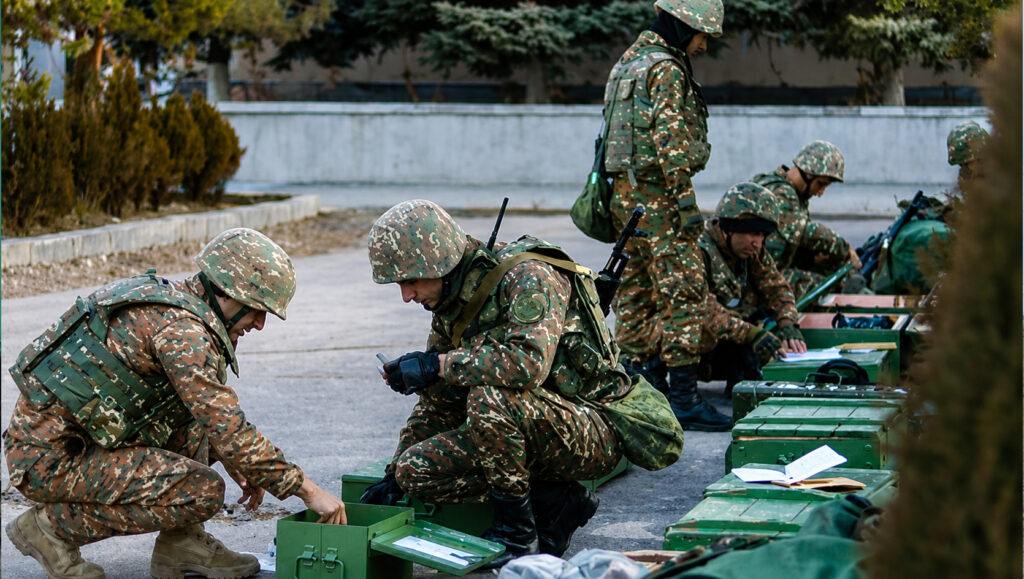
Military training camps held in Armenia do not serve their primary purpose. This view was expressed by expert and former chairman of the Military Industry Committee Avetik Kerobyan. According to him, participants do not return from the camps with new military skills and updated knowledge, while the organization of the camps often becomes a means of filling existing personnel and service gaps in the army.
25 Days With Zero Results
According to Kerobyan, the main problem with military training camps is that participants do not acquire the skills necessary to work with new equipment and operate under combat conditions.
In his assessment, most participants spend a significant portion of the 25-day training period in tent camps or on duty at military positions, while only limited time is allocated to firearms training.
“Ninety-nine percent spend part of those 25 days sitting idle in a tent camp. At best, they are given half a magazine of ammunition to fire. They spend the remaining 15 days at a position,” he said.
Kerobyan also sees a problem in the fact that different positions have different conditions, while virtually the same approach is applied to all participants in the training camps.
Training Camps Fill Personnel Gaps in the Army
According to the expert, one reason reservists are sent to military positions is the shortage of personnel in the active army.
He noted that the number of permanent-service military personnel is insufficient to adequately staff all positions. As a result, participants in military training camps are assigned to positional duty instead of acquiring new military skills.
According to Kerobyan, the same problem exists in the organization of compulsory military service, with conscripts spending extended periods alternately at positions and military units.
“New military skills are not being developed, and people are not developing new capabilities,” he noted.
Soldiers Must Know the Route to Their Positions by Heart
Kerobyan emphasized the need for training that would enable soldiers to operate in situations requiring an organized retreat or relocation to the next defensive line.
According to him, a servicemember should know in detail the final few kilometers leading to their position, including the specific characteristics of the route.
“There should be prepared second and third defensive lines along that route. A soldier must be able to travel that route in the dark, in the cold, during the day, and in winter,” the expert said.
According to him, servicemembers must be able to navigate the terrain under any conditions and use its characteristics to organize their defense as effectively as possible.
Kerobyan believes such training can be conducted in small special-purpose units, but this systematic approach should be applied on a broader scale.
Training Camps Should Become the Foundation of Territorial Defense
According to Kerobyan, the original concept of military training camps was not intended to supplement the active army’s routine duties but to help form territorial defense forces.
In his assessment, participants should be incorporated into specific territorial defense units and trained to carry out defensive tasks within their respective areas.
However, he said that they currently continue to operate primarily according to the logic of linear defense. “Today our army still holds a kilometer, not a square kilometer. A kilometer in length, rather than a square kilometer of territory,” he noted.
According to Kerobyan, an effective territorial defense system requires the creation of units with stable personnel structures that are continuously supplied with personnel and the necessary equipment.
Kerobyan said there is considerable evidence of problems with the effectiveness of military training camps. He stressed that even the condition of some military positions and the current organization of positional duty prevent the camps from being conducted fully and effectively.
According to him, if military training camps are to become one of the foundations of Armenia’s territorial defense system, their purpose must change, transforming them into long-term, systematic and specialized training.