
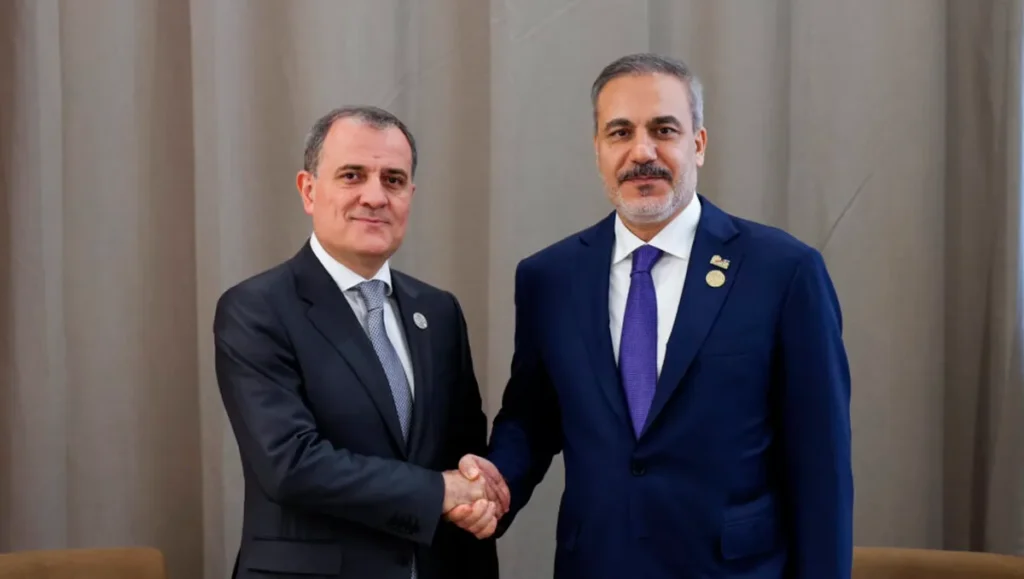
The security and geopolitical situation in the South Caucasus has changed substantially, and a fragile peace has emerged in the region. However, speaking of guaranteed peace at this point would simply be naive. Regional affairs expert Armen Petrosyan made this statement.
According to him, in the context of the changes that took place in the South Caucasus after the 2020 war, Turkey and Azerbaijan attempted to revive the “3+3” format, which had emerged in the early 2000s.
However, since the start of the war in Ukraine, this format has gradually been fading. According to Petrosyan, this is not due solely to a lack of interest among the participating countries. He says Turkish policy is driven by a deeper process of transforming its own role in the region.
Turkey Is Trying to Promote a “1+3” Format
“Turkey wants to become the initiator of promoting a ‘1+3’ format in this region,” Petrosyan said.
According to him, Turkey has the necessary capabilities to do so. Ankara’s relations with Georgia are at a fairly high level, its relations with Azerbaijan remain strategic and allied, while a normalization process is underway with Armenia.
According to the expert, at a certain stage the logic was that Turkey should make maximum use of the favorable situation that had emerged in the region and the world, without losing time and while strengthening its position in the region.
In his view, this should also have involved Turkey pursuing a more independent policy and advancing the Armenia-Turkey normalization process.
“But we saw a different policy,” Petrosyan said.
According to him, Turkey is also shaping its repositioning policy under the influence of the Armenia-Azerbaijan normalization agenda.
“Turkey Is Not Acting Like a Major Regional Power”
Petrosyan noted that in some cases Turkey is not acting like a major power in the region.
“Turkey is effectively not acting like a major regional power, but instead gives in, for example, to the blackmail, conditions, demands and so on of Azerbaijan’s leadership,” he said.
At the same time, according to the expert, the underlying aspects of Turkish policy that had previously not been fully visible are gradually becoming clearer.
Petrosyan believes Turkey is attempting to advance the conditional “1+3” format primarily through its allied relationship with Azerbaijan.
He sees manifestations of this process in the continuing meetings between the leaders of Turkey and Azerbaijan, including negotiations taking place in Baku, as well as meetings held in Turkey and the new agendas emerging between the two countries.
According to Petrosyan, Turkey is attempting to advance its agenda simultaneously at several levels.
“In addition to the political level, there is the economic one, and one of the most important is the military level,” he said.
Guaranteed Peace in the Region Is Not Possible to Speak of at This Point
According to the expert, it is currently impossible to speak of guaranteed peace in the region.
“At this point, in this region — both in the South Caucasus and in the much broader region — speaking about any kind of guaranteed peace or any diplomatic processes is simply naive,” Petrosyan said.
According to him, regional actors are preparing for possible military escalations while taking various factors into account.
In this context, he highlighted the Iranian factor as well as the question of whether Russia’s role could become more active or more passive.
Petrosyan believes Turkey is currently pursuing its policy with Azerbaijan “at a very harmonious, mutually coordinated level.”
He also bases this assessment on the recent political steps taken by Turkey and Azerbaijan.
“We see that it is nevertheless Turkey that is delaying the normalization process with Armenia, and recently, especially, we have once again seen destructive political approaches and steps by Azerbaijan, particularly at the level of political rhetoric and propaganda,” Petrosyan said.