
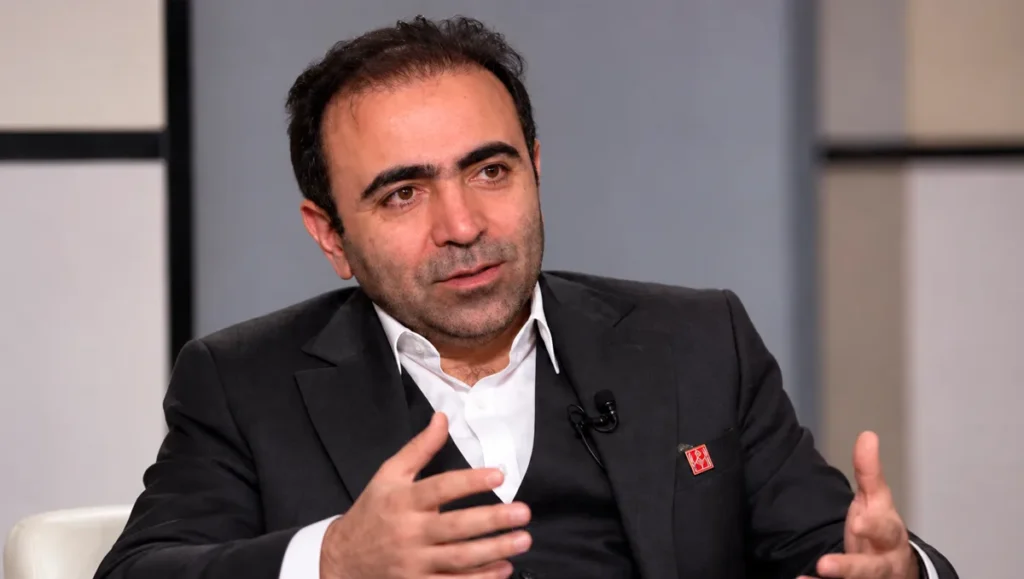
Armenia has been guided not only by economic interests in deciding to join the TRIPP project. The decision is also driven by a desire to overcome Armenia’s geopolitical deadlock and safeguard national sovereignty amid external pressure. Iranian Ambassador to Armenia Khalil Shirgholami made this statement while discussing TRIPP, the opening of communications between Armenia and Azerbaijan, and US involvement in the region.
According to the ambassador, a sense of “geopolitical suffocation” has been evident at various stages of Armenia’s history. This situation has contributed to the view that Armenia should use its potential to put an end to this geopolitical deadlock.
Shirgholami believes this approach, no less than economic considerations, played a role in Armenia’s willingness to join the project connecting Nakhichevan with the territory of Azerbaijan.
“To what extent TRIPP can help put an end to this sense of geopolitical suffocation is a debatable question. There are disagreements on this issue, and time will show to what extent this objective can be achieved,” the Iranian ambassador said.
Iran Has Firmly Opposed the “Zangezur Corridor”
Shirgholami recalled Azerbaijan’s demand for a “Zangezur Corridor,” noting that the concept included “non-conventional sovereignty” components that posed a threat to Armenia’s national sovereignty.
According to the ambassador, this was precisely why Iran firmly opposed the idea of the “Zangezur Corridor.”
“We have firmly opposed the idea of the ‘Zangezur Corridor’ because we believed that this project contributed to weakening Armenia’s national sovereignty,” Shirgholami said.
He stressed that Iran’s position contains no ambiguity.
“Armenia’s national sovereignty and territorial integrity are a red line for the Islamic Republic of Iran,” the ambassador stated.
According to him, Iran does not currently want to make premature judgments about TRIPP. However, if a situation arises in which Armenia’s territorial integrity or national sovereignty is adversely affected, Iran will “naturally take a very firm position.”
US Presence on Iran’s Border Has Raised Serious Concerns
The Iranian ambassador separately addressed US involvement on Armenian territory in the context of TRIPP implementation.
According to him, Iran has had serious concerns about the presence of Americans on the Armenia-Iran border and has communicated those concerns to the Armenian side.
Shirgholami linked this to the “hostile attitude” of the United States, particularly the Donald Trump administration, toward Iran.
“Considering the hostile attitude of the United States, and especially the Trump administration, toward the Iranian people, we have had serious concerns regarding the presence of Americans on the Armenia-Iran border, and we have communicated them,” he said.
At the same time, the ambassador stated that the “friendly and brotherly relations” between Iran and Armenia allow the two countries to manage this issue.
According to him, it is still impossible to say clearly to what extent the US presence in the TRIPP implementation process could affect Armenian-Iranian relations. That, he said, will become clear over time.
Tehran Calls for an Institutional Mechanism With Armenia
Shirgholami noted that managing Iran’s concerns surrounding TRIPP requires the creation of a special institutional mechanism with the Armenian government.
“The best way to address the concerns of the Iranian side is to establish a joint institutional mechanism with the Armenian government through which we can exchange views, present our concerns, discuss existing issues and manage emerging problems,” he said.
According to the ambassador, the need for such a mechanism is already apparent.
At the same time, he noted that there are differing views on TRIPP even within Armenia.
According to Shirgholami, Armenia’s national interest is of vital importance to Iran because the Iranian side views Armenia as a single people and a civilizational entity.
In Exchange for the Baku–Nakhichevan Link, a Railway to Iran
The Iranian ambassador stated that Tehran has supported the “Crossroads of Peace” concept, but, in his words, a crossroads must operate in all directions.
He stressed that if Armenia, within the framework of TRIPP, helps establish a land connection between Baku and Nakhichevan as part of the peace process, Azerbaijan must also play its part.
Specifically, Azerbaijan should enable the creation of a railway connection between Armenia and Iran through the territory of Nakhichevan.
“Just as Armenia responsibly supports the project and seeks to help Azerbaijan establish a land connection between Baku and Nakhichevan, thereby contributing to the peace process, the Republic of Azerbaijan should likewise responsibly ensure the possibility of a railway connection between the Islamic Republic of Iran and the Republic of Armenia through the territory of Nakhichevan,” Shirgholami said.
According to him, establishing the Julfa–Yeraskh railway connection could provide Armenia with new transit opportunities, turning it into an important link on the route connecting the Persian Gulf and the Indian Ocean with the Black Sea.
TRIPP Mechanisms Should Strengthen, Not Weaken, Armenia’s Sovereignty
Shirgholami emphasized the importance not only of implementing TRIPP itself but also of the mechanisms through which it will operate.
According to him, these mechanisms “are in themselves just as important as the implementation of the project itself.”
“These mechanisms must be designed to strengthen and stabilize Armenia’s national sovereignty and territorial integrity,” he said.
At the same time, according to the ambassador, the mechanisms should provide economic benefits for Armenia.
He stressed that “extremely great” attention must be paid to this issue because clearly defining the mechanisms is one of the project’s key questions.
According to the ambassador, Armenia’s authorities, as he understands it, still do not have a complete and comprehensive understanding of TRIPP’s implementation mechanisms.
“So far, as I understand it, Armenian officials still do not have a complete and comprehensive understanding of where these mechanisms will lead,” he said.
For Iran, This Is a “Historic Test” of Armenia’s Strategic Choice
Shirgholami also described TRIPP as a “historic test” for Armenia to determine how much strategic vision the country has regarding its present situation and future.
According to him, the Armenian government must be able to manage this sensitive issue in a way that simultaneously provides economic benefits for the Armenian people, does not harm the country’s territorial integrity and national sovereignty in the long term, and enables it to manage relations with its neighbors.
“The project can be assessed as a historic test to understand how much strategic vision Armenia has regarding the current situation and the future,” the Iranian ambassador said.
He stressed that Iran stands alongside Armenia and wants to see a strong and prosperous Armenia.
“In the short term, regardless of the various existing concerns and issues, in the long term and in our vision of the future, the Islamic Republic of Iran always wants to have beside it a strong, prosperous Armenia with a national identity,” Shirgholami concluded.