
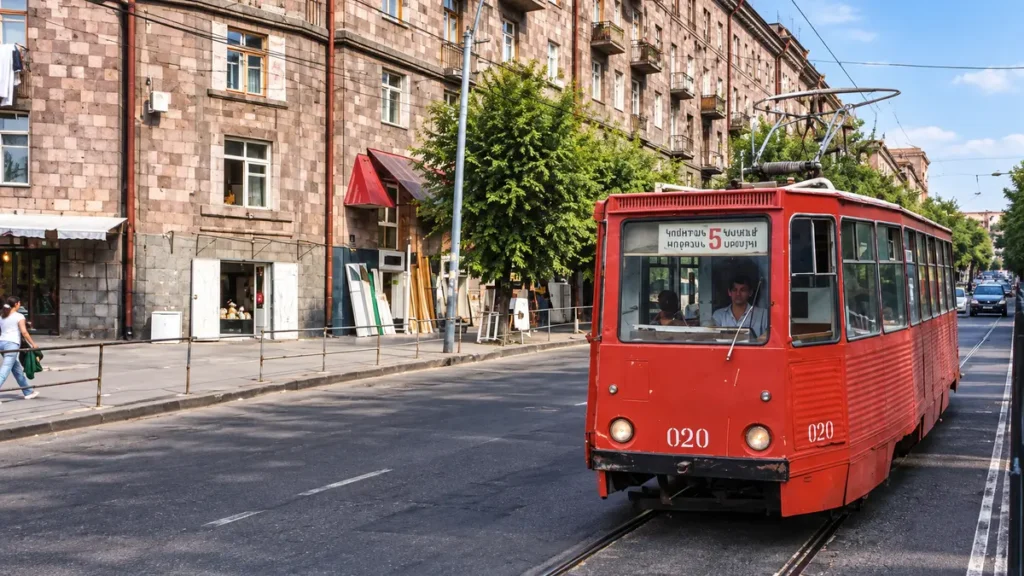
The Yerevan authorities plan to introduce dedicated public transport lanes running along the centre of the carriageway. Komitas Avenue will be the first street affected. Mayor Tigran Avinyan has announced preparations for a complete reconstruction of the streets, including dedicated bus lanes and paths for bicycles and scooters. The project also includes the complete renovation of pavements, the relocation of overhead cables underground and the replacement of trees that are no longer viable. The approach to landscaping will also be reconsidered: undeveloped patches of land are to be replaced with systematic solutions incorporating trees, shrubs and other greenery.
In connection with the planned changes, residents of the capital are concerned that narrowing the traffic lanes to accommodate a dedicated lane in the centre of the road is risky and could cause even more severe gridlock on Komitas Avenue. Passenger safety problems could also arise when people board and leave buses. Environmental activists warn that mature trees will become victims of the project. As a result, the city could lose a significant part of its green infrastructure while failing to resolve the capital’s main problem—traffic congestion.
Our interviewee, Elena Bolotova, an architect and urban planner specialising in linear infrastructure, also believes that the proposed project will not resolve congestion on Yerevan’s streets.
— Narrowing the lanes and creating a dedicated bus lane is only a half-measure given the volume of traffic in Yerevan. Congestion will also develop in the dedicated lanes because of taxis and public transport. Vehicles stopping to pick up and drop off passengers will create additional bottlenecks and force other motorists to make unnecessary lane changes.
The problem must be addressed by examining its root cause—the required volume of passenger transport. Accordingly, the city must look for a form of transport capable of carrying the largest possible number of passengers at the same time. The best option for Yerevan is to restore its tram lines.
— You say the proposed measures will not solve the problem as effectively as trams would. However, the tracks on the capital’s streets were dismantled long ago. How technically and financially realistic would it be to bring trams back today, and why does the municipality persistently choose buses instead of rail transport?
— Removing the tram system from Yerevan was an urban-planning mistake. It appeared that removing the tracks would create more lanes for vehicles and solve the congestion problem. However, that was a short-sighted decision. Cars still ended up stuck in traffic, together with the city’s entire passenger transport system.
Yerevan was not the first city to make this mistake. London and Paris also abandoned their trams at one point, but they have since brought them back and are happy with them again. In Moscow, we also believed that the metro would replace the tram. We managed to recognise the mistake in time, although several lines had already been lost.
We are now bringing trams back and launching new cross-city routes connecting different parts of Moscow. Some sections are served by trams operating autonomously without overhead power lines. These routes are in extraordinary demand. Passenger numbers on the newly launched lines are several times higher than expected. The effect has been remarkable.
For some reason, city residents are very fond of trams. They will choose them over every alternative, even if the journey takes longer. There is something magical about trams.
More seriously, it is important to understand that a tram will always outperform a bus in terms of capacity. One tram can carry as many passengers as two or three buses operating on the same route. A tram does not weave within its lane or create unnecessary obstructions for other road users.
Restoring tram tracks will, of course, require investment. The city will have to pay for its earlier mistake. In the long term, however, trams justify the expense and resolve traffic-flow problems far more effectively.
— Activists from the Green Yerevan organisation are raising the alarm. To make way for new infrastructure and renovated pavements, the city is reportedly prepared to cut down around 600 century-old elm trees. These account for more than half of the avenue’s entire green stock and provide vital shade during the summer heat. From the perspective of modern urban planning, how should a specialist approach street reconstruction to preserve this green shield first and then solve the transport problems around it? What should the main principle be to ensure that the project does not determine the trees’ fate, but that the existing century-old elms determine the design of the new roads and stops?
— Urban-planning decisions are such that the cost of a mistake can be extremely high and even irreversible. Trams can be brought back, but trees naturally cannot. This is obvious to any professional in our field, and there is nothing to debate.
What is needed is dialogue between specialists and the authorities, ensuring that the professional position of the former becomes the foundation for decisions made by the latter. There should be no other approach, particularly in capital cities.
Incidentally, Yerevan’s first electric tram began operating in 1933. By the mid-1980s, the city’s tram network had 12 regular routes, while the total length of its tracks reached 96 kilometres. At that time, the city’s rolling stock included as many as 230 tramcars.
A distinctive feature of the network was that tram lines ran along Komitas Avenue towards distant districts that could not be reached by metro. There were also cross-city routes directly connecting large residential areas without passing through the city centre.
The dismantling of Yerevan’s tram system began in the early 2000s. The city authorities cited plans to widen roads as an official reason for closing the system. They also pointed to the extremely high cost of electricity, which made tram operations 2.4 times more expensive than bus services.
Tram services in Yerevan ended permanently on 21 January 2004. The city’s remaining lines were subsequently dismantled.
Paris completely covered its tram rails with asphalt in 1938. However, trams made a triumphant return to the French capital in 1992.
London launched the official Operation Tramaway programme and sent its last tram to the depot in 1952. The system was revived in 2000, demonstrating that a metropolis cannot function without rail-based transport.
Prepared by Marina Brutyan