
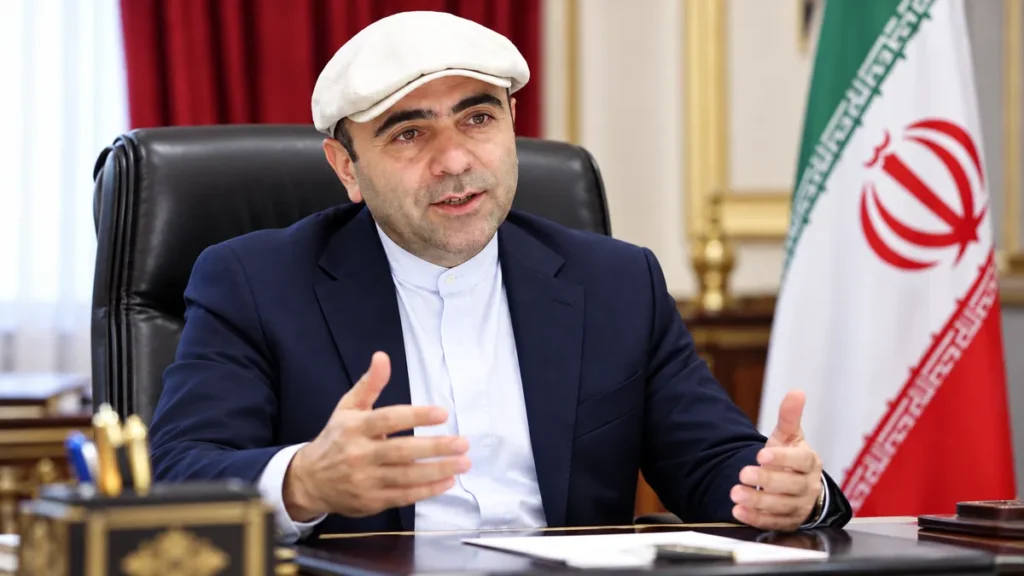
Iran is attempting to use Yerevan to establish a new dimension of cooperation in its relations with the European Union by taking advantage of disagreements between the United States and Europe on certain strategic issues. Political commentator Hakob Badalyan believes this signal is quite clear in the statements made by Iranian Ambassador Khalil Shirgholami and is particularly noteworthy given Tehran’s currently difficult relations with European countries.
What Was the Ambassador Implying?
Badalyan recalled that the Iranian ambassador said the approaches of the European Union and Iran to regional developments, including the Armenian-Azerbaijani peace process, had significant similarities.
According to Badalyan, this was a rather unexpected statement because Iran had apparently not previously spoken with such an emphasis about the European Union’s approaches and role.
“The Iranian ambassador’s statement is also noteworthy considering that Iran currently has rather difficult relations with these same European countries or, at least, with many of them,” the political commentator said.
According to him, many European countries have imposed sanctions on Iran, including over the continued closure of the Strait of Hormuz. The closure of the Strait of Hormuz, with the main restriction naturally imposed by Iran, is creating extremely serious energy problems for the European Union.
Badalyan said the ambassador was implying or declaring that Iran understood Yerevan’s strategic challenge of finding different connections and routes to international markets as a landlocked country. According to the political commentator, this naturally also implies relations with the European Union.
“At least in the underlying message of the ambassador’s statement, Iran is proposing that this work be considered within the logic of connecting different regions and serving as a transport link, thereby ensuring qualitative growth in the Armenian-Iranian strategic partnership and institutional relations,” Badalyan said.
The Trump Route as a Strategic Challenge for Iran
According to Badalyan, the ambassador’s statement is interesting in the context of Iran’s position on the Trump Route. Tehran has consistently said that a US military presence is unacceptable to Iran.
Badalyan believes this does not merely concern the presence of US armed forces or a state security body in the legal sense of the term.
“There is no doubt that any other security organization established within the framework of the Trump Route would imply an American military presence, if not an American-Israeli or simply an Israeli military presence,” he noted.
According to Badalyan, different configurations can be envisaged, but in every case they would represent a strategic challenge to Iran, and Tehran has consistently acknowledged this challenge.
At the same time, the political commentator finds it significant that, against this backdrop, Iran is using a discussion platform in Yerevan to send a noteworthy signal through its ambassador to European countries, the European Union and some of its members.
“That is, of course, if there are elites in the EU prepared to perceive, accept and politically process these signals,” Badalyan observed.
Iran Seeks to Exploit US-European Differences
Badalyan said that, considering Iran’s position on the American presence within the Trump Route, the ambassador’s signal to Europe was particularly interesting. American and European interests are clearly colliding over the Trump Route project, infrastructure passing through Armenian territory and the Middle Corridor more generally.
According to him, this reflects Trump’s competition with the European Union’s current governing elites, which have replaced Europe’s liberal-globalist elites.
“The Europeans are essentially being left out of the competition for the Middle Corridor, at least from a legal perspective, because the United States has secured its rights through the Trump Route. Europe has practically no legally established rights here, although it has fairly extensive involvement in terms of rhetoric or certain declarative structures. But that is insufficient. What matters on the ground is the legal right, which the European Union does not possess today,” Badalyan said.
Against this backdrop, Badalyan believes Iran is probably trying to exploit US-European differences and the competition over the Middle Corridor to give its Caucasus policy a new degree of flexibility.
“In effect, it is proposing cooperation with the European Union through Yerevan,” he said.
Through Yerevan to the European Union and, More Broadly, to Russia
According to Badalyan, the response this proposal receives from European elites will also depend on how seriously those elites can consider the necessity of relations with Russia in the context of Europe’s security architecture.
He emphasizes that when examining Iran’s regional policy, one must no longer overlook its key component: the comprehensive strategic partnership treaty between Russia and Iran. It was concluded on 17 January 2025 and entered into force that same year after being ratified by both Russia and Iran.
According to Badalyan, the treaty substantially determines Iran’s regional role not only in the Caucasus but also, to some extent, in the Middle East and Central Asia. From this perspective, he believes Iran is attempting to make a highly complex proposal to the European Union through Yerevan.
“Perhaps Iran is also considering establishing relations with the European Union through Yerevan in this way and, in a broader sense, facilitating a possible conversation between the European Union and Russia through Iran, given that such a dialogue has so far failed to emerge through any other channel,” Badalyan said.