
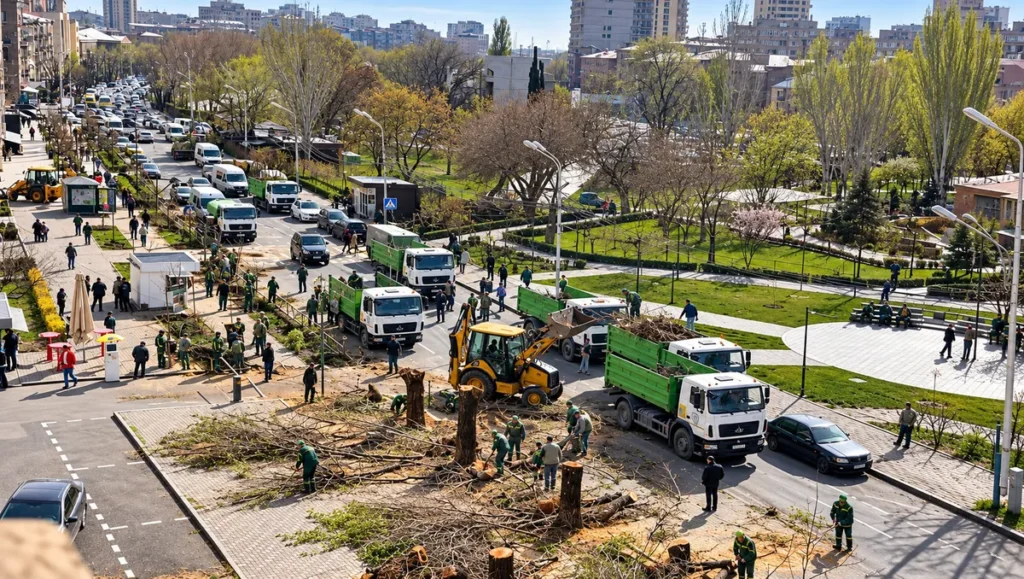
Yerevan has found itself at the center of global attention: the capital of Armenia is hosting the 17th Conference of the Parties to the UN Convention on Biological Diversity (CBD COP17). The international environmental summit, held under the slogan “Taking Action for Nature,” has brought together more than 15,000 delegates, scientists, and world leaders. Yet while the city has been presented on the international stage as the planet’s environmental capital, developments within Yerevan itself are raising questions about the local authorities’ commitment to the green values they publicly promote.
The issue is the widespread and systematic felling of mature, spreading trees — including elms, ash trees, and maples — that have grown for decades along Yerevan’s main streets and in residential neighborhoods. The municipal administration and the municipal non-profit organization “Greening and Environmental Protection” justify these actions as part of a large-scale “greenery replacement program.” Officials claim that the trees have reached the end of their biological lifespan, are deformed, or have been infested with pests, and therefore need to be replaced with ornamental saplings such as cherry blossoms, spherical catalpas, and Judas trees. In many cases, century-old tree canopies are also being destroyed to meet infrastructure needs: widening roads, creating parking spaces, or building new bicycle lanes.
This policy has met with strong resistance from civil society, independent environmental experts, and local residents. Civic initiatives and specialists are sounding the alarm because perfectly healthy, viable mature trees are regularly being cut down. In Yerevan’s sharply continental climate, where summer temperatures regularly exceed +40°C, destroying large tree canopies deprives the city of natural shade. Replacing century-old trees with fragile ornamental saplings has already contributed to a sharp deterioration in air quality and intensified the urban heat island effect, turning streets into blazing furnaces and threatening the health of vulnerable groups, particularly children and older people.
Françoise Jacob, the UN Resident Coordinator in Armenia, previously acknowledged in a conversation with media representatives that Yerevan is a unique natural area, but that today it is not in particularly attractive condition.
“There is a large-scale program to improve and restore it, involving Yerevan Municipality, the UN, and the Asian Development Bank. That is good, but I think this area should remain as natural as possible. Many of the buildings constructed there should never have been there in the first place. There are cities around the world with similar gorges that have managed to turn them into beautiful natural spaces where people come on weekends to cycle, walk, play, and simply spend time. Yerevan really needs a development plan based on the principles of sustainable development,” Jacob said. She added that whenever she hears the claim “we have planted 10 million trees,” she always asks: “And how many of them are still alive?”
Back in 2025, Jacob publicly stated that Yerevan had the worst air quality in the South Caucasus.
While century-old tree-lined avenues are being cut down in Yerevan to make way for roads, European cities are striving to meet entirely different standards. One prominent example of a science-based approach is Poland’s large-scale government program, the “City with a Climate” project. The initiative examined how to protect residents from the adverse effects of climate change. Funded by Poland’s National Fund for Environmental Protection and Water Management, the project had a budget of more than 6 million zlotys.
It was an unprecedented independent assessment of Polish cities in terms of scale. A team of scientists evaluated how effectively cities could cope with the adverse effects of climate change. The project did more than offer theoretical recommendations: researchers developed an individual “Transformation Roadmap” (MDT) for each city. Using satellite imagery, meteorological data, and thermal radar, they assessed the extent to which urban soils were being sealed — including by asphalt — the level of heat risk faced by vulnerable populations, and the boundaries of surface urban heat islands (PMWC), where streets become blazing furnaces.
Vectors.am spoke with the project’s co-authors.
The Polish scientists were candid that, without a detailed analysis of Yerevan itself, they could not provide a precise assessment of the Armenian capital. However, the fundamental scientific principles of urban planning and climatology they shared amount to a serious and uncompromising indictment of the policies currently pursued by Yerevan Municipality.
Our questions were answered by Michał Marcinkowski, head of the Climate Change Adaptation Department at Poland’s leading environmental research institution, the Institute of Environmental Protection – National Research Institute (IOŚ-PIB), and Dr. Bożena Kornatowska, a specialist in natural resources.
Vectors.am: In your opinion, can the heat-risk assessment tools and blue-green infrastructure development methods your team at the Institute of Environmental Protection (IOŚ-PIB) developed for Polish cities be effectively adapted to the realities of a southern, highly urbanized, and arid city such as Yerevan? Are there any international cooperation mechanisms or grant programs you know of through which we could benefit from your methodological expertise?
Michał Marcinkowski: In my opinion, one of the greatest strengths of the “City with a Climate” project — whose full title is “Strategic Consulting under the ‘City with a Climate’ Project” — was the involvement of experts from various disciplines working with Poland’s leading research institutions. The Institute of Environmental Protection – National Research Institute served as the project leader. Our partners were the Institute for Ecology of Industrial Areas, the Forest Research Institute, and the National Centre for Nuclear Research. This made it possible to provide cities with expert support tailored to their actual needs, which vary depending on a city’s location, size, and specific characteristics.
The main outcome of this initiative was the development of roadmaps to help cities transform toward climate neutrality. These roadmaps, however, were based on numerous expert assessments and thematic studies. Most of these studies did not produce a specific tool; instead, they proposed a particular methodological approach. I am convinced that this approach can be successfully applied in other cities as well.
An extremely important element must be considered here: the underlying data. Representative, up-to-date data with appropriate spatial resolution are essential for producing high-quality analytical results. For example, in my field of expertise, water management, our analyses of rainwater took into account information on terrain, land cover and development — both current and planned for the coming decades — geological structure, soils, and the hydrological and meteorological conditions recorded around each city over recent decades. However, detailed climate-change projections developed by experts specifically for Poland, with high spatial resolution, were crucial.
It is difficult for me to identify specific international cooperation mechanisms that would facilitate collaboration between our countries. However, I can say with complete confidence that any cooperation is important and brings substantial benefits to all parties. For example, our Institute is currently organizing a National Adaptation Hub in Poland. This is part of a broader European initiative, National Adaptation Hubs, implemented by more than 30 partners. Similar adaptation hubs are also being established in other countries. Our cooperation enables us to exchange experience and apply the best and most effective solutions not only within individual countries but across Europe as a whole.
Vectors.am: In Yerevan, the felling of old elms and ash trees is often justified by the municipal authorities on the grounds of their age and disease, while small ornamental trees, such as cherry blossoms, are planted in their place. How many decades does a young ornamental tree need to reach even half the compensatory and cooling effect provided by a single mature, spreading tree? Do your models confirm that such a sharp and radical change in the structure of urban greenery harms the health of vulnerable groups — older people and children — in the short term?
Bożena Kornatowska: The Institute of Environmental Protection – National Research Institute (IOŚ-PIB) has not conducted detailed studies or modeling of the consequences of replacing mature trees with young plantings. In other words, we do not have results that would allow us to determine how long young trees need to restore the climate-regulating functions of mature trees in an urban environment.
Scientific research indicates that mature trees with spreading canopies play a significant role in shaping the urban microclimate, primarily by shading surfaces and cooling the surrounding environment through transpiration. Replacing them with young trees means losing a substantial portion of these benefits. It takes many years for new plantings to provide a comparable cooling effect, and the time required also depends on the eventual size of the trees’ canopies.
The rate at which young trees begin to deliver microclimatic benefits depends primarily on the species, growth rate, and canopy size, as well as local growing conditions and climate. Available modeling methods can estimate how the cooling effect changes as trees grow and thus determine how long it may take for new plantings to achieve a certain level of the benefits provided by mature trees. However, this requires taking into account the characteristics of the trees being compared and local environmental conditions.
The importance of urban greenery in mitigating the effects of high temperatures is confirmed by research published in The Lancet (Iungman et al., 2023). Based on modeling covering 93 European cities, researchers estimated that increasing tree-canopy cover to 30% could prevent approximately 2,644 premature deaths annually associated with exposure to urban heat islands. These findings demonstrate the importance of trees in reducing health risks associated with high temperatures, although they do not directly relate to the situation in Yerevan.
The European Environment Agency (EEA, 2022) also emphasizes that urban greenery helps curb high temperatures and that access to green spaces is particularly beneficial to the health of vulnerable groups, including children and older people. Losing trees with broad canopies may therefore increase residents’ exposure to heat stress in the short term, especially during heatwaves. However, without local analyses, it is not possible to determine the scale of the health and social consequences of specific tree-felling operations.
Vectors.am: Today, trees in Yerevan are being cut down to make way for road reconstruction, including widening carriageways, creating parking spaces, and building new bicycle lanes. The authorities present this as modernization and the development of environmentally friendly transport. From the perspective of modern climatology, is it justified to cut down a mature tree-lined avenue to widen a road or build a bicycle lane? Or does the damage caused by destroying blue-green infrastructure and intensifying the heat island effect along the road outweigh the hypothetical benefits of such “modernization”? What does international urban-planning practice recommend in these situations?
Michał Marcinkowski: The process you describe is directly opposite to what we are trying to implement in Polish cities. Blue-green architecture (infrastructure) is a very important element of climate adaptation measures — essentially, a fundamental one. Its development is especially important in areas with the greatest degree of surface sealing and the densest development. City centers invariably fall into this category. That is why roads in these areas are not being widened. On the contrary, we are increasingly seeing the opposite process: roads are being narrowed and the number of parking spaces reduced. Blue-green infrastructure is being introduced in their place.
Such measures must, of course, be implemented alongside the development of public transport so that the changes do not restrict residents’ access to the city. In city centers, the emphasis should be on public transport. This is not only a mitigation measure — reducing air pollution associated with private cars — but also an adaptation measure, because it creates space for essential climate-adaptation investments, including blue-green infrastructure.
The development of bicycle lanes is a very important element of urban development. However, it is essential that they can be used comfortably. Thermal comfort is one of the conditions that determines this. Bicycle lanes should be shaded by trees along as much of their length as possible.
Earlier, in an interview with the Polish Press Agency (PAP), landscape architect Ewa Twaroch noted that a systematic approach to urban greenery was one way to address the urban heat island problem. “There is no doubt that the more greenery there is around us, the lower the temperature feels. That is why the simplest and, at the same time, extremely necessary solution is to take care of the city’s green framework: stop cutting down trees without compelling reasons and regularly plant new ones,” she said.
In December 2024, the journal Nature published the findings of a study by scientists from the University of Cambridge. They examined cities in tropical, desert, and temperate climates in detail. The study found that urban trees can reduce air temperatures at pedestrian level by as much as 12°C. In 83% of the cities studied, dense tree planting brought the highest average monthly temperatures below the “thermal comfort threshold” of 26°C.
In Conclusion: Yerevan in Numbers
In 2025, nearly 1,600 trees were cut down in Yerevan, the number of cars in the city increased by 12,000, and the number of construction permits issued over the past 10 years tripled, rising from 1,430 to 4,236, according to Ecolur.
According to projections by the climate platform Inziu.cc, Yerevan’s average annual temperature will increase by 1.1°C by 2050, while the number of extremely hot days will rise by 18. If this trend is broken down year by year, the destruction of the capital’s protective green infrastructure means that Yerevan could soon be experiencing an additional one to two days of oppressive summer heat every year.
According to annual statistics from the international platform IQAir, Yerevan was officially recognized as Armenia’s most polluted city for the whole of 2025, with an average air-quality index of 84, while cleaner areas of the country, such as Geghard, maintained this indicator at a safe level.
The situation is not improving. As of October 2026, the specialized resource AirQuality.am reports that the annual average concentration of hazardous fine particulate matter in Yerevan’s air stands at 30.2 μg/m³ — exactly six times the strict limits set by the World Health Organization (WHO). Over the past year, the capital recorded 207 days on which daily pollution limits were critically exceeded, although international health standards allow no more than four such days per year. The health damage caused by breathing Yerevan’s air over the past month alone is equivalent to smoking 21.5 cigarettes.
Marina Brutyan
👉 Economy