
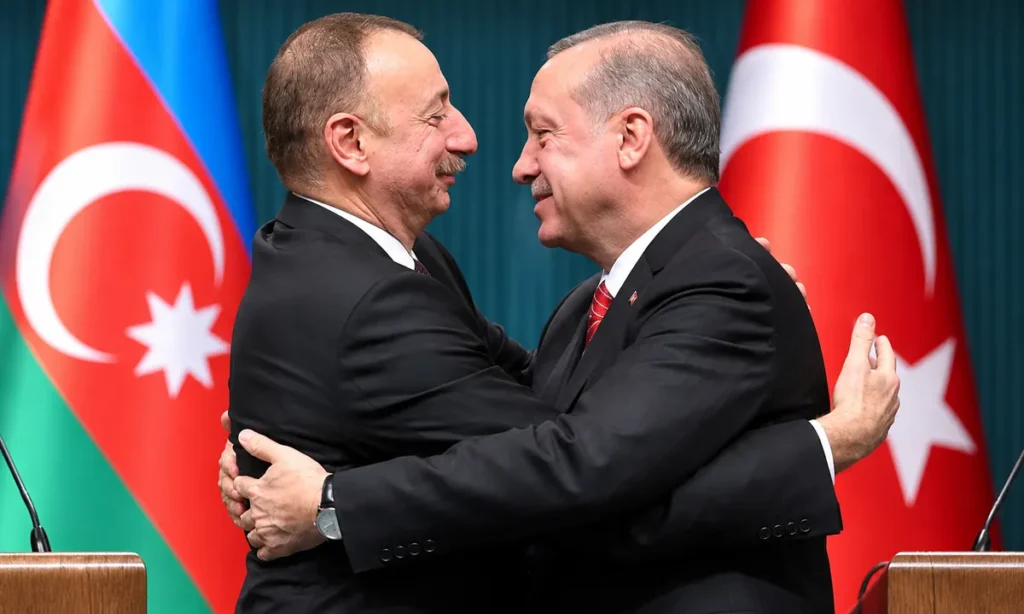
Azerbaijani President Ilham Aliyev will not attend the Organization of Turkic States summit in Ankara. Baku explained his absence by citing his need to attend the final of a football championship for children under 15. Political commentator Artyom Yerkanyan considers Aliyev’s absence an obvious political snub directed at Turkish President Recep Tayyip Erdogan.
Yerkanyan pointed out that Foreign Minister Jeyhun Bayramov will represent Azerbaijan at the summit, while the organization’s other members will participate at the level of heads of state. The observer states — Turkmenistan and the self-proclaimed Turkish Republic of Northern Cyprus — will also be represented by their leaders.
According to the commentator, Azerbaijan’s state news agency has already explained Aliyev’s absence. It emerged that the president plans to attend the final of an under-15 football championship on October 30.
“The explanation is that it had been agreed in advance that Ilham Aliyev would personally present awards to the winners, and for that reason he cannot attend the summit in Ankara,” Yerkanyan said.
He emphasized that the decision to hold the summit was made six months ago. Moreover, Erdogan recently called Aliyev personally and invited him to attend.
“The justification for his absence is not merely ridiculous; it is a political slap in the face. If Baku had not wanted to offend Ankara, it could have said, for example, that President Aliyev was ill and had a fever. But an explanation that treats an under-15 football match as more important than an event in Ankara organized on President Erdogan’s initiative and at his personal invitation becomes an open political demonstration,” the commentator said.
Yerkanyan recalled, however, that Erdogan had recently taken a similar step toward Aliyev. Three weeks earlier, Baku hosted a summit of the Organization for Cooperation in Asia, which the Turkish president did not attend. “Aliyev is therefore delivering a slap back at Ankara,” he said.
Nevertheless, according to Yerkanyan, Erdogan has recently taken several steps to accommodate Aliyev, but the Azerbaijani president has deemed them insufficient. The commentator said Aliyev’s attendance at the Ankara summit was extremely important to Erdogan. To secure it, the Turkish president even made concessions that, in Yerkanyan’s assessment, wounded his pride.
Specifically, Erdogan’s chief political adviser, Oktay Saral, was dismissed at Aliyev’s demand. Baku had accused him of interfering in Azerbaijan’s internal affairs. “First, at Aliyev’s demand, he removed his chief political adviser, Oktay Saral, whom Baku accused of interfering in Azerbaijan’s internal affairs,” Yerkanyan said.
Ankara’s concessions did not end there. According to the commentator, influential public figures were subsequently detained in Turkey after criminal cases had been opened against them in Azerbaijan and they had been placed on wanted lists.
Yerkanyan believes Erdogan hoped these steps would persuade Aliyev to show him at least some respect and accept the invitation to Ankara. However, that also failed to produce a result.
“Aliyev effectively disregarded Erdogan’s invitation. Yet Erdogan was simply proposing that he come to Ankara and resolve all the accumulated problems through dialogue,” he said.
Yerkanyan also cited a report by well-known Turkish journalist Ismail Saymaz. Saymaz recently wrote that, according to his information, the telephone conversation between Erdogan and Aliyev had been extremely tense and had produced no positive outcome.
“Moreover, Saymaz spoke with several senior Azerbaijani officials, who said that after what happened, relations between Azerbaijan and Turkey would never again be what they were in September and before,” the commentator said.
At the same time, Yerkanyan noted that Aliyev had congratulated Erdogan today on Turkey’s national holiday, Republic Day. He described the congratulatory message as fairly warm, although also restrained and consistent with established diplomatic protocol.
“Naturally, he called Erdogan a brother and assured him that the fraternal relations between Turkey and Azerbaijan had stood the test of centuries and would continue to develop. But actions demonstrate that words remain merely words when states’ actual interests sometimes conflict,” the political commentator concluded.