
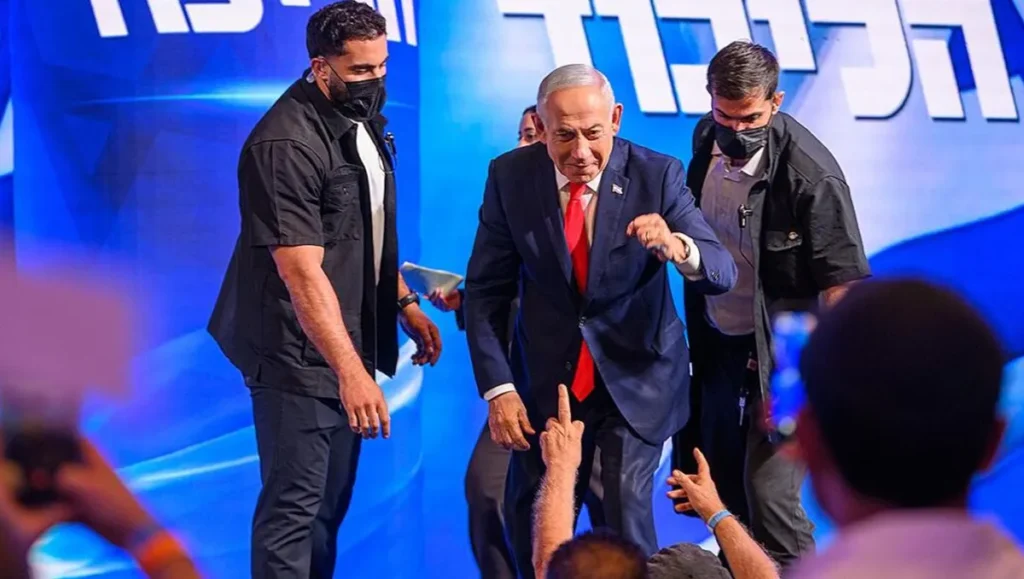
Neither Israel’s governing forces nor the opposition secured the majority needed to form a government in the election. At least 61 of the Knesset’s 120 seats are required, but no political force currently holds such a majority.
Political analyst Sergey Melkonyan identifies at least four possible scenarios in this situation.
First scenario: a national unity government between Netanyahu and the opposition
The first option is a compromise between Netanyahu and the opposition to form a national unity government. Melkonyan believes Donald Trump’s intervention could help bring this scenario about.
The analyst also links this possibility to US regional interests. In his assessment, as the likelihood of military escalation involving Iran increases, Washington needs Israel’s full involvement, which in turn requires domestic political stability.
Melkonyan also noted that some pro-Israel lobbyists in the United States and Trump advisers are unhappy about the presence of far-right politicians in Israel’s government. He specifically referred to Itamar Ben Gvir and Bezalel Smotrich, who, in Melkonyan’s characterization, have made racist and Nazi statements about Arabs and other peoples.
According to him, pro-Israel lobbyists in Washington believe these politicians’ presence in government complicates their work and damages Israel’s international standing, making the country politically “toxic.”
Melkonyan also recalled an episode in 2022 when Netanyahu wanted to appoint a representative of that far-right camp as defense minister. According to the analyst, the White House called and warned that such a decision could jeopardize military cooperation between the United States and Israel.
In Melkonyan’s assessment, this precedent demonstrates Washington’s ability to influence domestic political agreements in Israel.
Second scenario: a coalition involving discussions of Netanyahu’s eventual departure
Under the second scenario, Netanyahu could reach an agreement with one or more opposition parties and form a coalition government with their support. This would require the incumbent prime minister to secure enough votes from opposition forces to establish a Knesset majority.
At the same time, Melkonyan says the opposition is discussing the possibility of forming a government with the ruling party, but without Netanyahu. According to the analyst, many opposition politicians are willing to cooperate on that basis if Netanyahu is excluded from the new cabinet.
“Many in the opposition are ready to form a government with the ruling party, but on one condition: Netanyahu must not be part of it,” he said.
Melkonyan says another possible arrangement under discussion would allow Netanyahu to remain in power for two more years, then transfer power to another political force or representative and leave politics. The question of dropping the criminal cases against Netanyahu is also part of this option.
The second scenario therefore includes both a possible coalition agreement between Netanyahu and opposition parties and discussions about the incumbent prime minister’s subsequent departure from power.
Third scenario: opposition cooperation with Arab parties
According to Melkonyan, the Arab political sector unexpectedly won a large number of votes in this election, making it difficult for either the governing forces or the opposition to form a government.
He is referring to Arab citizens of Israel, who constitute around one-fifth of the country’s population. The analyst said their turnout reached 70–80% at some polling stations and exceeded 80% in certain cases. “That is a phenomenal figure. They did not previously turn out in such numbers; that level of engagement did not exist,” he said.
Melkonyan also noted that reports are circulating in Israel alleging that Arab voters were paid to go to the polls. He emphasized, however, that these reports are unconfirmed.
In the analyst’s assessment, Arab parties could play a decisive role in an opposition victory and the formation of a government. Yet this option is also complicated, as some opposition representatives and leaders say they will not reach any agreements with Arab political forces.
Melkonyan considers an agreement between Netanyahu and Arab parties almost entirely out of the question. Consequently, if those parties participate in forming a new government, it could happen through cooperation with the opposition.
Fourth scenario: snap elections
If no political force succeeds in forming a government, Israel could hold snap elections.
Melkonyan explained that the first opportunity to form a government goes to a representative of the force that received the most votes. That candidate must secure the support of at least 61 lawmakers. If unsuccessful, the opportunity passes to a representative of the next force. Should that attempt also fail, another candidate may be given a chance. If the necessary support still cannot be secured, snap elections are called.
The foreign policy course will not change
According to Melkonyan, Israel’s long-term trends nevertheless show that most voters support the political right. The principal differences between the governing forces and the opposition therefore concern domestic issues. The overall direction of foreign policy is unlikely to change substantially, regardless of who heads the government.
Melkonyan does not, however, rule out changes in certain foreign policy nuances depending on the composition of the government.