
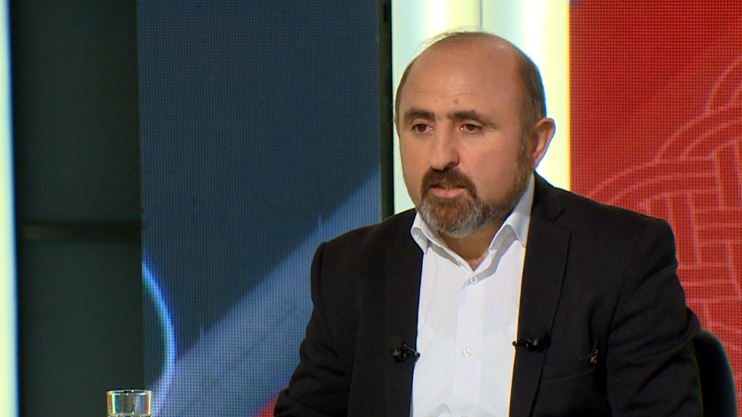
The selective release of negotiation documents on the Karabakh issue has become a tool in Armenia’s internal political struggle. The main goal, according to analyst Tatul Hakobyan, is to show that Robert Kocharyan was ready to “give up” Meghri and to shift the blame onto Serzh Sargsyan.
In Reality, Nothing Was Truly “Declassified”
“Honestly, nothing was new for me. Everything that could be important, I had already assumed. When we discussed the so-called ‘Lavrov Plan’, I went back to my old notes. Everything matched. The leaks we saw over the years were accurate. There was zero new information for me,” Hakobyan said.
Documents such as UN Security Council resolutions, the text of the 1994 Budapest OSCE Summit or the Lisbon statement of the OSCE Chairperson-in-Office are publicly available.
Despite that, these materials were taken from the personal page of former Minsk Group co-chair Vladimir Kazimirov, which Hakobyan considers unserious.
Serzh Sargsyan’s speech in Parliament was not classified either — it was public and widely known.
“The most absurd part was the 1999 Meghri–Karabakh exchange proposal, taken from the newspaper Haykakan Zhamanak. Calling this a ‘declassification’ is ridiculous. The text had been printed years ago. It was a draft option, which, I am sure, was discussed at some point but later rejected,” he said.
The Krakow “Three-Point Document” Was Written Quickly and Without Care
The Madrid Principles and the Kazan document almost fully match what had already been discussed and published.
“The 2016 Minsk Group proposals, Russia’s package proposals, and the 2018 Krakow document were also included. But the Krakow text, which contains only three points, is not serious. It was either written on the spot or presented selectively,” Hakobyan noted.
The Only New Element Was Serzh Sargsyan’s Letter
According to Hakobyan, the only genuinely new material in the entire package was Serzh Sargsyan’s letter to Russian President Vladimir Putin. But its publication raises serious ethical concerns.
“I was not against the letter being published. It was useful for me, because it clarified the previous leadership’s worries. But for fairness, it would have been better if Pashinyan and his team had also published their letters and negotiation records — from Dushanbe, Vienna, and elsewhere. They should have more strongly refuted Azerbaijan’s claims. For example, the claim that Pashinyan said in Vienna: ‘I cannot commit to a settlement; I will be killed’,” Hakobyan noted.
It Takes Two to Tango
The current authorities are often blamed for rejecting the 2019 proposals. But the reality, Hakobyan stresses, is that the 2019 proposals were almost identical to those from 2016. It was the same “Lavrov Plan”.
The essence of the Madrid Principles and the Kazan document was also unchanged.
“Yes, the original Madrid document was more favorable for Armenia. But Azerbaijan never accepted it. It neither rejected nor accepted it. And it was clear it never would. It takes two to tango,” he said.
The Delayed Referendum Was a Face-Saving Mechanism, Not a Real Solution
The idea of a delayed referendum appeared in all documents after Key West. But, according to Hakobyan, one should not be naïve. This clause was added only to help sides “save face”.
Azerbaijan’s maximum public concession was the promise of “the highest level of autonomy for Nagorno-Karabakh within the territorial integrity of Azerbaijan”. This was its red line.
Blaming Pashinyan Is Easy — But There Is a Big ‘But’
“Today it is very easy to blame Nikol Pashinyan: ‘why didn’t you accept the proposal in 2019’. Yes, he should be held responsible, and he deserves criticism. But there is one important ‘but’. If former authorities ask why he refused, we should also ask why they did not accept the same text in 2016,” Hakobyan said.
If the former leadership believed they lacked legitimacy for such a step, they should not have prevented Pashinyan from doing it — especially when he had unprecedented public support.
“Pashinyan came to power with extraordinary legitimacy. Yet from the first day the narrative was created that he ‘came to give away the lands’. The entire logic suggested only one thing: he came to surrender territories and lead the country to defeat,” Hakobyan concluded.