
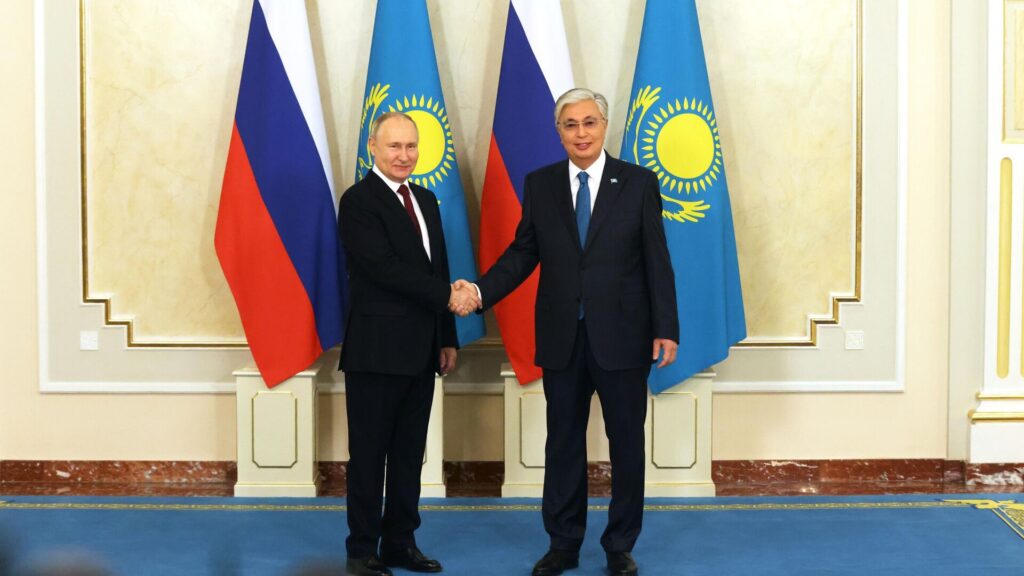
Russian Deputy Prime Minister Alexey Overchuk’s statement that Armenia’s status within the EAEU may be discussed should be viewed in the context of growing regional tensions and increasing competition among major powers. This opinion was expressed by political analyst Hakob Badalyan.
According to him, Russia’s actions may be linked to the fact that amid Armenia’s internal political processes — where the issue of power is effectively being decided — external actors are raising their political stakes.
“Russia is trying, during this electoral process in Armenia, where the question of power is essentially being resolved, to increase the value of its own interests, especially as it sees other actors, including the European Union, raising their stakes as well,” he stated.
Major Powers Are Increasing Their Activity
The political analyst noted that the European Union is also operating in the region through direct mechanisms, including rapid response groups, while the United States has intensified its political presence, as reflected by the expected visit of the U.S. Secretary of State to Armenia.
According to Badalyan, amid the growing activity of all major international actors, Russia’s actions should be seen as part of a broader competitive logic in which every side is attempting to increase the value of its influence.
Central Asia Matters More to Russia
Badalyan also emphasized that Armenia’s role within the EAEU is neither Russia’s only issue nor even its main strategic concern, since there are much larger geopolitical challenges in other directions.
In his assessment, Central Asia — and especially Kazakhstan — plays a particularly important role in this context.
“For Russia, the biggest challenge appears to be not Armenia, but the Central Asian zone and especially Kazakhstan, which, although it does not pursue an openly anti-Russian policy, nevertheless maintains active relations with Western centers, including the European Union, the United States, and the United Kingdom, all of which have deep involvement in the country,” he said.
Kazakhstan Is Preserving Strategic Independence
According to the political analyst, Kazakhstan’s foreign policy behavior demonstrates that even within the EAEU there are internal contradictions and tendencies toward strategic independence that are not always openly expressed.
“Kazakhstan is a major player within the EAEU framework. It is trying to preserve its independence while simultaneously maintaining very close relations with Western actors,” Badalyan noted.
The political analyst added that Kazakhstan has attempted to play a role even in Armenian-Azerbaijani processes, which also reflects the country’s growing international ambitions.
Central Asia Seeks a Bigger Role
In this context, Badalyan also recalled proposals voiced by Armenia concerning railway management and alternative logistical solutions that envisioned Kazakhstan’s involvement.
According to him, all these developments together demonstrate that Kazakhstan and Central Asian countries as a whole are attempting to position themselves more independently in international relations and play a more active role in the emerging balance among global powers.