
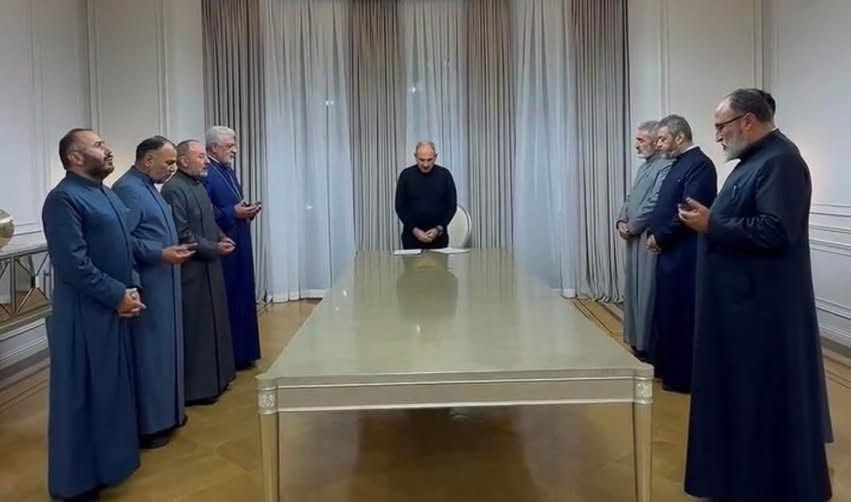
Armenia’s Prime Minister Nikol Pashinyan is starting the year by moving his confrontation with the Catholicos to a new level. The day before, in the prime minister’s official residence, he and a group of supportive bishops signed a public statement on camera and concluded the event with a prayer. According to the statement, a coordinating council is being established to handle the organizational aspects of a plan aimed at replacing the Catholicos. What does this plan involve?
The document states that the first step will be the public announcement of a “reform agenda” for the Armenian Apostolic Church. This would be followed by the removal of the Catholicos. The plan then envisages the election of a locum tenens, the adoption of a new church charter, and, as the final stage, the election of a new Catholicos.
A Procession as the First Step
How Pashinyan and the ten bishops supporting him intend to implement this plan became clear shortly afterward. On January 6 at 1:30 p.m., the prime minister invited the public to join a religious procession, which he plans to lead personally.
Pashinyan explained that the procession would mark the Nativity of Jesus Christ, affirm loyalty to the sacred tradition of the Armenian Apostolic Church, and express support for the church’s reform. He also stressed that the march was meant to demonstrate support for Armenian statehood and to oppose what he described as the use of the church by its de facto head and inner circle as an instrument of hybrid struggle against the state, sovereignty, and independence.
The Prime Minister’s Signature Changes the Rules
According to Edmon Marukyan, leader of the Bright Armenia party, Pashinyan’s recent statements go beyond political discourse and cross into the realm of constitutional order. For the first time, the prime minister has formally intervened in the internal affairs of the Armenian Apostolic Church in his official capacity.
Marukyan emphasizes that the document was signed not as a private individual or believer, but as the head of government. The fact that it was signed in the prime minister’s official residence, with the participation of bishops, fundamentally changes the legal nature of the process.
He argues that by using the full scope of state authority to interfere in the internal affairs of a religious organization, the prime minister has violated constitutional and criminal law norms. As a result, the issue is no longer an internal church dispute but a political matter directly related to Armenia’s constitutional order.
Institutional Risks and Political Consequences
Levon Zurabyan, vice-chairman of the Armenian National Congress, also warns that the statement adopted by the prime minister and the supporting bishops creates serious political and constitutional risks.
He argues that the participants have assumed powers not granted to them by law and have effectively initiated a process aimed at radically altering the governance system of the Armenian Apostolic Church. According to Zurabyan, the creation of a coordinating body outside the church’s canonical framework, with direct state involvement, threatens both church autonomy and constitutional stability.
Zurabyan views the unfolding process as a broad political program that goes far beyond internal church discussions and requires political and public resistance to protect Armenia’s constitutional and institutional foundations.