
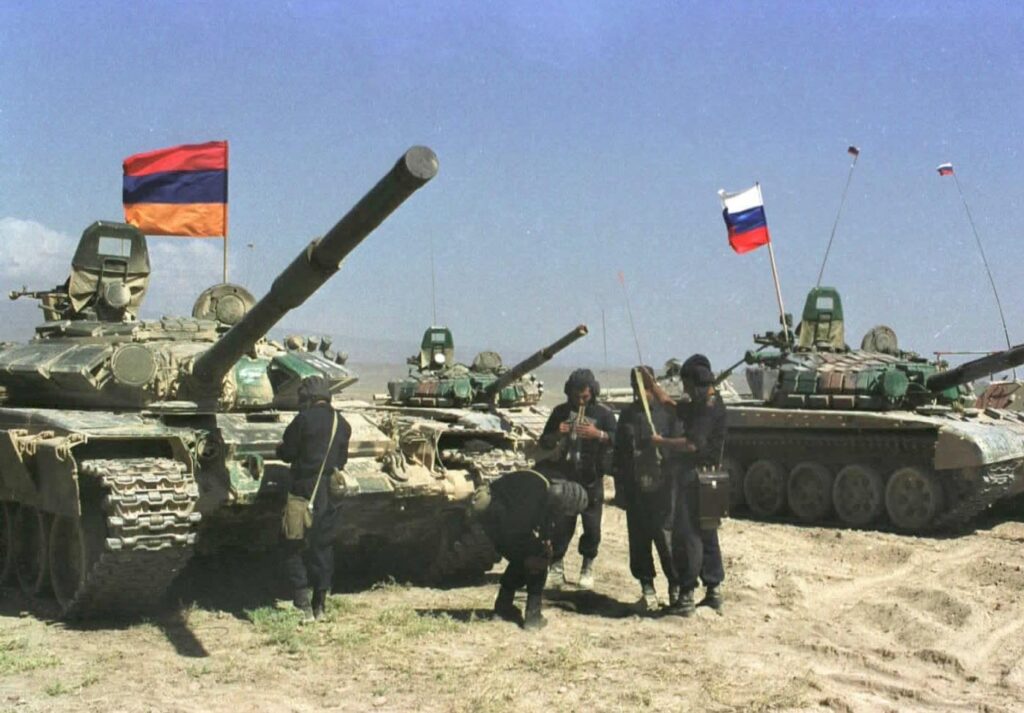
Discussions about the possible withdrawal of Russia’s 102nd Military Base from Armenia cannot be based solely on political statements or the peace agenda. The entire legal and contractual framework currently in force between Armenia and Russia must be considered in context, as the status of the military base and the presence of Russian border troops are linked to a number of documents. This was stated by Davit Ananyan, former head of Armenia’s State Revenue Committee and a PhD in Economics.
Despite numerous denials from representatives of the ruling authorities, he is convinced that issues related to the withdrawal of the 102nd Military Base have nevertheless been discussed behind closed doors between Yerevan and Moscow.
According to Ananyan, the Russian president has a clear understanding of the legal and contractual relations governing the military base’s presence in Armenia and the significance of that framework.
Ananyan noted that understanding the historical significance of the military base requires examining not only the agreements currently in force but also their background, going as far back as the Treaty of Kars, although it is not directly connected to the subsequent Russian-Armenian agreements.
According to Ananyan, the presence of the military base should also be viewed in the context of Russia’s legal succession from the Soviet Union and the relations that developed during that period.
In his view, it is this entire framework that makes it possible to understand the historical and security role assigned to the Russian military presence in Armenia.
The Status of the Military Base Was Shaped by a Series of Agreements
According to Ananyan, the Russian-Armenian agreements of 1992, 1995, 1997 and 2010 are among the documents regulating strategic relations between the two countries.
They also cover the legal status of the 102nd Military Base, the right of Russian border troops to remain in Armenia and the scope of their activities.
“If we examine all these legal documents and the references they contain, it becomes clear that the 102nd Military Base is not the kind of military contingent that can be very easily withdrawn from Armenia,” he said.
He expressed the view that the Russian president’s statement concerning the military base may have been aimed more at testing the reaction of Armenian society — whether people in Armenia fully understand the historical mission of the Russian contingent, the border troops and the 102nd Military Base, particularly from the perspective of border control, including the Armenian-Turkish border.
A Peace Treaty Is Not a Security System in Itself
Ananyan noted that the current authorities are trying to convince the public that once peace treaties are concluded between Armenia and its neighboring countries, the main external security risks can be considered resolved.
“In reality, the peace agenda promoted by the authorities cannot neutralize all external security risks,” he said.
According to Ananyan, even if Armenia signs peace treaties with Turkey and Azerbaijan, this in itself does not mean that those agreements will eliminate potential security risks.
Ananyan noted that history contains numerous cases in which peace agreements or mutual non-aggression arrangements between states were subsequently violated.
Ananyan believes Armenia’s security should be built on a combination of several components.
In addition to the armed forces, additional capabilities and resources are needed to respond to external security risks.
In this context, in his view, the issue of the 102nd Military Base and the Russian border presence cannot be separated from Armenia’s overall security system and viewed solely as a matter of an individual political decision.