
Armenia’s railway system is not being used to the extent its potential allows, while during the years of the current concession management, the main investments have been directed toward maintaining existing infrastructure rather than creating new opportunities.
According to economist Aghasi Tavadyan, the key issue for Armenia today is not only the separation of railway ownership and management, but also how to turn the system into полноценная infrastructure connecting Armenia’s economy with the outside world.
The expert recalled that Armenia’s railway has been under Russian concession management since 2008, and that the timing was not accidental.
“At that time, following the military events around Abkhazia and South Ossetia, direct railway communication between Armenia and Russia was suspended,” Tavadyan said.
Today, in his assessment, Armenia’s railway system effectively operates in a very limited direction, mainly serving connections between Armenia and Georgia.
“Our railway is an orphan,” the economist said, explaining that the system is unable to serve Armenia’s economy to the extent of its actual potential.
Armenia’s Railway Has Not Become a Main Pillar of the Economy
Tavadyan sees a significant difference between the railway systems of Armenia and Russia.
In Russia, railway transport is a key component of the national economy. The Russian Railways system serves numerous sectors, while a significant share of freight transportation is carried by rail.
In Armenia, the situation is the opposite.
Because railway links to major external markets are limited, the main burden of the country’s external economic connections has fallen on road transport.
As a result, Armenia’s railway has not become the infrastructure that could substantially reduce import and export costs, provide alternative connectivity and link the Armenian economy to several external routes.
According to the economist, if the railway had stable connections in multiple directions, it could significantly expand the opportunities available to Armenia’s economy.
Restoring Railway Links with Russia Would Have Major Economic Importance
Tavadyan believes that one of the most important directions for Armenia is restoring railway communication with Russia.
The main obstacle remains the unresolved issue of Abkhazia.
If direct railway communication from Armenia to Russia could be restored, its economic significance, according to the economist, could be considerable.
The reason lies in the structure of Armenia’s foreign trade.
In recent years, Armenia has recorded significant export growth toward the Russian and EAEU markets.
Therefore, a direct railway connection with Russia could not only facilitate the movement of people but, above all, expand freight transportation opportunities.
Tavadyan stresses that the railway issue should be considered primarily from the perspective of trade turnover rather than passenger transportation.
In that case, the railway could become an important tool for reducing Armenia’s export and import costs.
No New Railway Potential Was Created During the Concession Years
According to Tavadyan, the work carried out by South Caucasus Railway has generally not resulted in a substantial expansion of Armenia’s railway system.
He says most of the investments made were directed toward maintaining the existing railway infrastructure.
“Most of the investments that have been made were aimed at maintaining the railway rather than creating any new infrastructure,” he said.
The economist also links this to the commercial logic of the concessionaire.
As a profit-oriented organization, the operator invests to the extent that it sees an opportunity to generate additional revenue.
In Armenia’s case, demand has been limited. Closed borders have prevented large-scale international freight transportation, changes in the operation and export volumes of the Sotk mine have reduced freight flows on certain routes, while some passengers prefer road transport.
In other words, under the existing system, the concessionaire has had limited economic incentives to undertake large-scale new investments.
Armenia’s Railway Can Develop Along Two Main Directions
Tavadyan identifies two main geographical directions for the development of Armenia’s railway.
The first is north–south.
In this case, Armenia could provide a railway connection between Iran and Russia, creating broader regional connectivity.
The second is east–west.
This would involve new regional communications that could integrate Armenia’s railway into emerging routes toward Azerbaijan and Turkey.
According to the economist, both directions are economically important for Armenia because the more railway connections the country has, the less dependent it will be on a single route or communication system.
The “Trump Route” Is Not Part of the Existing Concession
Tavadyan distinguishes between Armenia’s existing railway and the proposed new connection through Syunik, the so-called “Trump Route.”
According to him, this project has not been transferred under the existing concession arrangement and should be regarded as a separate infrastructure project.
In other words, resolving the management issue of Armenia’s railway and creating a new connection through Syunik are not the same process.
According to the economist, the “Trump Route” can be developed separately, regardless of who eventually manages Armenia’s existing railway system.
At the same time, he notes that infrastructure still needs to be restored or built along this route. Railway infrastructure in Syunik has effectively not operated since the Soviet period.
According to him, the Azerbaijani side is already carrying out work on its section, while Armenia still needs to clarify the timing and conditions of construction.
Why the Idea of Management by a Third Country Emerged
Against this broader background, Armenia’s government, according to Tavadyan, is examining alternatives to the current concession management model.
One option discussed is transferring railway management rights to a third country.
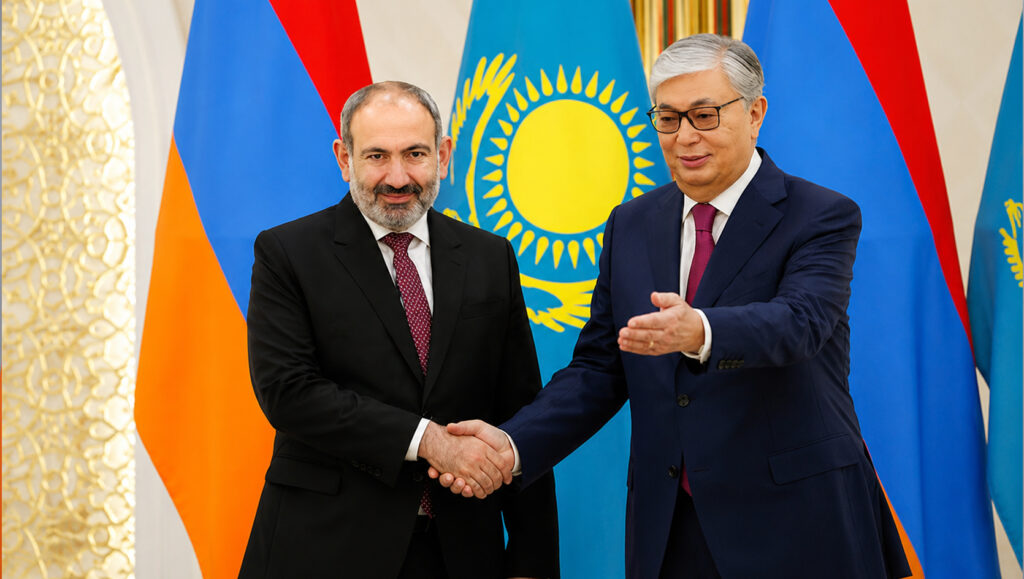
Kazakhstan has been mentioned among the possible candidates.
Tavadyan stresses, however, that no final decision has been made and discussions about Kazakhstan remain at the level of speculation and political debate.
At the same time, he explains why Kazakhstan could be an interesting option for Armenia.
According to Tavadyan, Kazakhstan has several characteristics that distinguish it from other potential operators.
First, Kazakhstan is a member of the EAEU.
This is important because Armenia’s railway management would not be transferred to a country outside the EAEU economic system that could enter into additional political confrontation with Russia.
The economist recalls that it was former Kazakh President Nursultan Nazarbayev who presented and promoted the idea of the EAEU in Astana.
But according to Tavadyan, another factor is even more important.
Kazakhstan has greater economic autonomy and, consequently, EAEU membership is not as vital to its economic security as it is in Armenia’s case.
As a result, Tavadyan believes Kazakhstan could theoretically take a more neutral position on the management of Armenia’s railway.
Kazakhstan Could Become an Intermediate Option
According to Tavadyan’s logic, if the concession remains with Russia, Armenia’s railway continues to be closely tied to the Russian economic and geopolitical system.
If it were transferred to the United States, Turkey or a Western country, the opposite problem could emerge: railway management could be perceived as an infrastructural shift by Armenia toward another geopolitical pole.
In this respect, Kazakhstan could be viewed as an intermediate option.
“The concession management would not be transferred to a state that currently has political problems with Russia, such as Turkey, the United States or any European country, but to a state that is relatively neutral,” Tavadyan’s argument essentially suggests.
In his assessment, such a model could theoretically give Armenia greater opportunities to connect its railway system with different external directions without tying it entirely to one geopolitical center.
However, the economist warns that at this stage it is too early to make any definitive economic assessment of the Kazakhstan option.