
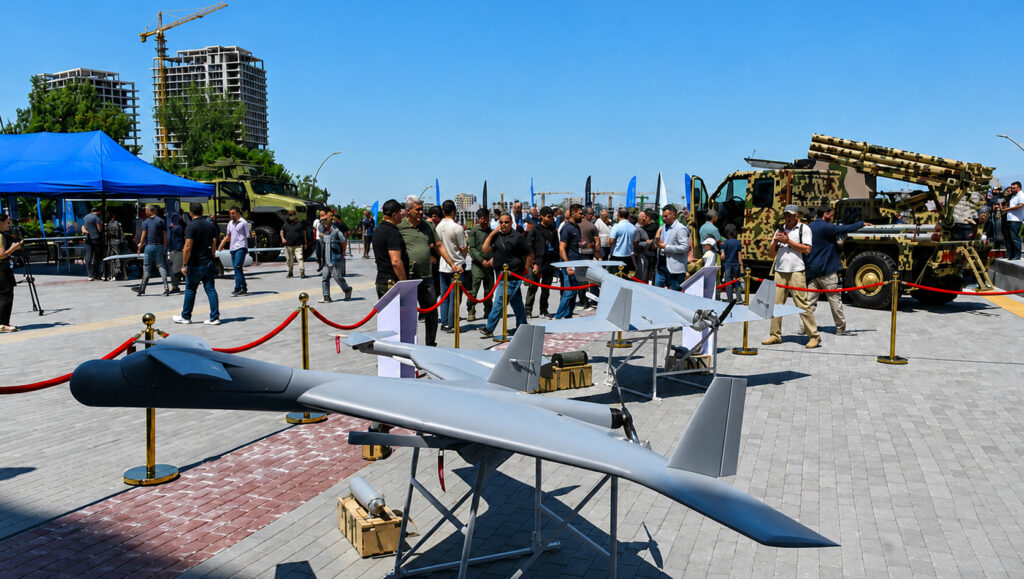
In recent years, significant progress has been recorded in the rearmament of Armenia’s Armed Forces, particularly in artillery and unmanned aerial vehicles. However, in several areas, especially military aviation and missile systems, the gap between the capabilities of Armenia and Azerbaijan remains significant.
Military analyst Leonid Nersisyan made the remarks while discussing Armenia’s defense procurement and changes in the regional military balance.
Significant Changes in Both Quantity and Quality
According to him, in recent years Armenia has sought to reduce its dependence on a single supplier and has been purchasing weapons and military equipment from various countries, particularly India. There is also cooperation with France, China, Iran and the United States.
Nersisyan said particular emphasis has been placed on developing artillery systems.
“Armenia, for example, is in a considerably better position than it was in 2020, before the war. We have seen quite serious changes here in both quantitative and qualitative terms,” he said.
According to the expert, there has also been some progress in air defense.
However, he said there is insufficient information in open sources regarding short-range air defense systems and, in particular, counter-drone capabilities.
He noted that Armenia has acquired Indian Akash air defense systems, which he considers effective, although their missiles are relatively expensive.
For this reason, Nersisyan believes Armenia needs to develop more affordable means of countering small unmanned aerial vehicles.
As an example, he pointed to anti-aircraft artillery systems, which are once again attracting interest around the world.
“More modern types are now being developed. There needs to be a sufficiently systematic approach specifically toward layered air defense,” the military analyst said.
Aviation Remains One of Armenia’s Most Problematic Areas
According to Nersisyan, considerable work remains to be done in the field of military aviation within Armenia’s defense system.
He noted that Armenia has also acquired Airbus-produced helicopters, but a comparison with Azerbaijan shows that the imbalance in this area remains very large.
“There is no point in hiding it; these figures are quite easy to verify through open sources. Azerbaijan has continued to develop its aviation, and it can already be roughly calculated that, as a result of orders and planned deliveries, it will have up to 100 military aircraft within several years,” he said.
According to Nersisyan, the situation is further complicated for Armenia by the fact that developing military aviation requires substantial financial resources, while Armenia is a relatively small state.
Therefore, he argues, Armenia must not only consider the quantitative development of its aviation but also find effective models for its use.
“We need to think of sensible approaches to how this aviation should be used so that it is effective and does not get hit, especially considering the relatively small number of military bases,” he said.
The Drone Imbalance Has Narrowed
Discussing the military balance between Armenia and Azerbaijan, Nersisyan said it is changing, although at different speeds across different areas.
According to him, Armenia’s position has improved significantly, particularly in the field of drones.
“If we talk about unmanned aerial vehicles, the situation is now better than it was in 2020. There have been fairly large-scale purchases from local companies, and these have been demonstrated. Some purchases from abroad have also been presented,” he said.
According to the analyst, the previous imbalance between Armenia and Azerbaijan in artillery has also narrowed significantly.
At the same time, he again stressed that a substantial gap remains in military aviation, while Armenia still has considerable work to do in the field of missile systems.
Armenia Should Focus on Quality
According to Nersisyan, if the comparison is based not on individual types of weapons but on the overall size of the armed forces, Armenia faces a more difficult challenge.
“If we are talking purely about numbers, Armenia should place greater emphasis on maximizing the quality of its troops and forming a well-trained reserve,” he said.
At the same time, the military analyst believes Armenia could be in a more favorable position to change the military balance over the long term.
In his assessment, economic factors could also contribute to this.
“We see that Armenia’s economy is growing, while Azerbaijan’s economy is not. In that sense, over the long term, it may be possible to move toward a point where we can say that the forces are at least equal,” Nersisyan said.