
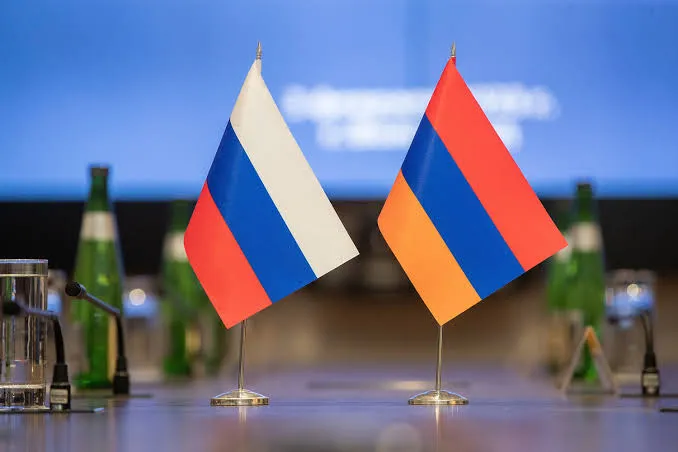
The political potential of Russia’s 102nd Military Base as a factor in ensuring Armenia’s security and defense has been largely exhausted. Military expert Leonid Nersisyan expressed this view.
The deterrence factor no longer works as it once did
According to his assessment, the main rationale behind the military base’s presence was to deter a potential adversary through the Russian flag and the military and political power standing behind it. However, events of recent years have shown that this deterrence factor no longer works as it once did.
According to Nersisyan, the 102nd Military Base initially performed precisely this deterrence function to a certain extent. Following the collapse of the Soviet Union, the rationale for maintaining the base, in his assessment, was that Russia’s presence would force a potential adversary to take into account the risk of confrontation with Moscow.
“It seems to me that the logic was that the Russian flag was here, and no one would attack because no one would want problems with Russia,” the military expert said.
According to him, until 2020, it could be argued that this mechanism worked to some extent. Subsequent developments, however, showed, in Nersisyan’s view, that Russia’s military presence did not provide the deterrent effect attributed to it.
“Over time, it became clear that either it does not deter, or it never did and simply no one knew it. That myth that the Russian flag here matters, at least now, no longer works,” he noted.
The expert particularly highlights the events that have taken place since 2020. In his assessment, developments in 2020, 2021, 2022 and 2023 demonstrated that Russia’s military presence did not become a factor capable of preventing military action against Armenia.
“When something fails to work that many times, it becomes clear to everyone that it is not going to work,” Nersisyan said.
Military potential: a force roughly the size of one regiment
At the same time, if the issue is considered purely from a military perspective, the capabilities of the 102nd Military Base are also limited, according to the expert.
Nersisyan said that the base’s ground component is roughly equivalent to a motorized rifle regiment, supplemented by artillery and aviation components. According to open sources, approximately 3,500–4,000 personnel serve at the base.
In terms of military equipment, according to the expert, the base has approximately 70 T-72 tanks, S-300V and Buk air-defense systems, 122 mm and 152 mm artillery, Smerch and Grad multiple-launch rocket systems, as well as other military equipment.
“On paper, as a list, the figures seem quite substantial. But it must also be understood that because the base has always been located in an area with difficult logistics, bringing weapons here and taking them out has always been quite expensive and difficult,” Nersisyan noted.
In his assessment, this factor, along with the age of the equipment, could seriously affect the base’s actual combat capability. The expert assumes that a significant proportion of the equipment may be in poor technical condition.
“I can assume that the condition of at least a substantial part of this military equipment must be very poor after all these years. In my opinion, at least 50 percent of it — the infantry fighting vehicles, tanks and various other equipment — would not be in combat-ready condition,” he said.
A 4,000-strong base cannot militarily stand against Azerbaijan
According to Nersisyan, the size and armament of the 102nd Military Base are insufficient to create a serious military balance in the event of a large-scale attack against Armenia.
“Naturally, a unit that is more than ten times smaller than Armenia’s army cannot by itself [stand] either in a war with Azerbaijan or against Turkey. In Turkey’s case, I would say dealing with a unit of that size would probably be a matter of one or two days,” he noted.
The expert also points out that a significant proportion of the base’s military equipment is quite old. According to him, most of it predates 1991. Some newer systems were subsequently deployed at the base, including Orlan-type unmanned aerial vehicles, several Smerch systems and other equipment, but in his assessment this has not substantially changed the overall picture.
Nersisyan compares the base’s military equipment with that of the Azerbaijani Armed Forces, noting that Azerbaijan possesses even newer Russian-made weapons.
“Azerbaijan has much better Russian military equipment than the 102nd Base. They have newer, much more modern Russian equipment manufactured between 2011 and 2017–2018,” he said.
According to the expert, even in the event of a possible war with Azerbaijan, the base could theoretically be deployed in a limited sector, but its capabilities would not be sufficient to have a significant impact on the outcome of a large-scale war.
In the case of Turkey, there is also a logistical problem
Nersisyan considers the deployment of additional Russian troops to Armenia in the event of a possible war with Turkey to be a separate problem.
According to him, one of Russia’s main strengths is its ground forces, but without a land border with Armenia, rapidly deploying those forces would pose a serious logistical challenge.
“If they decide to enter a war with Turkey in any form for Armenia, even then I find such a war difficult to imagine. They have no border with Turkey, their strength is precisely their ground forces, and in terms of logistics they are quite weak when it comes to moving troops to Armenia,” he noted.
According to Nersisyan, transporting a large force solely by air would also be insufficient because the capacity of Armenia’s airports is limited. In his assessment, in such a war the Russian side would also have to resolve the issues of land communications and the deployment of additional forces.
At the same time, he notes that in the event of a military confrontation with Turkey, the Turkish air force would also pose a challenge for Russia. In his assessment, it is smaller but better trained and more technologically equipped.
Thus, according to Nersisyan, the significance of the 102nd Military Base should be considered primarily in the context of the political and strategic rationale under which it was established and maintained. At the core of that rationale, in his assessment, was not the ability of a limited force stationed on Armenian territory to wage a large-scale war, but rather the deterrence of a potential adversary through Russia’s presence.
Developments in recent years, in his view, have demonstrated that this deterrence mechanism no longer has its former effectiveness.