
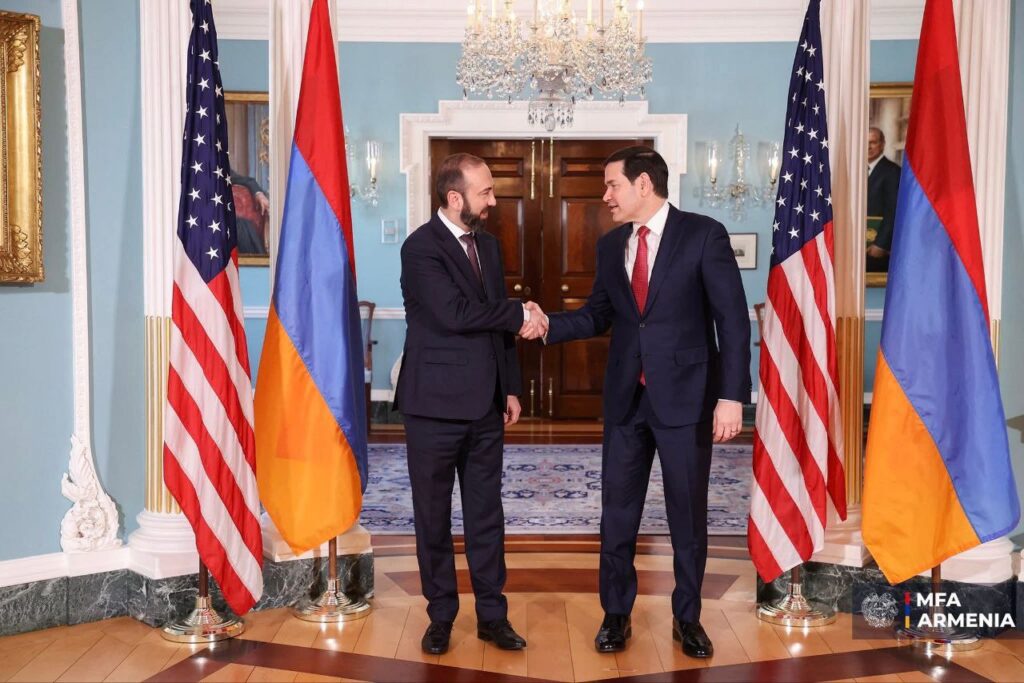
On January 13 in Washington, Armenia’s Foreign Minister Ararat Mirzoyan and U.S. Secretary of State Marco Rubio presented the framework program for the “Trump Route to International Peace and Prosperity” (TRIPP) project. According to the Armenian side, the document records only the agreements that have been negotiated and published, containing no hidden or undisclosed conditions.
At a press conference, Ararat Mirzoyan stated that the framework program sits between the political declaration signed at the White House on August 8, 2025, and a future legally binding document. In his words, “only what is recorded on paper and published has been agreed upon,” and no other agreements exist.
What the framework program provides
According to the presented document, TRIPP is aimed at creating an uninterrupted multimodal transit route through Armenian territory. The project is intended to connect mainland Azerbaijan with the Nakhchivan Autonomous Republic and become an important link in the Trans-Caspian trade route connecting Central Asia and the Caspian region with Europe.
The framework program emphasizes the importance of sovereignty, territorial integrity, and reciprocity. The ultimate goal of the project is stated as strengthening the security and prosperity of Armenia and Azerbaijan, as well as expanding regional trade and transit opportunities with U.S. involvement.
Particular attention was drawn to the ownership structure of TRIPP. According to statements by Armenia’s Foreign Minister, 74% of the shares will belong to the United States, and 26% to the Republic of Armenia. Mirzoyan called this distribution fair, emphasizing that the American side assumes the main investment obligations, while Armenia’s contribution is primarily granting construction rights. The partnership is set for 49 years, with the possibility of extension for another 50 years, during which Armenia’s share could increase to 49%.
Iran’s reaction: a tough signal from Tehran
Iran’s reaction was not long in coming. Almost immediately after the Armenian statements, Iran’s ambassador to Armenia, Khalil Shirgolami, delivered a sharp assessment. He emphasized that Tehran is forming the perception that Armenia is becoming a center of activity for forces hostile to Iran.
The ambassador also stated that if protests in Iran succeed, Armenia would be among the losers, linking the internal stability of the Islamic Republic with regional security. He specifically expressed concern over protests at the Iranian embassy in Yerevan, where, according to him, disrespectful and offensive slogans were voiced.
Shirgolami stressed that such actions “will remain in the memory of the Iranian people,” recalling that Iran has stood by Armenia during difficult times. According to him, the Iranian side has repeatedly communicated its concerns to the competent Armenian authorities.
The risk of half-century commitments
So how beneficial are the decisions made? On one hand, U.S. participation and the public recording of the principles of sovereignty and territorial integrity increase the project’s international legitimacy and create additional guarantees for Armenia. On the other hand, the controlling stake in U.S. hands and the long-term nature of the partnership objectively limit Armenia’s room for independent maneuvering.
In essence, the main vulnerability of the TRIPP project lies in its ownership structure: 74% of the shares go under U.S. control, while Armenia is allocated only 26% for 49 years. Formally, such distribution is justified by the volume of investments and is called “fair,” but in practice it represents a significant limitation on Armenia’s control over a strategically important infrastructure asset. With this configuration, Armenia’s influence on management decisions will be minimal, and the project itself creates long-term dependence on an external operator.
Claims that the shares of the parties will “almost equalize” after 49 years appear more like a political argument than a real guarantee. A half-century horizon implies generational changes, political regime shifts, and evolving international conditions, and no one can confidently assert that the terms, context, or even participating companies will remain in their current form.
An economic project with political consequences
Another risk for Armenia is that the country is gradually being caught between three different logics: the American — focused on transit, investment, and geoeconomic influence; the Iranian — based on security considerations and preventing the presence of hostile forces near its borders; and the Russian — linked to maintaining countries traditionally regarded as within Russia’s sphere of influence.
Despite the project’s explicitly economic rhetoric, TRIPP is already forming a clear geopolitical contour. Tehran’s sharp reaction shows that the region increasingly perceives it as a component of geopolitical choice, with consequences extending far beyond logistics and trade.
The Iranian ambassador’s statement was the first public signal that deeper Armenian-American cooperation is beginning to irritate regional partners. For Tehran, increased U.S. presence in Armenia means not only economic competition but also a potential security risk along its own borders.
Thus, Armenia’s key challenge is to maintain a balance between new opportunities opened by Western cooperation and traditional regional relationships, especially with Iran. How transparently and carefully this policy is managed will determine whether the project becomes a stabilizing factor or a source of new tensions in the South Caucasus. So far, the atmosphere of optimism surrounding the project does not inspire confidence.