
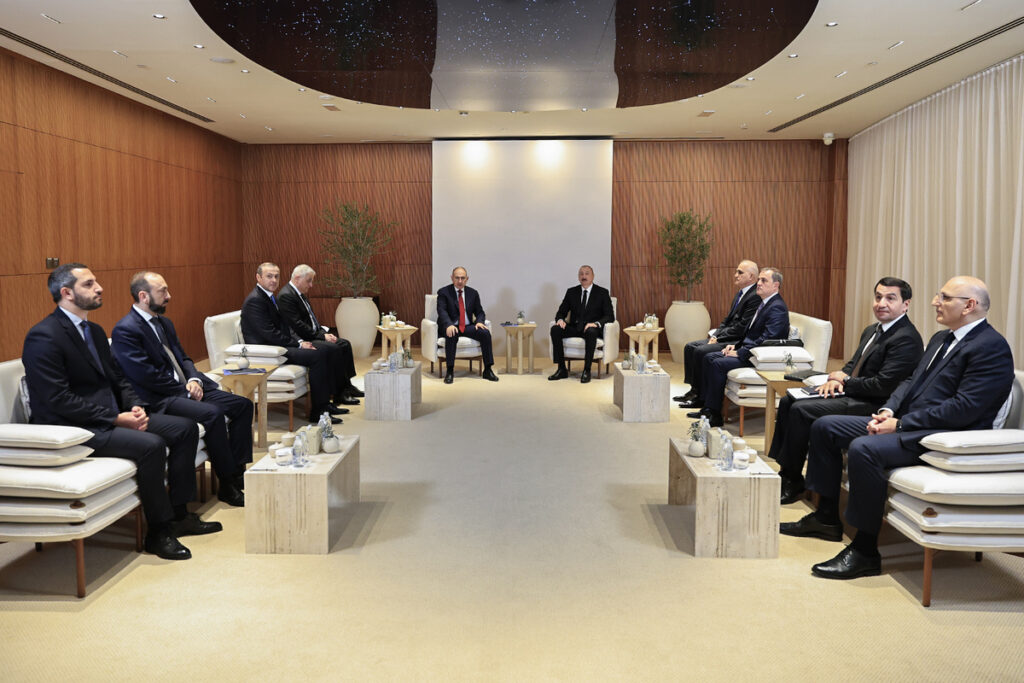
The meeting between Nikol Pashinyan and Ilham Aliyev in Abu Dhabi can hardly be viewed as a mere случай encounter resulting from the two leaders’ simultaneous presence in the same location. Although it is known that the leaders of Armenia and Azerbaijan arrived in the United Arab Emirates for the “Human Fraternity” award ceremony — as parties recognized for advancing the Armenian-Azerbaijani peace process — the very format of the meeting suggests something more.
The talks were held not only in a one-on-one format, but also with the participation of full delegations. The Armenian delegation included Vice Prime Minister Mher Grigoryan, Secretary of the Security Council Armen Grigoryan, Minister of Foreign Affairs Ararat Mirzoyan, as well as Deputy Speaker of the National Assembly and Special Envoy for the normalization of Armenian–Turkish relations Ruben Rubinyan. The Azerbaijani side was represented by Shahin Mustafayev — Mher Grigoryan’s counterpart on border delimitation, demarcation, and infrastructure unblocking — along with Aliyev’s well-known aides Hikmet Hajiyev and Foreign Minister Jeyhun Bayramov.
This composition alone indicates that the meeting was far from a purely formal exchange.
Official Silence Instead of Concrete Agreements
It is difficult to determine exactly what issues were discussed in Abu Dhabi based on official statements. As usual, they are limited to general wording, noting the existence of “progress,” trends toward restoring economic relations, and other broad characterizations.
One of the most striking aspects, however, is the absence of the key issue of border delimitation and demarcation from the official communiqué. This is despite the fact that the regulations governing the relevant commissions were approved back in 2024, and the direction of the process — from north to south — was agreed upon in January 2025. Nevertheless, the process has effectively not begun.
The reasons for this are complex and require in-depth analysis. Yet the complete lack of any reference to this issue in the official summary of the Abu Dhabi meeting adds an element of mystery to the process.
At the same time, experience shows that after such meetings, concrete agreements often emerge later — in the form of faits accomplis that become apparent only with time.
On the Eve of the U.S. Vice President’s Visit
The Abu Dhabi meeting also gains particular significance due to another factor that appears to have received insufficient attention in Armenia. This concerns the upcoming visit of U.S. Vice President J.D. Vance to Armenia and Azerbaijan. As announced, the visit is scheduled for the second half of February.
In effect, the leaders of Armenia and Azerbaijan met in Abu Dhabi just days before this visit and held several hours of discussions at the delegation level. This inevitably recalls last year’s chain of developments.
It should be recalled that Nikol Pashinyan and Ilham Aliyev also met in Abu Dhabi last year, on July 10. That meeting lasted around five hours, and about a month later, on August 8, the well-known agreements were recorded in Washington.
A Repeating Scenario?
That 2025 meeting was also preceded by contacts with Turkey. On June 19, 2025, Ilham Aliyev visited Turkey and met with Recep Tayyip Erdoğan, and the following day, June 20, Nikol Pashinyan paid a working visit to Turkey, also meeting Erdoğan. At the time, the possibility of a Pashinyan–Aliyev meeting in Turkey was actively discussed, but it did not take place. Instead, a few days later, the meeting in Abu Dhabi on July 10 was announced.
Today, we once again observe the same logic: a meeting in Abu Dhabi on the eve of an important event within the Washington framework. Although this time it is not about a physical meeting in Washington, J.D. Vance’s visit clearly fits into the broader context of the August 8 Washington agreements.
What Is Being “Prepared” in Abu Dhabi
In this context, it is highly likely that the Abu Dhabi meeting can be viewed as a preparatory stage for J.D. Vance’s visit. This implies that the leaders’ meeting with full delegations involved the development of specific arrangements to be presented to the U.S. Vice President.
It is also possible that Washington — in this case, the U.S. administration — has already posed certain questions to Yerevan and Baku regarding the topics to be discussed and the expected steps during the upcoming visit.
Therefore, the Abu Dhabi meeting warrants the closest attention. In the coming days or weeks, new and fairly concrete agreements in Armenian-Azerbaijani relations may emerge, with Abu Dhabi having served as the “kitchen” where they were prepared.
Political commentator Hakob Badalyan