
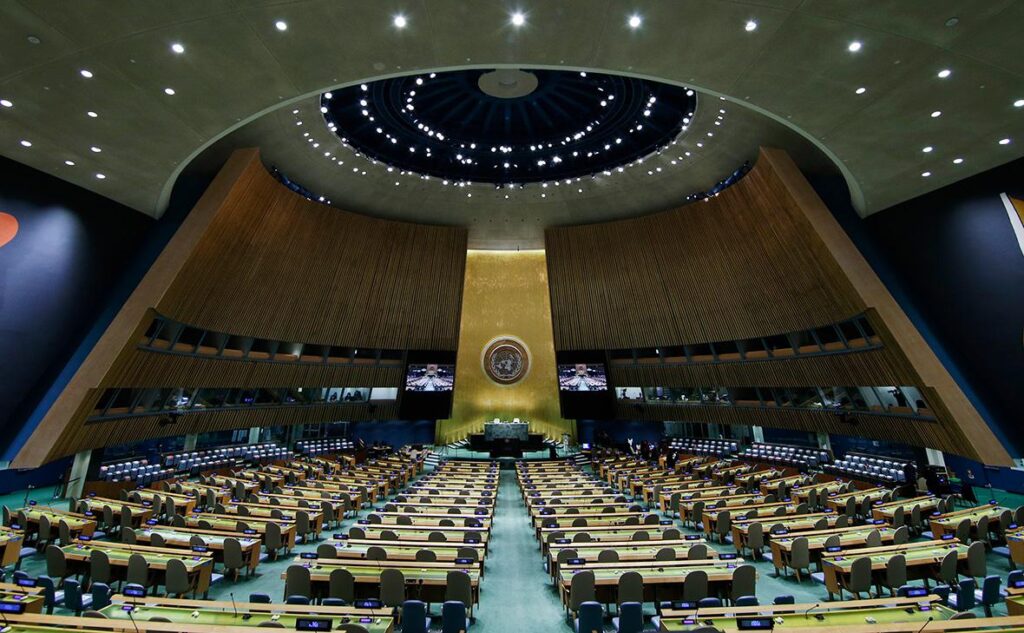
The world is currently going through a period of radical transformation and global turbulence, while the international order that existed for decades has effectively collapsed. This opinion was expressed by political analyst Stepan Danielyan.
According to him, international relations are being reshaped, and the world is moving toward a new system that will be heavily influenced both by developments around Iran and by the agreements that emerge after the end of the war in Ukraine.
“We are moving toward the formation of a new system of international relations. The agreements reached after the conflict around Iran and after the end of the war in Ukraine will not be merely local arrangements. They will determine the future of the entire world order,” the political analyst stated.
Local Elections Are Becoming Geopolitical
In this context, Danielyan believes that even parliamentary and domestic elections in various countries now carry clear geopolitical significance.
According to him, changes of government are no longer limited to domestic political consequences and directly affect a country’s foreign policy orientation.
As an example, he points to Georgia, where ongoing internal political tensions are, in his assessment, actually an expression of geopolitical struggle.
Serbia and Europe Are Repositioning
Danielyan also referred to Serbia, where, according to him, mass protests demanding the resignation of the president and parliamentary leadership are currently taking place.
The political analyst believes that the developments in Serbia cannot be viewed solely as domestic political events, because the country is reconsidering its traditional foreign policy orientation.
“Serbia is already declaring that it no longer considers Russia a brotherly country,” he noted.
Danielyan also mentioned Romania and Moldova, stressing that political developments there are likewise directly connected to broader geopolitical realignments.
Germany Could Reshape Europe
According to the political analyst, developments in Germany are especially important.
Danielyan stated that a possible victory of the high-ranking Alternative for Germany political force could have extremely serious consequences for Europe as a whole.
“The leaders of this force have declared that, if victorious, they could withdraw the country from the European Union and NATO. That would mean the entire structure of the European Union could collapse,” he said.
The South Caucasus Remains a Strategic Region
In Danielyan’s view, Armenia’s situation is particularly sensitive because the South Caucasus is a region where the interests of several major power centers intersect simultaneously.
He believes that a possible change of government in Armenia could trigger fundamental geopolitical changes throughout the region.
“The South Caucasus is a space where either balance or imbalance may emerge between Turkey, Iran, and Russia,” Danielyan stated.
In this context, the political analyst also stressed the importance of regional communications. According to him, the core issue is not whether transport routes should be opened or closed, but rather under what principles they will function and who will control them.
“The question is not whether communications should exist or not. The real issue is how they will operate, who will control them, and whose interests they will serve,” he said.
Two Possible Scenarios
According to Danielyan, there are two main possible scenarios.
Under the first scenario, transport routes could fall under the control of one or two countries, turning the region into a permanent zone of conflict and geopolitical rivalry.
“In that case, a struggle begins over who controls these roads and who uses them against others. Such communications can lead to wars and further escalation,” the political analyst warned.
However, he also pointed to a second scenario, in which all interested countries reach a common agreement and build a system based on mutual interests.
According to Danielyan, under such a model communications become not a source of conflict, but a tool for peace.
“If the United States, Russia, China, Iran, and other interested countries reach an agreement, these communications could guarantee peace,” he stated.
Peace Requires Shared Guarantees
Danielyan believes that real peace is only possible when it is guaranteed not by one single country, but simultaneously by several influential powers.
“When all interested countries come to an agreement, only then does guaranteed peace emerge,” the political analyst emphasized.