
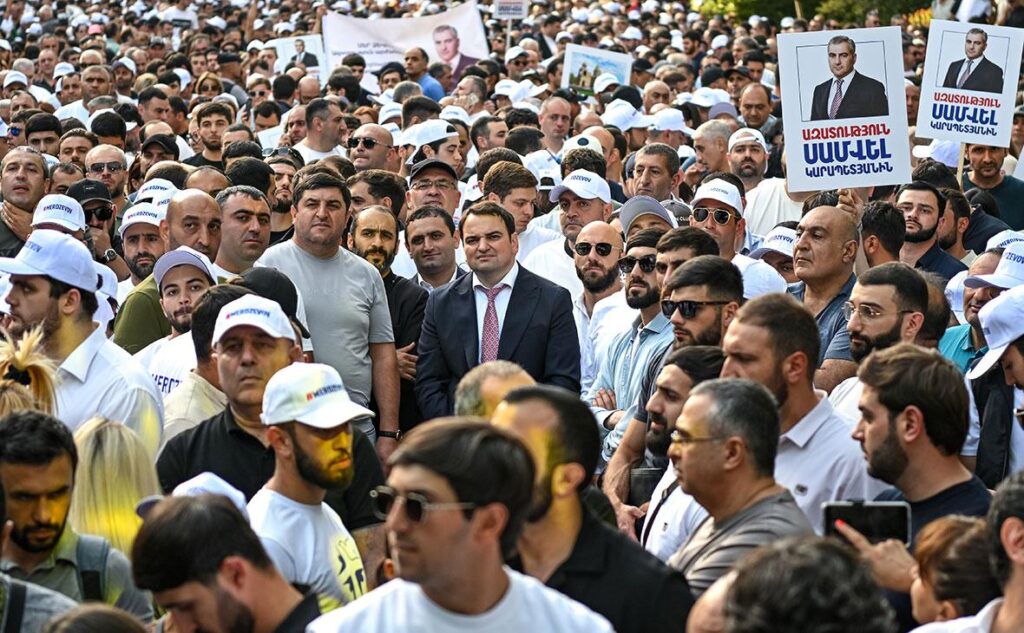
The vulnerability of the opposition in Armenia’s political field has today reached its maximum level. This was stated by political scientist Arman Grigoryan, who emphasized that the main responsibility for the current situation lies with the opposition itself. According to him, opposition forces are not only “fragmented” but also incapable of offering society a clear, adequate, and competitive agenda.
No Alternative, No Explanations
According to the political scientist’s assessment, one of the key problems of the opposition is the absence of a clear agenda capable of countering the narrative shaped by Nikol Pashinyan. The opposition does not propose a political vision that could challenge both the assertions of the current authorities and the thesis that the opposition coming to power would inevitably lead to a new war or destabilization.
“There are no clear explanations coming from the opposition,” Grigoryan notes, stressing that the problem is not merely their absence. Far deeper is the issue of a crisis of trust, especially regarding those forces that possess the greatest resources and are most widely represented in the political field.
The Cost of Avoiding Responsibility for the Past
Grigoryan pays special attention to the fact that the previous positions of forces and individual figures who call Nikol Pashinyan a “capitulator,” “one who is surrendering lands,” or a “traitor” fundamentally did not differ from the policy that Pashinyan himself pursued in 2018–2020.
“To come and criticize Nikol Pashinyan without speaking about one’s own mistakes, without acknowledging one’s share of responsibility—this is a serious problem,” he emphasizes. In the political scientist’s conviction, society—even while in a state of apathy—instinctively senses very well when criticism is insincere and lacks credibility.
It is precisely this circumstance, according to Grigoryan, that makes the current opposition politically advantageous for Nikol Pashinyan. The acting prime minister can always counter by asking the question: “Who exactly do you want to replace me with?”—reminding people of opposition figures from the past and their evasion of responsibility.
Uncertainty Surrounding the “Our Way” Movement
Speaking about the “Mer Dzevov” (“Our Way”) movement, Grigoryan notes that here the problem is not a political burden from the past, but the absence of a clear agenda. According to his observations, the movement’s public statements are limited to general, declarative theses about the need to develop production and the economy—without specific mechanisms or clear political proposals.
“I still have not seen a serious agenda that would simultaneously serve as an alternative to Nikol Pashinyan and possess concrete content,” he says, adding that on issues of foreign policy and security, no serious or systematic approach has been heard from the movement either.
Dead End of “Peaceful” Rhetoric
In the political scientist’s conviction, part of the opposition forces, in trying to compete with the authorities, repeat the same peace-oriented theses, declaring that they too stand for peace and are ready to respect already existing agreements. However, in Grigoryan’s opinion, such rhetoric cannot pose a real competitive threat to Nikol Pashinyan.
Moreover, he notes that focusing on the issue of Artsakh or the Armenian-Azerbaijani settlement process is precisely the field that benefits the current authorities. In this way, political discussion is shifted to a secondary level, bypassing the question of responsibility.