
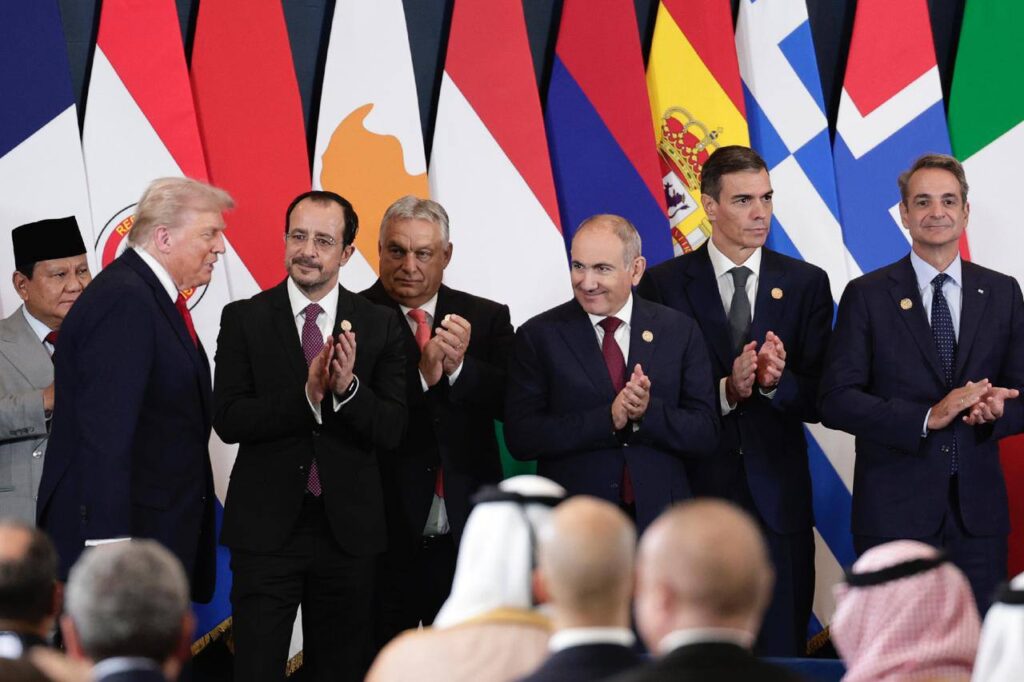
Armenian Prime Minister Nikol Pashinyan is not going all-in, as he lacks sufficient agency to make such a wager. In reality, Pashinyan is heavily dependent on external players. This view is held by political commentator Hakop Badalyan.
According to the expert, the degree of risk is determined by major external actors, and the overall picture is multilayered. Nevertheless, Pashinyan is doing everything possible to retain power.
Azerbaijan, for its part, is attempting to integrate into broader geopolitical processes.
“The origins of these actions extend far beyond Azerbaijan itself. Yet in recent years, Aliyev has managed to adapt to international currents, resolving issues related to Armenia—and previously Artsakh—by embedding himself in those flows and reaping his own benefits,” Badalyan notes.
In this context, the expert also examines Aliyev’s statement on lifting the ban on cargo transit to Armenia via Azerbaijani territory.
“I regard this primarily as a staged propaganda exercise. Similar practical steps will follow in the near future, with their core purpose being to generate propaganda value for Pashinyan’s election campaign. The August 8 Washington Declaration handed Pashinyan a trump card—allowing him to claim he has delivered peace—in exchange for concessions, including on the dissolution of the OSCE Minsk Group co-chairmanship,” he says.
Badalyan points out that the Declaration’s provisions clearly imply a corridor logic (TRIPP), while Armenia as a state gained only temporary stability from the document—a stability driven more by the regional geopolitical environment than by the text itself.
“Nikol Pashinyan gained precisely this propaganda trump card, because without it—without the ability to say ‘look, I have brought peace’—he would have absolutely nothing substantive to present to the electorate,” Badalyan emphasizes.
He recalls that in Pashinyan’s 2021 election platform, “peace” had an entirely different structure: it included prospects for Artsakh’s separation-for-salvation, as well as the de-occupation of Shushi and Hadrut.
“Five years later, peace has the opposite content. But without even the option to speak of it, Pashinyan would have had nothing to offer voters. That option was granted to him on August 8—and it aligns with the interests of both Azerbaijan and major international players who want to preserve Armenia’s current state-policy logic,” Badalyan concludes.